Connect with us

News

Terrorism: Police tighten S’East security as Kanu knows fate today

Published

on

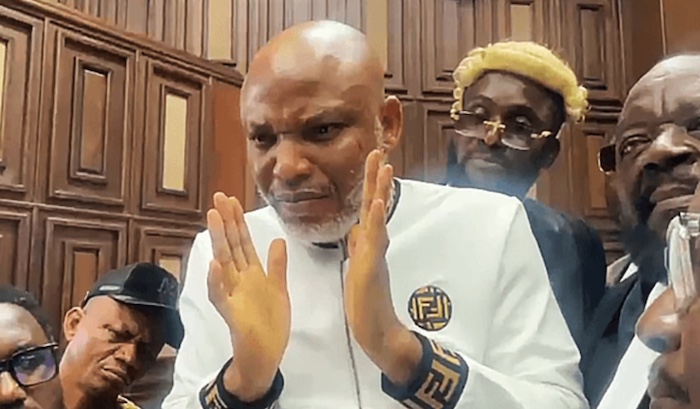
The detained leader of the Indigenous People of Biafra, Nnamdi Kanu, will today know his fate in the prolonged legal battle with the Federal Government.

A court, presided over by Justice James Omotosho of the Federal High Court in Abuja, is expected to rule on a series of applications filed by both Kanu and the Federal Government, including a request by the IPOB leader challenging the competence of the charges against him and seeking his release on the grounds of alleged unlawful detention and infringement of his fundamental rights.

Kanu has been in the custody of the Department of State Services since June 2021, following his controversial interception and return to Nigeria from Kenya in circumstances his lawyers describe as “extraordinary rendition”.

He is facing seven terrorism-related charges bordering on alleged incitement, running an unlawful group, and acts threatening national security—allegations he vehemently denies.

Justice Omotosho, on November 7, fixed Thursday to deliver judgment in the charges brought against Kanu.
Justice Omotosho announced the date while ruling on the matter after Kanu failed to open his defence, having exhausted the six days allocated to him by the court to present his defence.

While Kanu failed to open his defence after the prosecution closed its case, the IPOB leader filed a fresh motion challenging his trial.

He stated that the earlier Terrorism Prevention and Prohibition Act had been repealed, and as such, there are no valid charges against him.
He asked the court to expunge from its record “the purported plea of not guilty entered by him,” claiming it was based on deception and in defiance of the Supreme Court’s decision.

He also sought an order setting aside all subsequent proceedings, arguing that they were founded on a nullity.

Kanu further asked the court to hold that the charges disclosed no offence known to law, as they were allegedly based on a repealed terrorism law. He requested an order striking out the charge for want of jurisdiction and directing his release.

He urged the court to dismiss the charges and allow him to go home.

However, Justice Omotosho had held that since Kanu failed to utilise the opportunity granted to him to conduct his defence, he could not claim to have been denied his constitutionally guaranteed right to a fair hearing.

Justice Omotosho reiterated the court’s position that no ruling or preliminary objection would be determined at this stage.

He noted that the case was filed in 2015 but suffered delays before being re-assigned to his court earlier this year, where it received an accelerated hearing.

See also  Adamawa gov Fintiri defects to APC

He stated that the prosecution called five witnesses and tendered several exhibits before closing its case on June 19, 2025.

The judge observed that multiple adjournments were granted at the instance of the defendant, who sought to cross-examine prosecution witnesses.

He recalled that Kanu’s no-case submission was earlier overruled, and the defendant was directed to open his defence.

Omotosho emphasised that the court had ensured a fair hearing, but noted that Kanu, despite initially agreeing to enter his defence, abandoned it and began claiming that there was no existing law under which he was being tried.

He said the defendant had not demonstrated seriousness in the proceedings, adding that he had personally appealed to Kanu “in God’s name” to present his defence and engage counsel.

Citing Supreme Court authorities, Omotosho held that if a defendant fails to utilise the opportunity of a fair hearing, the court cannot compel him to enter his defence.

The judge ruled that it was on this basis that Kanu had waived his right to defence and proceeded to fix a date for judgment.

Kanu’s legal journey has been marked by numerous adjournments, court orders, appeals, and counter-applications.

In October 2022, the Court of Appeal discharged him of all charges and ordered his release, ruling that his rendition from Kenya violated international law. The Federal Government immediately appealed to the Supreme Court, which later set aside the appellate court’s decision and ordered that he return to the trial court.

His continued detention has remained a contentious issue, attracting widespread national and international attention. Various groups, including Igbo socio-cultural organisations, human-rights activists, and political leaders from the South-East, have repeatedly called for his release, arguing that it would help de-escalate rising insecurity in the region. The Federal Government, however, maintains that he has a case to answer and insists he must stand trial.

Today’s declaration is therefore pivotal, with implications not only for Kanu’s personal liberty but also for national stability and ongoing discussions around political reconciliation and security in the South-East.

Security has been strengthened around the Federal High Court premises as supporters, journalists and observers await the outcome of a matter that has remained one of Nigeria’s most politically sensitive trials in recent years.

Meanwhile, Kanu filed a suit before the Court of Appeal asking it to stop the trial Court from delivering judgment today in his trial. However, a date for hearing has not been fixed by the appellate Court, and no order has been given based on his request.

See also  NNPC April crude supplies to Dangote cross 1bn barrels

Police ready to maintain peace in Abia

Meanwhile, in Abia, Kanu’s home state, the police are not leaving anything to chance.

According to the Police Public Relations Officer, ASP Maureen Chinaka, the state Commissioner of Police, Danladi Isa, has noted that Abia State is currently peaceful, but nevertheless security strategies are in place ahead of whatever the outcome of the Thursday judgement on Kanu.

She quoted Isa as saying, “We have already placed security coverage to monitor the entire state. We put some security strategies in place to make sure there is no breakdown of law and order.”

Chinaka added that already, the state police are partnering with other security agencies in the state to keep the state safe.

“I tell you, in Abia State, officers of the Abia State Police Command, under the Commissioner of Police, are all out to ensure that law and order is maintained. And of course, we are collaborating with other sister security agencies to ensure we maintain safety.

“So, Abia is safe. The command, as the lead internal security agency at all times, is out to ensure the maintenance of law and order and protection of life and property. We are collaborating with sister security agencies. So, what I am saying is not only for tomorrow (Thursday).

“Already, every Monday, we have activities of police and other sister security agencies patrolling the state to ensure that there is maintenance of law and order.

“So, the command is not expecting any anti-behaviour on Thursday, whichever way the judgment goes. That’s why I said that officers are on the ground 24/7. The command is always out to ensure that the state is safe”.

Recall that Umuahia in Abia State is the hometown of the IPOB leader, Kanu. As of the time of this report, there has yet to be reported presence of security men in his Afaraukwu country home.

In Enugu State, the PPRO Daniel Ndukwe asked, “Have you seen the judgement that he is going to be convicted?”

The Force spokesman, Benjamin Hundeyin, did not reply to a WhatsApp message sent to his mobile telephone.

Kanu files a complaint against DSS witnesses.

In a related development, Kanu has filed a criminal complaint against two Department of State Services witnesses as the Federal High Court prepares to deliver judgment in his terrorism trial.

The complaint, dated November 13, and obtained by The Punch on Wednesday, was filed before a Chief Magistrate’s Court in Abuja.

See also  Kogi Assembly suspends LG boss over misconduct allegations

The complaint signed by Kanu himself mentions Mr TAA, Mr BBB, the Attorney General of the Federation (Lateef Fagbemi SAN), Director General Department of State Services (Adewale Adeleye or his successor in office) as the defendants and himself as the complainant.

Kanu alleges that the witnesses—identified in court as TAA (PW1) and BBB (PW2)—gave “false evidence on oath.”

The filing cites Sections 156, 158(1), 159(1), and 160 of the Penal Code, Section 88 of the Administration of Criminal Justice Act 2015, and Sections 34 and 36 of the 1999 Constitution (as amended).

The complaint reads partly, “On diverse dates between May and July 2025, at the Federal High Court, Abuja, during the hearing and trial-within-trial in the case of Federal Republic of Nigeria v. Nnamdi Kanu (FHC/ABJ/CR/383/2015), Mr TAA and Mr BBB, being witnesses called by the prosecution in my trial, wilfully gave false evidence on oath, knowing same to be false and/or not believing same to be true and material to the admissibility of the 2015 and 2021 statements, thereby committing perjury contrary to Sections 156, 158 and 159 of the Penal Code.”

Kanu alleged that TAA falsely denied knowing Mr Brown Ekwoaba, the Assistant Director (Investigations) at the DSS National Headquarters, who, according to him, supervised his October–November 2015 interviews and detention. The complaint referenced page 352 of the Certified True Copy of proceedings of June 26, 2025, where TAA reportedly stated: “I cannot recall… I didn’t know any other Mr Brown, my Lord.”

The IPOB leader said the denial was untrue, citing an affidavit by Prince Emmanuel Kanu confirming six visits to the DSS office where Ekwoaba allegedly conducted interviews; another affidavit by Benjamin Madubugwu confirming similar interactions; and public records showing Ekwoaba served as Assistant Director (Investigations) from 2015 to 2020 before becoming a State Director.

Kanu further accused BBB of false testimony, noting that although he claimed (on page 202 of the CTC of proceedings) to have never met Kanu except in court, he had previously testified (pages 184–188) that he led Kanu’s video interview at the DSS Headquarters on July 17, 2021.

He added that the two witnesses, who appeared masked and behind screens by order of the trial court, gave “materially false” testimony to obscure the true chain of custody of his 2015 and 2021 statements.

punch.ng

FOLLOW US ON:

FACEBOOK

TWITTER

PINTEREST

TIKTOK

YOUTUBE

LINKEDIN

TUMBLR

INSTAGRAM

Continue Reading
Click to comment

Leave a Reply

Your email address will not be published. Required fields are marked *

News

FG raises allowances, boosts welfare for civil servants

Published

on

The Federal Government of Nigeria has approved a sweeping increase in peculiar allowances and other welfare benefits for civil servants, in a move aimed at improving take-home pay and boosting morale across the public service.

The announcement was made on Friday by the Head of the Civil Service of the Federation, Didi Walson-Jack, during a press briefing in Abuja, where she outlined key reforms endorsed by the Federal Executive Council.

According to Walson-Jack, the review affects workers under both the Consolidated Public Service Salary Structure (CONPSS) and the Consolidated Research and Allied Institutions Salary Structure (CONRAISS), ensuring a broad-based impact across all cadres.

She said the revised peculiar allowances have been structured to reflect across all grade levels, resulting in a meaningful increase in earnings for both junior and senior officers.

In addition, the government approved an upward review of several key allowances, including duty tour allowance (DTA), estacode, and book allowance. Walson-Jack noted that virtually all allowances listed under the Public Service Rules have now been revised.

A major highlight of the reform is the approval of 100 percent Duty Tour Allowance for civil servants attending approved training programmes, regardless of whether travel is involved.

“Even if you are based in Abuja and attend training within Abuja, you are entitled to full DTA,” she said.

Beyond salary-related adjustments, the government also introduced a new exit benefit scheme for retiring civil servants under the Contributory Pension Scheme. The scheme provides 100 percent of a retiree’s total annual emoluments as an exit package, in addition to their pension, effective January 1, 2026.

See also  Canada deports 366 Nigerians, 974 await removal

Walson-Jack described the move as a step toward ensuring dignity in retirement, stressing that no public servant should leave service without adequate financial support.

The government also confirmed the operationalisation of the Employee Compensation Scheme, designed to provide financial protection for workers who suffer job-related injuries or death.

The reforms come amid growing calls from labour unions for improved welfare, as rising living costs continue to put pressure on workers. Analysts say the combined measures could significantly enhance financial stability for civil servants and improve overall productivity in the public sector.

punch.ng

FOLLOW US ON:
FACEBOOK

TWITTER

PINTEREST

TIKTOK

YOUTUBE

LINKEDIN

INSTAGRAM

Continue Reading

News

Wiretapping: El-Rufai pleads not guilty, faces fresh charges

Published

on

The Federal Government, on Thursday, expanded the criminal case against former Kaduna State Governor, Nasir El-Rufai, introducing fresh allegations bordering on interference with critical national infrastructure and unauthorised access to classified information.

The new counts are contained in a further amended five-count charge filed on April 13, 2026, before the Federal High Court in Abuja, replacing an earlier three-count charge instituted on February 16, 2026.

At his arraignment on Thursday before Justice Joyce Abdulmalik, El-Rufai, however, pleaded not guilty to all counts after the court granted the prosecution’s request to substitute the initial charge.

The Department of State Services, through its counsel, Oluwole Aladedoye (SAN), told the court that the amended charge significantly revised the allegations against the former governor, urging the court to adopt the new processes.

Unlike the earlier charge, which focused mainly on alleged unlawful interception of communications, the fresh counts introduce a broader national security dimension.

In count one of the amended charge, the prosecution accused El-Rufai of “intentionally and unlawfully interfer[ing] with the communication” of the National Security Adviser, Nuhu Ribadu, describing the communication channel as part of Nigeria’s critical national information infrastructure.

The charge states that the alleged act contravenes provisions of the Designation and Protection of Critical National Information Infrastructure Order, 2024, and is punishable under the Cybercrimes (Prohibition, Prevention, etc) Amendment Act, 2024.

In a separate and newly introduced count, the prosecution alleged that El-Rufai, “without authorisation, intentionally secured access to classified information” relating to Ribadu, including details of his arrest and detention order issued on February 12, 2026.

This count marks a shift from the earlier framing of the case, which was limited to claims of intercepted communications, to a more serious allegation involving breach of classified state information.

The amended charge also retains and restructures earlier allegations. Count four accuses the defendant of unlawfully intercepting the NSA’s communications, while count five alleges that he and others still at large used technical systems that compromised public safety and national security, thereby instilling fear among Nigerians.

See also  BREAKING: Navy Officer Lt Yarima Who Confronted Wike Escapes Assassination Attempt

Part of count four reads, “That you, Mallam Nasir El-Rufai, adult, male, intentionally and without authorisation, intercepted the communications of the National Security Adviser, Nuhu Ribadu, as admitted by you on 13th February, 2026, while appearing as a guest on Arise TV Station’s Prime Time Programme in Abuja… and thereby committed an offence contrary to and punishable under Section 12(1) of the Cybercrimes Act.”

Count five further states, “That you… did use technical equipment or systems which compromised public safety, national security and instilling reasonable apprehension of insecurity among Nigerians… and thereby committed an offence contrary to and punishable under Section 131(2) of the Nigerian Communications Act, 2003.”

The February charge had contained only three counts, focusing on alleged admission of unlawful interception, failure to report individuals involved, and actions capable of undermining public safety.

However, the amended charge introduces two additional counts and separates previously combined allegations into distinct offences, effectively broadening the scope of criminal liability.

Defence counsel, Oluwole Iyamu (SAN), confirmed receipt of the amended charge and did not oppose its substitution.

Following this, the court struck out the earlier charge and proceeded with the fresh arraignment.

After the plea was taken, the prosecution applied for an accelerated hearing, seeking three consecutive trial dates.

The defence objected, arguing that El-Rufai’s access to legal counsel could be affected due to his custody under the Independent Corrupt Practices and Other Related Offences Commission.

The defence also drew the court’s attention to a pending bail application filed on February 17, noting that an earlier missing affidavit had been located.

The DSS informed the court that it was not opposing the bail request.

In another application, the prosecution sought to shield the identities of two witnesses, requesting that their names be replaced with pseudonyms in court records, citing security concerns.

See also  NNPC April crude supplies to Dangote cross 1bn barrels

The defence opposed the request, insisting that it violated the defendant’s constitutional right to know his accusers and that no concrete threat had been demonstrated.

Further arguments arose over access to proof of evidence, with the defence urging the court to compel disclosure to enable proper preparation for trial.

The prosecution opposed the application, describing it as procedurally misplaced.

The defence also filed a motion seeking to quash the amended charge, while the prosecution asked the court to dismiss it as lacking merit.

After listening to both sides, Justice Abdulmalik adjourned the matter to May 18, 19 and 20, 2026, for hearing.

Bail bid fails

The PUNCH gathered that the Kaduna State High Court refused El-Rufai’s bail application on the grounds that the seriousness of the allegations against him, as well as concerns over possible interference with investigations, outweighed the arguments advanced for his release.

The ruling was delivered on 21 April 2026 by Justice D.H. Khobo of the Kaduna Judicial Division in Charge No: KDH/KAD/ICPC/01/2026, filed by the Federal Republic of Nigeria through the ICPC.

El-Rufai had approached the court via a motion dated 25 March 2026, seeking bail “either on self-recognisance or upon such liberal terms as the court may deem fit.”

His application, brought under Sections 35(4) and 36(5) of the 1999 Constitution (as amended) and provisions of the Kaduna State ACJL 2017, argued that the offences were not capital in nature and, therefore, carried a presumption in favour of bail.

He further contended that he had strong community ties, fixed addresses, and substantial assets, which, according to him, eliminated any risk of flight.

El-Rufai also told the court he voluntarily returned from Egypt on 16 February 2026 to honour an EFCC invitation, and argued that the amended charge was “fundamentally defective” and “unintelligible.”

He also raised health concerns, claiming he required specialist medical attention.

See also  First lady distributes 10,000 sanitary pad packs to Anambra schoolgirls

The ICPC opposed the application through a nine-paragraph counter-affidavit deposed to by Idris Abubakar, insisting that the offences were serious and “economically sabotaging.”

The anti-graft agency argued that the former governor posed a flight risk, adding that there was a likelihood he could interfere with witnesses and ongoing investigations involving other suspects.

It also alleged an incident at the Nnamdi Azikiwe International Airport, Abuja, on 12 February 2026, where El-Rufai allegedly obstructed law enforcement officers.

The ICPC further dismissed his medical claims, stating that no supporting medical report was provided.

In his ruling, Justice Khobo held that the gravity of the nine-count charge, coupled with allegations of interference and obstruction, made bail inappropriate at this stage.

The court stated, “In the instant application, given the gravity of the nine-count charge against the defendant/applicant, the respondent’s credible apprehension regarding the interference with the ongoing investigations linked to other persons still at large… the interest of justice is best served by ensuring the applicant remains available for an accelerated trial.”

The judge also faulted the defence on health grounds, noting, “The applicant in my view has failed to provide sufficient medical evidence to justify the grant of bail on health grounds.”

Consequently, the court held, “Accordingly, the defendant/applicant’s application for bail pending trial fails and is hereby refused.”

Justice Khobo ordered that El-Rufai “shall remain in the custody of the respondent (ICPC) pending the commencement of the trial,” while directing that proceedings be conducted on an accelerated basis.

The court also fixed June 1, 2, 3 and 4, 2026, for day-to-day hearing, following what it described as a consensus between prosecution and defence counsel.

For now, the former governor remains in ICPC custody as the substantive trial awaits commencement.

punch.ng

FOLLOW US ON:
FACEBOOK

TWITTER

PINTEREST

TIKTOK

YOUTUBE

LINKEDIN

INSTAGRAM

Continue Reading

News

Why El-Rufai’s Bail Application Was Denied

Published

on

A Kaduna State High Court has denied bail to former governor of the state, Nasir El-Rufai, in an ongoing trial over alleged financial misconduct.

Delivering a ruling on Tuesday, Justice Darius Khobo held that it was in the interest of justice for the defendant to remain in custody to ensure his availability for trial.

El-Rufai was arraigned by the Independent Corrupt Practices and Other Related Offences Commission on a nine-count charge bordering on the alleged conferment of benefits under false pretences and dishonest disposal of loan funds.

He pleaded not guilty to all charges.

According to the court, the bail application was supported by a 24-paragraph affidavit, in which the former governor argued that the offences were non-capital.

He also cited his status as a former governor, his strong community ties, and his voluntary return to Nigeria from Egypt.

El-Rufai further claimed that he had underlying health conditions requiring specialist care.

The anti-corruption agency opposed the bail request, filing a counter-affidavit.

The ICPC argued that the offences were “economically sabotaging” and raised concerns about possible interference with witnesses and ongoing investigations.

It also described the defendant as a “flight risk with the means to evade trial due to his high standing in society.” The commission added that no medical evidence was provided to support claims of ill health.

In his ruling, Justice Khobo said the bail application relied heavily on El-Rufai’s status, describing it as “a double-edged sword.”

He noted that concerns raised by the ICPC about interference with investigations were significant.

See also  Forensic report reveals Amupitan has no X account, says INEC

According to the certified true copy (CTC) of the ruling delivered on April 21, obtained by The Cable, the judge held that the prosecution made “weighty depositions” justifying the refusal of bail, adding that the defence failed to counter them with further evidence.

The judge said, “It is, however, noteworthy here that in spite of these weighty depositions in the Prosecution/Respondent’s counter affidavit, which sought to controvert the depositions in the Applicant’s supporting affidavit, the Applicant never deemed it fit to file a further and better affidavit to further controvert the said weighty depositions in the Prosecution/Respondent’s counter affidavit.

“In the instant case, therefore, failure to file a further affidavit by the applicant to further controvert the above-outlined weighty depositions in the Respondent’s counter affidavit leaves the said weighty depositions in the counter affidavit unchallenged and deemed to be admitted as being correct, and I so hold.

“The law is trite: if in an application for bail pending trial there is good reason to believe or strongly suspect that the accused will jump bail, thereby making himself unavailable to stand his trial, and/or will interfere with the witnesses, thereby constituting an obstacle in the way of justice, the Court will be acting within its undoubted discretion to refuse bail.

“In the instant application, the applicant alluded to facts that he has health conditions requiring specialist monitoring, but the applicant did not attach any medical evidence to substantiate his claim of ill-health.

“The law is settled that where an application for bail seeks to lay claim to ill-health, credible evidence in that branch of medicine ought to be made available before the court by the Applicant.

See also  Yuletide: Dangote assures Nigerians of stable fuel supply

“Accordingly, the Defendant/Applicant’s application for bail pending trial fails and is hereby REFUSED.

“The Defendant/Applicant shall remain in the custody of the Respondent (ICPC) pending the commencement of the trial.

“The Respondent/Prosecution is hereby ordered to ensure the trial of the Defendant commences expeditiously and shall be given an accelerated hearing by this Court on a day-to-day basis where practicable.”

Afterwards, the prosecutor and el-Rufai’s counsel agreed that the trial should commence the first week of June.

The case was then adjourned to June 1, 2, 3, and 4, 2026.

FOLLOW US ON:

FACEBOOK

TWITTER

PINTEREST

TIKTOK

YOUTUBE

LINKEDIN

INSTAGRAM

Continue Reading

Trending