Connect with us

News

Burnham emerges front-runner for UK PM as Starmer resigns

Published

on

Keir Starmer, on Monday, resigned from office as Prime Minister of the United Kingdom, following weeks of internal revolt within the Labour Party.

The development set the stage for a rapid leadership transition that is increasingly expected to elevate former Manchester mayor Andy Burnham to Downing Street.

Announcing his departure outside 10 Downing Street, Starmer said he would remain in office only long enough to oversee an orderly handover.

“Every decision I’ve taken has been about putting the country I love first,” he said, according to a New York Times report, adding that, “That is why I will resign as leader of the Labour Party.”

In an emotional address, he added: “I will give my successor my full and unequivocal support,” while thanking his wife Victoria, who he described as “a rock by my side.”

His resignation marks a dramatic turning point for a government that only recently swept to power in 2024, ending 14 years of Conservative rule.

Despite that landslide victory, Labour’s mandate was widely described as fragile after it secured just 34 per cent of the popular vote, leaving Starmer politically exposed from the outset.

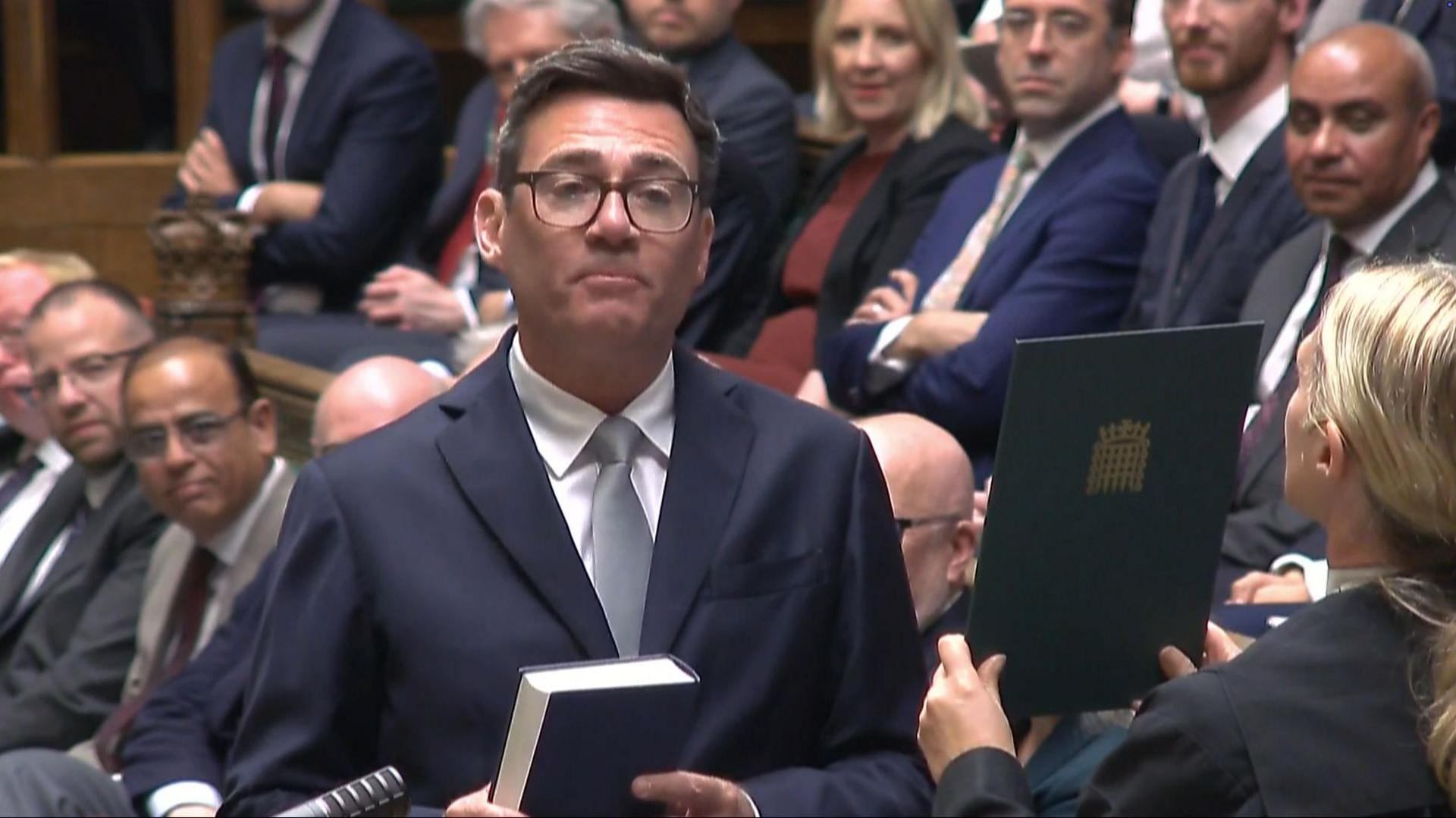
Attention within Westminster has now decisively shifted to Andy Burnham, whose rapid emergence has transformed what was initially expected to be a drawn-out leadership contest into a near-certain succession scenario.

Burnham, who only recently re-entered the national political frontline after winning a parliamentary seat in Makerfield, has quickly consolidated support across influential sections of the Labour Party.

He described the unfolding transition as a moment of renewal.

See also  Natasha: Akpabio congratulates senators over Appeal Court judgment

“People want to see progress on economic growth, cost of living, public services, housing and opportunities for the next generation,” Burnham said.

Party insiders increasingly view him not just as a contender, but as the inevitable successor, with senior figures already aligning behind him to avoid a prolonged and divisive leadership battle.

A senior Labour figure, Wes Streeting, publicly signalled support for a smooth transition, warning against internal fragmentation.

“We could spend the summer exaggerating small differences, or we can roll up our sleeves and help him deliver the change our party and our country needs,” Streeting said, effectively strengthening Burnham’s path to leadership.

Burnham’s rise has been accelerated by a combination of political timing and internal fatigue within Labour ranks following months of declining authority under Starmer.

The former Manchester mayor, long seen as a potential future prime minister, has benefited from both grassroots appeal and institutional backing, positioning him as the dominant figure in the post-Starmer landscape.

His recent political re-entry through a by-election victory in Makerfield is widely regarded as the pivotal moment that reopened his path to national leadership.

From that point, his campaign gained momentum, culminating in what party sources describe as a “clear alignment” of senior MPs around his candidacy.

Starmer’s resignation now triggers what is expected to be one of the fastest leadership transitions in recent British political history.

Labour is set to open nominations on July 9, with a new leader expected by September, though that timeline could collapse if Burnham stands unopposed.

If that scenario materialises, Burnham could assume leadership within weeks, effectively bypassing a full leadership contest and entering Downing Street as prime minister.

See also  Wike saga: Throwback to military impunity

Political observers say such an outcome would represent a rare consolidation of power within Labour, reflecting both Burnham’s growing dominance and the party’s desire to avoid further instability.

In his farewell remarks, Starmer defended his record, insisting his government had left the country stronger than he inherited.

“I will do everhthing I can to ensure an orderly handover of power,” he said, adding, “I am leaving Britain far stronger and fairer than the one I inherited.”

His tenure included increased defence spending, expanded NHS investment and immigration reforms, but was increasingly overshadowed by policy reversals, internal dissent and declining public confidence.

Controversies surrounding senior diplomatic appointments and Labour’s poor local election performance further weakened his authority in the months leading up to his resignation.

Burnham’s potential premiership is already being defined in broad political terms, with allies framing his leadership as a shift toward economic reform, cost-of-living intervention and stronger public service investment.

He has emphasised priorities including economic growth, housing, transport reform and regional development, particularly in northern England, where his political base remains strongest.

In contrast to Starmer’s more technocratic approach, Burnham is widely expected to pursue a more interventionist domestic policy agenda, signalling a possible ideological reorientation within Labour if he formally assumes office.

The resignation marks Britain’s seventh change of prime minister in just over a decade, underscoring a prolonged period of political volatility since the Brexit referendum.

With Starmer departing and Burnham poised to rise, Labour now enters a decisive phase that could redefine its identity in government.

As one senior figure put it, the party is no longer simply managing a transition of leadership; it is preparing for a “full reset of power at the top of British politics,” with Burnham now firmly at its centre.

See also  China set to launch world's first pregnancy robot using artificial womb

punch.ng

FOLLOW US ON:

FACEBOOK

TWITTER

PINTEREST

TIKTOK

YOUTUBE

LINKEDIN

Continue Reading
Click to comment

Leave a Reply

Your email address will not be published. Required fields are marked *

News

Taraba sanitation chair defends salary cut for street sweepers

Published

on

The Chairman of the Taraba State Environmental and Sanitation Agency, Illiya Kefas, on Tuesday said the decision to reduce the monthly allowance of members of the Operation Keep Taraba Clean programme, popularly known as street sweepers, from N15,000 to N10,000 was an internal administrative measure and not a directive from Governor Agbu Kefas.

According to the Tribune, the clarification came a day after he told journalists in Jalingo on Monday that the reduction followed a directive from the governor aimed at managing available resources after the recruitment of new workers into the state and local government civil services.

Speaking on Tuesday, the agency chairman said the salary adjustment became necessary because of the agency’s increasing workforce and operational expenses across the state’s 16 local government areas.

“The arrangement was an internal decision to sustain the activities of the agency and not a directive from the governor,” he said.

The development marks the latest reduction in the earnings of the street sweepers since the programme was introduced in 2023.

The workers were initially engaged by the state government in 2023 with a monthly allowance of N20,000.

However, in March 2024, their monthly allowance was reduced to N15,000 after they were reportedly asked to either accept a N5,000 cut or forfeit their positions.

In May 2026, the workers received N10,000, representing another N5,000 reduction and leaving their earnings at half of what they received when the programme began.

Explaining the latest adjustment, Kefas said the agency manages a large workforce, including 16 local government coordinators, supervisors, monitoring teams and more than 100 casual workers engaged in sanitation activities across the state.

See also  FCT doctors’ strike continues despite partial payment of arrears

“We have 16 Local Government Coordinators, including Ngada and Yantu. We pay some N200,000, while the least among them earns N100,000. We also have a monitoring team,” he said.

He added, “We also have supervisors. The least we pay them is N50,000 per person, and we have 10 of them,” he added.

According to him, the agency spends over N5m monthly on feeding casual workers engaged in sanitation activities across the state’s 16 local government areas.

“There are more than 100 casual staff across the 16 local governments. We spend over N5 million on feeding the boys who work on a daily basis,” he said.

Kefas said team leaders supervising roadside sanitation exercises also receive daily allowances, while the agency commits substantial resources to waste evacuation and other environmental sanitation activities.

He maintained that the agency’s financial commitments made the salary adjustment necessary to sustain its operations.

In a subsequent text message to journalists on Monday, the chairman defended the decision, saying workers who were dissatisfied with the new allowance were free to leave.

“I have the right to ask my people to work at N10,000. Anyone interested will work, and if you are not, you can go your way,” he stated.

He added: “There is nothing wrong to slash their salaries. Do you journalists ask us how we manage the agency?”

The chairman also cited limited allocations from the Federation Account and the state’s expanding wage obligations following the recruitment of new civil servants as factors affecting the agency’s finances.

See also  Police disperse #ReleaseNnamdiKanuNow protesters after regrouping in Abuja

punch.ng

FOLLOW US ON:

FACEBOOK

TWITTER

PINTEREST

TIKTOK

YOUTUBE

LINKEDIN

Continue Reading

News

Wiretapping: El-Rufai to file no-case submission as DSS closes case

Published

on

Former Kaduna State Governor, Nasir El-Rufai, is set to file a no-case submission in his alleged wiretapping trial, after the Department of State Services closed its case against him before the Federal High Court in Abuja on Tuesday.

The DSS is prosecuting El-Rufai on an amended five-count charge bordering on alleged unlawful interception of communications and breach of national security.

According to the charges, the former Kaduna State governor had claimed on Arise Television during a live interview in February that he had intercepted a telephone conversation involving Ribadu, which allegedly revealed plans by security operatives to arrest him, an offence the agency said was contrary to Section 12(1) of the Cybercrimes (Prohibition, Prevention, etc) Amendment Act, 2024.

At the resumed hearing, counsel for the DSS, Oluwole Aladedoye, informed the court that the prosecution would not be calling any further witnesses, prompting the formal closure of its case.

Following the development, El-Rufai’s lawyer, Paul Erokoro (SAN), told the court that the defence would file a no-case submission, contending that the prosecution had failed to establish sufficient evidence to warrant his client entering a defence.

The defence sought two weeks to file the application, while the prosecution requested another two weeks to respond.

Erokoro also applied for a variation of the bail conditions earlier granted to the former governor, describing them as stringent and difficult to fulfil.

He argued that the conditions requiring Level 17 civil servants with properties in Abuja’s Maitama or Asokoro districts to stand as sureties, as well as verification and attestation letters from the Kaduna State Traditional Council, were onerous.

See also  Okonjo-Iweala unveils $50m fund to empower women in digital trade

The prosecution, however, opposed the application, insisting that public officers who met the conditions existed and urging the court to reject the request.

Ruling on the application, Justice Joyce Abdulmalik declined to vary the bail conditions, holding that there were civil servants who owned properties in the designated areas and could serve as sureties.

The judge subsequently adjourned the matter until September 22 for the filing of the no-case submission and continuation of proceedings.

punch.ng

FOLLOW US ON:

FACEBOOK

TWITTER

PINTEREST

TIKTOK

YOUTUBE

LINKEDIN

Continue Reading

News

Medical trip: Okowa seeks passport release amid EFCC probe

Published

on

A former governor of Delta State, Ifeanyi Okowa, has reportedly sought his international passport held by the Economic and Financial Crimes Commission, The PUNCH has learnt.

Sources within the anti-graft agency said the former governor visited the commission’s office on Awolowo Road, Lagos, as part of efforts to retrieve his travel document to enable him to attend to medical issues abroad.

The former governor was arrested on November 4, 2024, and subsequently questioned at the Port Harcourt Zonal Directorate of the commission.

A source familiar with the development said the former governor’s visit to the Lagos office was connected to ongoing discussions regarding the release of his passport.

“No, he was not arrested; he was at the commission’s Lagos office as part of the ongoing investigation into his case.

“Also, he made moves to secure the release of his international passport to attend to some medical issues abroad,” one of the sources said.

However, it was not immediately clear whether the former governor succeeded in obtaining the document.

Efforts to get the reaction of the EFCC were unsuccessful as the commission’s spokesperson, Dele Oyewale, did not respond to calls placed to his telephone line as of the time of filing this report.

The EFCC has retained the international passport of Okowa since his arrest on November 4, 2024, over allegations of diverting N1.3tn in 13 per cent derivation funds received by the state from the Federation Account between 2015 and 2023.

The anti-graft agency is also investigating allegations that Okowa failed to account for the funds and another N40 billion allegedly used to acquire shares in UTM Floating Liquefied Natural Gas and a major commercial bank.

See also  Okonjo-Iweala unveils $50m fund to empower women in digital trade

He was arrested in Port Harcourt and later granted bail after meeting the conditions set by the commission.

The allegations remained under investigation by the EFCC, while the former governor denied the allegations after he was released.

“To successfully take N1.3tn, it means you have to be taking between N16bn and N20bn every month into your pocket.

“I don’t even know if the President of this country will be able to do that, not to talk of the governor of Delta State.

“They have forgotten that the first three years we came into office – 2015, 2016 and 2017 – the money that was coming into the state was not even enough to pay salaries at all,” he said then.

Efforts to get his reactions through one of his associates, Charles Aniagwu, failed.

punch.ng

FOLLOW US ON:
FACEBOOK

TWITTER

PINTEREST

TIKTOK

YOUTUBE

LINKEDIN

Continue Reading

Trending