Connect with us

News

Kwara massacre: Survivors traumatised after deadly attack in Woro, soldiers occupy deserted community

Published

on

At about 5pm on a dark evening penultimate Tuesday, motorcycles began streaming into Woro. By nightfall, gunfire echoed through its narrow streets, homes were ablaze and residents were fleeing into surrounding forests. Today, soldiers patrol the empty settlement, but fear — not security — defines daily life in the agrarian community left shattered by one of the deadliest attacks in recent memory, DARE AKOGUN and TOHEEB OMOTAYO report

Armoured Personnel Carriers now stand where children once played at dusk. At the entrance to Woro in Kaiama Local Government Area of Kwara State, soldiers in combat gear stop the few vehicles daring enough to approach the once-bustling agrarian settlement.

Police officers man inner checkpoints, rifles slung across their shoulders, eyes fixed on the tree lines stretching into thick forests that link Kaiama, Baruten and the Benin Republic. Despite the heavy security presence, Woro remains deserted.

No smoke rises from cooking fires. No traders display grains and vegetables along the federal road that cuts through the settlement. Mud houses that survived the flames stand with doors ajar, abandoned in haste.

Many others have been reduced to blackened skeletons, their zinc roofs twisted by heat. Days after the February 3, 2026 attack that left more than 200 residents dead, fear has outweighed assurances provided by security patrols.

“The people are afraid to return to Woro after experiencing such a tragic incident,” Comrade ZulQharnain Shero Musa, Special Assistant to the Chairman of Kaiama Local Government Area, told The PUNCH. “Many of them feel the place is still not safe despite the military presence.”

Survivors are scattered across neighbouring communities — in Kaiama town, Baruten and parts of Niger State. At the Wawa Internally Displaced Persons camp in Borgu LGA of Niger State, families shelter under makeshift structures.

Relief materials have begun to arrive, including bags of rice and maize, mattresses, clothing and medical supplies. Officials were seen distributing food items to women and children, many still visibly shaken.

But relief supplies cannot silence the trauma of that evening.

“It was a dark Tuesday night for us in Kaiama,” Musa said. “What happened was painful and devastating. Around 5pm, the assailants came.”

He said the attack followed weeks of tension after unknown men reportedly visited Woro under the guise of religious outreach.

“They came to preach a strange doctrine that does not align with Islam or Christianity,” Musa said. “They tried to force it on the people, but the community rejected it. We told them they could practise their religion, but not impose it.”

See also  FERMA unveils initiative to curb road crashes in Kogi

According to him, a letter delivered in January to the village head had raised concerns.

“The Emir read it and forwarded it to the DSS and the palace of the Emir of Kaiama. We do not know how the attackers found out that the letter had been shared,” he added.

By Tuesday evening, survivors said the men returned in overwhelming numbers.

“They came two on each motorcycle — hundreds of them,” Musa recalled. “They were armed with sophisticated weapons. There was no security presence nearby.”

A 22-year-old survivor, Aliyu Abdul Hamid Jogodo, popularly known as Omo Salka, said the attackers moved through the town without resistance.

“The attackers stormed Woro and went straight to the Emir’s palace,” he said. “They began shooting indiscriminately, killing people and burning shops.

“They killed many of my friends. One of them was Malam Buhari, whose death I will never forget. They also kidnapped my friend’s mother and killed my boss’s brother, Dr Muhammad Yusuf, the officer in charge of the Woro Primary Health Care Centre. The pain is unbearable.”

Another resident, Abdulrasheed Taofiq, 30, gave a similar account.

“They came into the town on many motorcycles and headed directly to the village head’s house,” he said. “After that, they began gathering people and setting houses and shops on fire. Gunshots were everywhere. There was no way out.”

What followed, according to multiple accounts, was a coordinated assault.

“They cordoned off the village and moved from house to house,” Musa said. “They brought people out, tied their hands behind their backs and executed them.”

The Emir’s palace was also attacked.

“They went to the Emir’s house, brought out his children and one of his wives. They executed the children and kidnapped the second wife. By about 6pm, the house was set ablaze,” Musa said.

A 35-year-old resident identified simply as Tunde offered further clarification.

“The Emir has two wives,” Tunde said. “The first wife was not at home when the attackers stormed the palace. The second wife was kidnapped. They killed all his children and burnt his house.

“The Emir was not at the palace during the attack. He was outside Woro when the assailants arrived.”

Sources confirmed that the monarch survived and is currently in hiding in Kaiama town after his palace was razed. Efforts to speak with him were unsuccessful.

For residents attempting to flee, the federal road became another danger zone.

“Motorists on the busy road were stopped. People inside vehicles were attacked and killed,” Tunde said.

See also  ECOWAS, Islamic Scholars Unite Against Terrorism In West Africa

Our correspondent saw a burnt commercial truck conveying sacks of maize and guinea corn along the road.

Explaining the incident, Tunde said the vehicle stepped on a landmine while attempting to enter Woro.

“The bomb was buried on the road and was not noticeable. The explosion was massive and delayed the Army’s rescue efforts,” he said. “The soldiers had to retreat to a nearby village. The vehicle was burnt to ashes.”

As the attack unfolded, survivors reported seeing an aircraft overhead.

“A white helicopter flew over the village. It circled and left without intervening. After it left, the killings continued from about 6pm to 8pm,” Musa said.

He added that when another aircraft, believed to be military, later returned, the attackers retreated into the forest, only to re-emerge under cover of darkness.

“They came out again at night,” he said. “The killings continued until about 2am.”

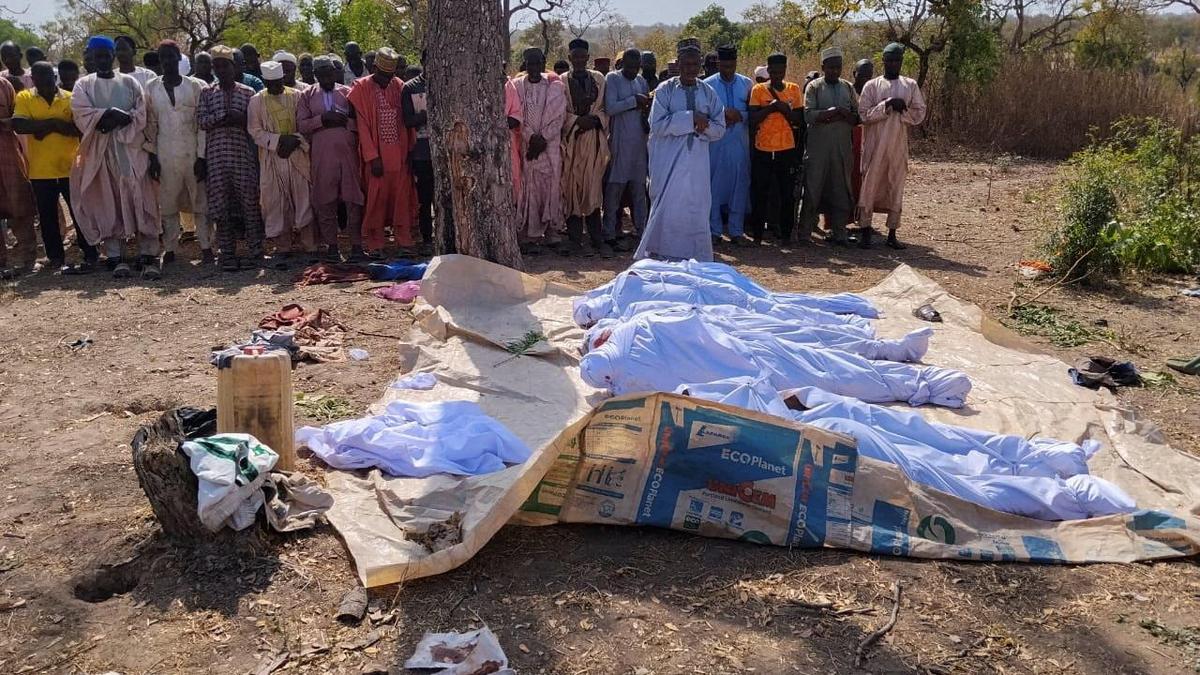
By dawn, the scale of the massacre began to emerge. As of Friday, more than 200 bodies had been buried in mass graves at different locations.

“First it was 30, then 68, then 75,” Musa said. “Later it rose to 162. Now the number recorded is over 200. Some bodies were recovered days later.”

Survivors believe the figure may be higher.

“From what we are seeing and hearing, the number could be more than 300,” Aliyu said.

Abdulrasheed gave an even higher estimate. “Between two days ago and now, we counted 321 bodies in the community,” he claimed.

Musa said more than 100 people were abducted during the attack.

“Over 100 people were kidnapped, and there have been no traces of them,” he said. “During search operations, more bodies have been found in the bush.”

Another survivor, who requested anonymity for security reasons, said the attackers disguised themselves.

“They dressed like soldiers and wore full armour. There was even a woman among them carrying ammunition,” she said. “We did not suspect anything at first.”

She recalled seeing them pass her shop along the Kaiama-Woro road.

“Minutes later, we heard gunshots. That was when we realised they were not soldiers. Everyone started running.”

Some of her relatives were abducted.

“My seven-year-old stepsister, who has a chronic illness, was taken during a family event in Woro. Another sister was also abducted. I do not know how the little one will survive in the forest,” she said.

She also recounted the ordeal of a trader popularly known as “Iya Bag.”

“They tried to break into her house but failed. They set it on fire, thinking everyone inside was dead. The family escaped through a back window, but she lost everything,” she said.

See also  Over 100,000 policemen assigned to VIPs — EU report

The violence reportedly spread to neighbouring Nuku village. Even days later, residents said they heard distant gunshots in the early hours of Thursday, fuelling fears that more victims were killed in the surrounding forest.

Aliyu described how he survived.

“When the shooting started, I ran into the bush. I stayed there until morning before returning,” he said.

Abdulrasheed also recounted his escape. “I ran into a nearby house and hid,” he said.

Both men said nearly all residents had fled.

“Almost everyone has left,” Aliyu said. “People packed what they could carry and fled.”

Hospitals in Kaiama and New-Bussa have continued to treat injured survivors. A source familiar with the situation said many victims were in serious condition but responding to treatment.

The Inspector-General of Police, Kayode Egbetokun, has sent a delegation to the area as part of ongoing security and assessment operations. Security has since been reinforced across the Kaiama axis, with soldiers patrolling adjoining roads and border communities.

Yet the deserted homes reflect a deeper crisis — trust in safety has not returned.

“There is illegal mining in the forest,” a community member who requested anonymity said. “The group known locally as the Mahmuda terrorists have built houses there. Farmers can no longer go to their fields.”

Woro’s farmlands, once the backbone of its economy, now lie untended. Dry-season crops remain unharvested, and livestock have either strayed or been stolen.

For many families, returning would mean confronting both trauma and the destruction of their livelihoods.

At the IDP camps in Wawa and other host communities, displaced residents gather in prayer. Children cling to their mothers, while men speak quietly about relatives still missing.

“We have never seen anything like this,” Musa said.

Aliyu appealed for urgent intervention. “The government should assist our community with security and relief materials. We are pleading for help,” he said.

Abdulrasheed added, “Security agencies should remain in the community and support those whose homes and property were destroyed.”

In Woro, fresh graves dot the outskirts of the village. The scent of burnt timber lingers in the dry air as security operatives continue their patrols.

Until the abducted return and residents regain confidence to rebuild, Woro remains not only under guard, but in mourning.


Continue Reading
Click to comment

Leave a Reply

Your email address will not be published. Required fields are marked *

News

Makinde signs executive order regulating vigilante, security groups

Published

on

Oyo State Governor, Seyi Makinde, on Wednesday, signed into law the Executive Order 001 of 2026 on the Regulation of Associations, Groups and Organisations offering Security and Allied Services in the state.

He said the move was necessary to ensure that all groups and associations involved in security-related activities, such as vigilante and other community-based security groups, operate within a clear legal and operational framework that supports peace, order and rule of law in the state.

At the signing ceremony on Wednesday in Ibadan, the state capital, Makinde stressed that the executive order became necessary in view of the growing security challenges confronting communities and the increasing number of groups engaging in security-related activities without proper coordination.

While noting that security remains a collective responsibility of both the government and citizens, he explained that the order was designed to ensure that all organisations involved in security and allied services are properly registered, documented and monitored by the state government.

The governor equally stressed that the people must avoid any action that could lead to ethnic tension, while cautioning socio-cultural groups to desist from narratives that could result in ethnic profiling, discrimination or confrontation as the state government would not tolerate any form of criminality under the guise of security operations.

Makinde also used the occasion to address the recent abduction of students and teachers in Oriire Local Government Area of the state, assuring residents that the government, in collaboration with security agencies and relevant stakeholders, are working to ensure the safe return of the victims.

See also  WHO releases $500,000 to support Ebola response in DR Congo

He also lauded the security agencies and residents for their patience and restraint during the difficult period, reaffirming his administration’s commitment to strengthening security coordination across the state.

The governor urged citizens to report suspicious activities to security agencies rather than resorting to self-help or unlawful reprisals.

Earlier, the state Attorney-General and Commissioner for Justice, Abiodun Aikomo, explained that all associations, groups and organisations offering security-related services with a membership strength above five persons must notify and register with the government through the Office of the Special Adviser on Security.

He added that existing groups must notify the office within 72 hours of signing the Executive Order and comply with the directive for documentation and certification.

Aikomo further stated that the regulation would enable the government to identify and monitor individuals or groups carrying weapons or operating in security uniforms across the state.

He warned that failure to comply with the executive order constitutes a violation of the law and would attract punishment accordingly.

He added that the Office of the Special Adviser on Security, the Commissioner of Police and the Nigeria Security and Civil Defence Corps have been directed to enforce full compliance with the order, which became effective immediately after it was signed by the governor.

punch.ng

FOLLOW US ON:

FACEBOOK

TWITTER

PINTEREST

TIKTOK

YOUTUBE

LINKEDIN

INSTAGRAM

Continue Reading

News

Coup trial: Accused colonel rejects military court

Published

on

The second accused person in the charges brought against 36 persons accused of alleged mutiny and plot to overthrow the government of President Bola Tinubu, Col Mohammed Ma’aji, has challenged the jurisdiction of the Defence Headquarters Garrison General Court Martial sitting in Asokoro, Abuja, to hear the case.

Ma’aji, in a preliminary objection filed before the court martial in charge No: DHQ/GAR/ABJ/49/ADM, between the Armed Forces of Nigeria and Brig Gen M.A. Sadiq, Col Ma’aji, alongside 35 others, urged the court martial to strike out the charges instituted against him, arguing that the military tribunal lacked the jurisdiction to entertain the case.

Ma’aji, in the objection, contended that the charges were fundamentally defective and incompetent in law.

The objection, brought pursuant to Rules 36(1) and 37(1) of the Rules of Procedure Army 1972, urged the tribunal to make an order striking out and/or dismissing the charges against the 2nd Accused.

“Take notice that the 2nd accused hereby objects to the jurisdiction of the General Court Martial to entertain Counts One to Nine of the charges preferred against the 2nd Accused in Charge No: DHQ/GAR/ABJ/49/ADM, namely ARMED FORCES OF NIGERIA V. BRIG. GEN. M. A. SADIQ (N/10321) & 35 ORS and hereby prays the General Court Martial for the following reliefs:

“An Order striking out and/or dismissing the charges against the 2nd Accused in Charge No: DHQ/GAR/ABJ/49/ADM for lack of jurisdiction. An order declining jurisdiction to entertain the charge as constituted.

“And for such further order(s) as the Honourable General Court Martial may deem fit to make in the circumstances.”

The second accused in the charge also argued that the complainant, listed as the Armed Forces of Nigeria, lacked the legal capacity to institute criminal proceedings.

According to Ma’aji, “The complainant (Armed Force of Nigeria) is not a juristic person and thereby lacks the requisite competence to initiate and prosecute the criminal proceedings in Charge No: DHQ/GAR/ABJ/49/ADM.”

See also  Tegbe denies promising to fix power grid in three months

Ma’aji further maintained that because the complainant allegedly lacked legal personality, the General Court Martial was equally deprived of jurisdiction to hear the matter.

Citing several Supreme Court and Court of Appeal authorities, including Green v. Green, Fawehinmi v NBA, and Mothercat Nig Ltd v Reg. Trustees of the Full Gospel Assembly Nig, the defence argued that only natural persons or entities expressly recognised by law could sue or be sued.

The written address submitted in support of the objection stated, “The name ‘Armed Forces of Nigeria’ described as ‘complainant’ in Charge No: DHQ/GAR/ABJ/49/ADM is unknown to law and destitute of any legal capacity to exercise Prosecutorial powers in respect of the charges preferred against the 2nd Accused.”

The second accused also challenged the competence of counts one to nine of the charge, which allegedly accused him of inciting other officers to join a plot to overthrow President Tinubu.

Ma’aji insisted that the allegations contained in the particulars of the charges did not fall within the offence of mutiny as contemplated under Section 52(1)(b) of the Armed Forces Act, 2004.

He argued that the particulars of the charge “disclose offences against the Sovereign State otherwise known as the Federal Republic of Nigeria and constitutional order rather than offences relating to military or service discipline or command structure.”

He maintained that the phrase “plot to overthrow the government of the Federal Republic of Nigeria” contained in the charge could not be equated with “lawful authority in the Federation” as envisaged under Section 52(3) of the Armed Forces Act.

“It is submitted that the Federal Republic of Nigeria does not fall within the phrase ‘a lawful authority in the Federation’ as used in Section 52(3) of the Armed Forces Act, Laws of Federation, 2004,” Ma’aji contended.

Relying on constitutional provisions and judicial precedents, he argued that the court-martial, being a tribunal of limited jurisdiction, could not extend its powers beyond what was expressly granted by statute.

See also  Ondo council chair seeks monarchs’ support to fight insecurity

Ma’aji also cited the Supreme Court’s warning against judicial expansion of statutory provisions, insisting that any ambiguity in penal legislation must be resolved in favour of the accused persons.

Quoting the Supreme Court decision in Nigerian Navy v. Lambert, the second accused submitted: “It is settled law that penal statutes are to be construed strictly to the benefit of the accused person and that where there is a reasonable construction that avoids the penalty in any particular case, the court must adopt that construction.”

The preliminary objection further contended that for a charge of mutiny or incitement to mutiny to stand, there must be allegations of concerted insubordination, defiance of military authority or refusal of lawful command or organised military rebellion against superior military command.

According to the defence, the particulars supplied by the prosecution failed to disclose those essential ingredients.

On this ground, he urged the General Court Martial to uphold his preliminary objection and dismiss the charges against him for want of jurisdiction.

Meanwhile, a witness in the ongoing trial of six alleged coup plotters before the Federal High Court in Abuja, on Wednesday, told investigators that Ma’aji allegedly threatened to force his way into the Presidential Villa, even if insiders refused to cooperate.

The fourth defendant, Zekeri Umoru, made the allegation in a video previewed in court during proceedings in the trial-within-trial over the admissibility of the defendants’ extrajudicial statements.

Umoru and five others in April were arraigned before Justice Joyce Abdulmalik on 13 counts of criminal charges over alleged complicity in an alleged coup plot to overthrow Tinubu’s government.

The six defendants: Maj Gen Mohammed Ibrahim Gana (retd), Capt Erasmus Victor (retd), Insp Ahmed Ibrahim, Zekeri Umoru, Bukar Kashim Goni and Abdulkadir Sani, however, pleaded not guilty to all the counts after the charge was read to them.

See also  VIDEO: Defence Minister backs Naval officer A.M Yarima over viral clash with Wike

At the resumed sitting, Umoru, who worked with Julius Berger on the Presidential Villa clinic project, alleged that Ma’aji, through the third defendant, Insp Ibrahim, asked him to recruit between 18 and 19 persons working inside the Villa, including soldiers, Department of State Service personnel and Julius Berger staff.

According to the video evidence played in court, Umoru alleged that plans were discussed to switch off electricity within the Presidential Villa to aid the operation, but he warned that such an action would immediately trigger investigations and lead to the detention of workers on duty.

He further claimed that Insp Ibrahim later demanded N100m from Ma’aji to facilitate access into the Villa through an ambulance route, but Ma’aji allegedly rejected the amount as excessive, insisting he could still gain entry by force, although “there would be bloodshed.”

The witness also told investigators that he became uncomfortable with the alleged plan and repeatedly attempted to return the money given to him, insisting that the Presidential Villa “was not child’s play.”

He denied having access to the Villa’s solar power plant, despite allegations that he intended to sabotage the electricity supply within the complex.

The court further heard that Umoru did not immediately report the alleged plot to authorities because Insp Ibrahim allegedly advised him to delete messages and avoid contacting Ma’aji due to an ongoing audit in their office.

Following the screening of the video evidence, Justice Abdulmalik adjourned the matter until May 21 for continuation of the trial-within-trial.

punch.ng

FOLLOW US ON:

FACEBOOK

TWITTER

PINTEREST

TIKTOK

YOUTUBE

LINKEDIN

INSTAGRAM

Continue Reading

News

Nigerians have constitutional right to self-defence from insecurity — Bwala

Published

on

The Special Adviser to President Bola Tinubu on Policy Communication, Daniel Bwala, says Nigerians are constitutionally empowered to self-defence themselves against attackers, including in situations involving lethal threats, while maintaining that the government is working to address insecurity across the country.

Bwala stated this during an interview on Arise Television on Wednesday.

He was reacting to recent violent incidents in the country, including the killings in Esiele community in Orire Local Government Area of Oyo State and the abduction of teachers and pupils of LA Primary School.

The presidential aide said the Nigerian Constitution guarantees citizens the right to self-defence.

“The constitution has guaranteed to every citizen of Nigeria the right to self-defence; you have the right to defend yourself,” he said.

“When your right, my right, and that of my neighbour is put together, it becomes collective rights to defend ourselves and Nigerians have the right to defend themselves.

“If you come to my house to try to kill me, any lethal weapon I use to defend myself is guaranteed by the Constitution,” he added.

Bwala, however, noted that firearm possession remains regulated by law.

He said, “Nigerians don’t have the right to bear certain arms unless those arms are permitted but the collective people can come together to apply to the government for the right to coordinate themselves.”

Explaining the government’s position on insecurity, Bwala said criminality is a global challenge but insisted that collective action is necessary to address it.

“Solution is what we all look to; evil men operate anywhere in the world, no matter how tight you are as a government.

See also  ECOWAS, Islamic Scholars Unite Against Terrorism In West Africa

“You do your best and expect that with the help of God and collective participation of the people through collective intelligence, we will be able to put an end to it,” he said.

On public reactions to recurring attacks, he said citizens will continue to express frustration.

“I know the Nigerian people will continue to complain. For example, no matter how we say that we are sorry and the incident happens again, people will complain, cry and mourn because it’s the lives of the Nigerian people that are taken away by the evil element. We will put an end to this as a people,” he said.

Bwala also linked rising insecurity to election cycles and societal pressures.

“Every eve of elections in Nigeria from 2014, 2018, 2022, and now 2026, you will see that crisis increases because of the idea of a crisis economy. A lot of people take advantage of that but the will and spirit of the collective people is what will put an end to this situation,” he said.

He further noted the role of local vigilance groups and security collaboration.

“As a people, we have vigilantes, and in Borno State, we have paramilitary organisations that provide intelligence to law enforcement,” he said.

punch.ng

FOLLOW US ON:

FACEBOOK

TWITTER

PINTEREST

TIKTOK

YOUTUBE

LINKEDIN

INSTAGRAM

Continue Reading

Trending