

Connect with us

Lifestyle

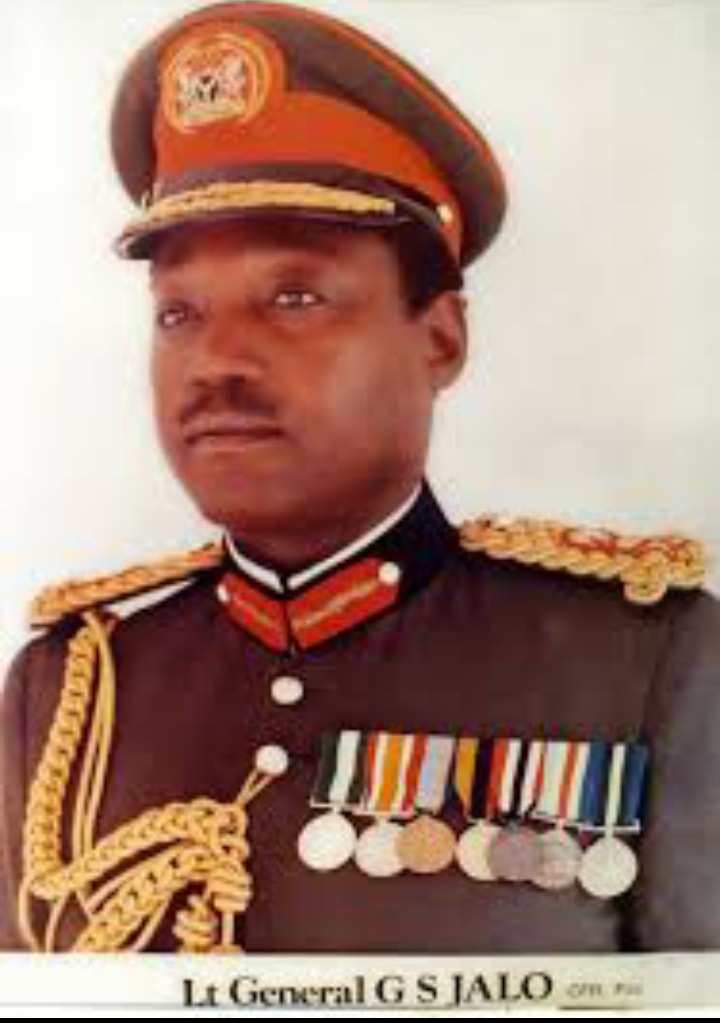
LIEUTENANT GENERAL GIBSON SANDA JALO

Published

on

Early life and education

He was born on 1 March 1939 (some sources say 1938) at Demsa in present-day Adamawa State (formerly Adamawa Province, British Northern Nigeria).

He hailed from a royal family of the Batta people: his father was the late Hama Batta, Chief Zaro (Jalo) Kpanti, Paramount Ruler of Demsa.

For his schooling:

Numan Elementary School, Adamawa Province (1946-1950)

Yola Middle School, Adamawa Province (1951-1952)

Government College, Keffi (1953-1958)

After his secondary education, he enlisted in the Nigerian Army in 1959.

He underwent officer cadet training: one account says he attended the Regular Officers Course in Ghana (Teshie) and then the Mons Officer Cadet School (UK) in 1960.

Military career and progression

Commissioned into the Nigerian Army in October/November 1960 as a 2nd Lieutenant.

Promotion timeline (approximate):

Lieutenant: 7 April 1962

Captain: 20 September 1964

Major: 10 June 1967

Lieutenant Colonel: 11 May 1968

Colonel: 1 April 1970

Brigadier General: 1 October 1973

Major General: 1 January 1976

Lieutenant General: 15 April 1980

Key appointments and commands:

During the Nigerian Civil War (1967-1970), he served in 2nd Division and eventually took command of it.

He was Commander, Lagos Garrison (1971-1972) according to one source.

He was Commandant of the Nigerian Defence Academy (NDA) from August 1975 to January 1978 in one source.

He also served as General Officer Commanding (GOC) 3rd Infantry Division (later 3rd Armoured Division) in Jos.

Senior leadership: COAS & CDS

He became Chief of Army Staff (COAS) of the Nigerian Army in April 1980, succeeding Ipoola Alani Akinrinade. He held that post until October 1981.

See also  See the travails of Nigerian parents struggling to raise children abroad

Subsequently, he became Chief of Defence Staff (CDS) of Nigeria, taking office around 2 October 1981, and served until December 1983.

As CDS he was the head of the Nigerian Armed Forces (Army, Navy, Air Force) and a key member of the military leadership during the latter part of the Second Republic era.

Honours, legacy & character

He was conferred national service awards: CFR (Commander of the Federal Republic) and FSS (Force Service Star).

According to sources, his hobbies included field hockey and football; he was reportedly known on the football pitch as “7 Miles” in earlier days.

His leadership during the civil war and subsequent senior roles solidified his place among Nigeria’s senior military officers of his generation.

One commentary pointed out that his appointment as COAS in 1980 came at a time when the North-East zone (his region) had produced senior military officers, thus contributing to regional representation in the senior military.

Later life and death

He retired from the military in ~1984 (some sources say end of 1983) after his service as CDS.

In later life he engaged in private sector roles: chairman and non-executive director positions in various companies (e.g., Société Bancaire Nigeria Limited; Mix & Bake Flour Mills; Sea Trucks Group Nigeria; Jason Oilfield Ventures Ltd).

He died on 10 January 2000 in London, United Kingdom.

Significance & contextual note

His rise to the very top of the Nigerian military at a time of significant political change (transition from military to civilian rule and back) situates him in a critical era of Nigeria’s history.

See also  The Statue of Obatalá in Costa do Sauípe: A Living Symbol of Yoruba Heritage in Brazil

As CDS until December 1983, his tenure overlapped with major events in Nigeria including changes in government, and the build-up of military capacities.

His background from Adamawa (north‐east) and his ascent reflect the evolving regional and ethnic dynamics of Nigerian military leadership.

His service during the civil war (in 2nd Division) places him among those senior officers shaped by that conflict, which remains central to Nigeria’s modern military history.

FOLLOW US ON:

FACEBOOK

TWITTER

PINTEREST

TIKTOK

YOUTUBE

LINKEDIN

TUMBLR

INSTAGRAM

Continue Reading
Click to comment

Leave a Reply

Your email address will not be published. Required fields are marked *

Lifestyle

PHOTOS: A Biafran Armoured Vehicle at the National War Museum, Umuahia: Ingenuity in a Time of Siege

Published

on

Displayed at the National War Museum in Umuahia, Abia State, this armoured vehicle stands as a striking material reminder of the technological improvisation that characterised the Biafran side during the Nigerian Civil War (1967–1970). The vehicle is commonly identified as an up-armoured T16 Universal Carrier, adapted and deployed by Biafran forces in the face of severe resource constraints.

The Nigerian Civil War in Context

The Nigerian Civil War, often called the Biafran War, erupted in July 1967 following the secession of the Eastern Region of Nigeria as the Republic of Biafra under the leadership of Lt. Col. Chukwuemeka Odumegwu Ojukwu. The conflict was rooted in a complex mix of political instability, ethnic tensions, economic disputes, and the fallout from the 1966 military coups.
The federal government imposed a land, sea, and air blockade on Biafra, drastically limiting access to weapons, fuel, spare parts, and food. This blockade forced Biafran engineers, mechanics, and technicians to rely heavily on local innovation and adaptation to sustain their war effort.

The Up-Armoured Universal Carrier

The vehicle shown in the museum is believed to be based on the T16 Universal Carrier, a light tracked armoured vehicle originally designed during the Second World War. Universal Carriers were widely used by Allied forces and were present in Nigeria during the colonial era.
During the war, Biafran forces modified available carriers by:

Reinforcing them with improvised armour plating

Adapting engines and mechanical components using locally available materials

Reconfiguring them for reconnaissance, troop movement, or limited combat roles

See also  The image celebrates Captain Chinyere Kalu, Nigeria’s first female commercial pilot.

Although such vehicles could not match the firepower or durability of modern armoured tanks, they represented a pragmatic response to isolation, allowing Biafra to maintain some level of mechanised capability.

Ingenuity Under Pressure

The armoured carrier exemplifies what many historians describe as Biafran wartime ingenuity. Alongside makeshift armoured vehicles, Biafra also produced:

Locally assembled rockets and mortars (such as the Ogbunigwe)

Modified civilian vehicles for military use

Small-scale refineries and workshops to support logistics

These efforts were driven by necessity rather than abundance, highlighting the role of technical skill and improvisation in asymmetric warfare.

Human Cost and Global Attention

The war resulted in devastating human losses. Scholarly estimates suggest around 100,000 military deaths, while civilian deaths range from approximately 500,000 to over 2 million, largely due to famine and disease exacerbated by the blockade. These figures vary widely among historians and humanitarian organisations, reflecting the difficulty of precise wartime accounting.
Notably, the Nigerian Civil War was among the first conflicts to receive extensive global television coverage. Images of starving Biafran children broadcast internationally shaped global humanitarian awareness and influenced the development of modern relief organisations.

Preservation and Historical Memory

Today, the presence of this armoured vehicle at the National War Museum, Umuahia serves an educational purpose rather than a celebratory one. It invites reflection on:

The realities of civil conflict

The limits and possibilities of local technological innovation

The enduring human and social consequences of war

As an artefact, it underscores how material culture can help future generations understand both the creativity and tragedy that emerge under extreme historical conditions.

See also  Ghana Must Go: The Bag, the Border, and the Blame (PHOTOS)

Sources

National War Museum, Umuahia (museum displays and archival descriptions)

Nigerianland, Nigeria History Makers – Pictures

Falola, T. & Heaton, M., A History of Nigeria (Cambridge University Press)

FOLLOW US ON:

FACEBOOK

TWITTER

PINTEREST

TIKTOK

YOUTUBE

LINKEDIN

TUMBLR

INSTAGRAM

Continue Reading

Lifestyle

A Woman of Elegance, Resilience, and Impact: Alhaja Simbiat Atinuke Abiola

Published

on

This seldom-seen image from 1991 gently captures the serene presence of Alhaja Simbiat Atinuke Abiola (née Shoaga), pictured alongside her daughter, Wuraola Abiola, at her husband’s birthday celebration in Lagos—just a year before her passing. A prominent member of the renowned Abiola lineage, her life was rooted in service and generosity.

Alhaja Simbiat was not only the cherished spouse of the late Chief Moshood Kashimawo Olawale Abiola, she was also a formidable figure in her own right. In the early 1980s, she shattered glass ceilings by launching and directing Wonder Bakery, an innovative enterprise that provided employment to over 140 Nigerians—at a time when female business leaders were a rarity in the country.

Yet, her brilliance extended well beyond commerce.

In 1992, while waging a brave battle against cancer in a hospital in the United Kingdom, Alhaja Simbiat watched the heart-wrenching news of the Cairo (Dahshur) earthquake. Touched by the plight of the children affected, she selflessly donated $100,000 to support the reconstruction of a school that had been reduced to rubble. Even as her health declined, her compassion remained boundless—reaching across nations and touching lives.

That same year, Nigeria mourned the loss of a quiet luminary. Alhaja Simbiat passed away at age 51 in a British hospital, leaving behind a legacy defined by kindness, tenacity, and quiet leadership.

She was far more than a devoted wife and loving mother—she stood as a beacon of humanity, vision, and unwavering dignity.

May her soul continue to rest in perfect peace.

Source: historylovers

Photo: theelitesng

FOLLOW US ON:

FACEBOOK

TWITTER

PINTEREST

TIKTOK

YOUTUBE

LINKEDIN

TUMBLR

INSTAGRAM

See also  The Statue of Obatalá in Costa do Sauípe: A Living Symbol of Yoruba Heritage in Brazil
Continue Reading

Lifestyle

VIDEO: Seyi Tinubu arrives Alaafin’s palace for installation as ‘Okanlomo of Yorubaland’

Published

on

The city of Oyo is currently witnessing an influx of political figures and traditional rulers for the installation of new high-ranking chiefs by the Alaafin of Oyo, Oba Abimbola Owoade.

Seyi Tinubu, accompanied by his wife, Layal, arrived at the palace of the Alaafin on Sunday.


Alaafin confers chieftancy titles on Seyi Tinubu. Credit: X|adejare_stephen


Alaafin confers chieftancy titles on Seyi Tinubu. Credit: X|adejare_stephen

PUNCH reports that Seyi, the son of President Bola Tinubu, will be installed as the “Okanlomo of Yorubaland,” a title which translates to “the beloved child” or “the one dear to the hearts of all Yoruba people.”

The title is said to symbolise a custodian of Yoruba values, unity, and cultural heritage.

The Senator representing Zamfara West and a former Governor of Zamfara State, Abdul’Aziz Yari, has also reportedly arrived in Oyo, accompanied by a delegation of northern senators and political figures.


Alaafin confers chieftancy titles on Seyi Tinubu, Senator Yari. Credit: X|adejare_stephen

Yari will also be installed as the “Obaloyin of Yorubaland” on the same occasion by the Alaafin.

The Director of Media and Publicity to the Alaafin, Bode Durojaiye, in a recent statement, reportedly stated that the ‘Obaloyin of Yorubaland’ title represents love, compassion, justice, and a bridge between physical and spiritual realms.

Both titles are said to come with responsibilities that include promoting Yoruba culture, advising the Alaafin, fostering unity, and advancing education and social welfare.


Alaafin confers chieftancy titles on Seyi Tinubu, Senator Yari. Credit: X|adejare_stephen

Videos circulating on social media reveal that the venue of the event is set, capturing the presence of several notable figures, including former Governor of Kano State, Abdullahi Ganduje, lawmakers, and a diverse assembly of traditional rulers and chiefs.

See also  No Igbo will have peace until Nnamdi Kanu regains freedom – Obi Cubana tells Tinubu

Watch videos below:

CLICK TO WATCH THE VIDEO

Credits: PUNCHNG

FOLLOW US ON:

FACEBOOK

TWITTER

PINTEREST

TIKTOK

YOUTUBE

LINKEDIN

TUMBLR

INSTAGRAM

Continue Reading

Trending