Connect with us

Lifestyle

Read shocking story about Delta community where residents drink from human waste-polluted river

Published

on

Torugbene, in Burutu Local Government Area of Delta State, is a remote riverine community where residents depend on a river contaminated with human waste for their daily water needs, exposing them to serious health risks. Amid reports of rising child deaths, deteriorating water infrastructure, and worsening climate pressures, the community’s plight underscores decades of unfulfilled government promises that have not translated into access to safe and potable drinking water, DANIEL AYANTOYE writes

A 26-year-old Adaobi Ogbemudia strapped her five-month-old son, Freedom, to her back and held tightly to a commercial motorcycle as it sped along the rough Torugbene–Bomadi road in a desperate attempt to save his life.

But midway along the battered stretch, the infant stopped breathing. He died before they could reach Bomadi General Hospital.

It was the third time Adaobi would be making that journey since his birth on October 1, 2025, in their home in Torugbene, Burutu Local Government Area of Delta State.

Barely a month after birth, Freedom began to experience continuous diarrhoea. Soon after, his fragile body developed widespread rashes, which Adaobi described as “pimples like chickenpox.”

“We kept taking him to the health centre. They gave him antibiotics and later referred us to Bomadi, where he was admitted for a week,” she told Saturday PUNCH, her voice breaking with grief.

Although Freedom’s condition improved briefly after treatment, the relief was short-lived. Within days of returning home, he began to vomit again.

On March 14, when the symptoms became severe, the toddler was rushed to the hospital, but he did not survive the journey.

Tears welled in Adaobi’s eyes as she said softly, “His death has emptied me.”

Her grief is not an isolated case.

In the same Torugbene community, 35-year-old Vivian Kiji is also mourning her one-year-old daughter, Peace, who died on April 8, 2026.

According to the infant’s mother, her body began to swell, and small rashes appeared.

“I noticed her body was swelling. I then took her to the clinic, but there was no improvement. They said it was a fever,” she said. Days later, the child died.

Findings by Saturday PUNCH show that these children, like many others in the community, were bathed and fed with water from the Torugbene River, a polluted stream that remains the community’s main source of water.

Worrisome situation in Torugbene

After several hours on a commercial motorcycle along the rough, sandy Bomadi–Torugbene road, the journey into the community feels like entering a forgotten settlement.

The farther one moves away from Bomadi, the more evident the signs of neglect become: waterlogged bushes, broken stretches of land, and stagnant creeks that cut off parts of the terrain.

By the time this reporter arrived, the atmosphere was calm, but the air carried a thick, humid earthiness mixed with the unmistakable stench of polluted water.

In Torugbene, life revolves around water, not from taps or boreholes, but from a slow-moving brown river that runs through the heart of the community and is increasingly affected by environmental and climate pressures.

The river is part of a wider network of creeks in the Niger Delta, linked to the Fokado River system that flows through the Burutu axis in Burutu LGA.

Through Torugbene, it connects to other waterways that lead toward Warri and neighbouring communities.

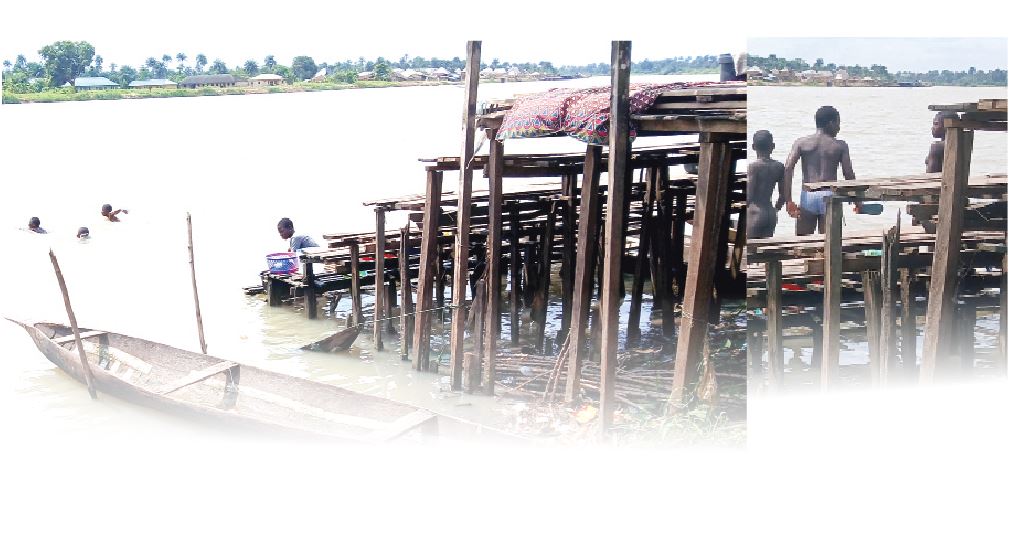
Along its banks, 14-year-old Tariere Kuro was seen sitting on a wooden staircase leading into the river. She leaned forward as she washed plates, dipping them into the river and lifting them out in a steady rhythm.

Nearby, already-washed plates and cups were arranged in a basket.

“This is where we wash plates and cloths,” she said, smiling.

For Kuro, the river is more than a water source; it is central to daily survival, used for cooking, washing, bathing, and even drinking.

Like many residents, she has grown up with complete dependence on it.

A few metres away, children played in another section of the river, splashing and laughing as they bathed. One of them alternated between bathing and fetching water, repeatedly filling yellow jerry cans after brief dips in the river.

One of them, identified simply as Aboy, said fetching water was part of his daily routine.

“I fetch water and also bathe before going home. I come here every day while my elder sister washes plates. She will come later,” he said.

When asked what the water would be used for, he replied, “We drink it and also cook with it.”

Nearby, another child carefully placed a bucket already filled with river water on a wooden stool, preparing to carry it home.

See also  The image celebrates Captain Chinyere Kalu, Nigeria’s first female commercial pilot.

The brownish waterway, as observed by our reporter, appears darker in some stretches and is lined with floating debris, broken plastics, nylon bags, and fragments of household waste.

Yet, despite its visibly poor condition, it remains the community’s only reliable source of water and a vital lifeline.

Canoes glide across its surface, while children repeatedly throng the banks with empty buckets and jerry cans, returning home with water from the same contaminated source that sustains daily life.

Makeshift toilets on the river

Just a short distance from where residents fetch water and children bathe stands a cluster of makeshift toilets.

Constructed from rough timber and supported by slender poles, the structures hang precariously above the water and are divided into compartments.

Their frames are weak and weather-beaten, with sections enclosed by rusted zinc sheets, while others remain partially open, offering little or no privacy.

Beneath them, the stream flows steadily, carrying waste directly into its current. Only a few metres separate these facilities from the exact points where residents collect water for drinking and cooking.

In addition to human waste, Saturday PUNCH observed that household refuse is also routinely dumped into the stream due to the absence of an organised waste disposal system.

Community without borehole

For many residents, the lack of alternatives has turned what should be alarming into an accepted reality.

55-year-old Florence Akpule said the river is central to the community’s survival.

“In this village, this stream is very important to us. We drink, cook, wash and fish there,” she said.

Akpule, a fisherwoman, depends on the creek not only for domestic use but also for her livelihood.

Like many others in Torugbene, she spends long hours on the water setting nets and checking traps.

“This is how we have been living,” she said with a faint smile. When asked about the water quality, she acknowledged its contamination but stressed that there is no alternative.

“We know the water is not clean, but there is no other option. It has become part of our lives.”

She added that there were no functional boreholes in the community.

A visit to Torugbene confirmed this: there is no borehole or alternative clean water source for residents.

What should serve as a lifeline has instead become a persistent public health concern.

Across the Niger Delta, water contamination remains a recurring environmental crisis.

Unsafe water kills 829,000 yearly

Global and local studies highlight the deadly consequences of unsafe water, linking contaminated sources to hundreds of thousands of preventable deaths annually.

The World Health Organisation estimates that about 829,000 people die each year from diarrhoeal diseases caused by unsafe drinking water, poor sanitation, and inadequate hygiene, while at least 1.8 billion people globally rely on faecally contaminated water sources.

Further estimates attribute about 502,000 diarrhoeal deaths annually to polluted water, underscoring the scale of the crisis in low- and middle-income countries where many health facilities lack basic water, sanitation, and hygiene services.

WHO data also indicates that, as of 2025, half of the global population lives in water-stressed areas.

In Nigeria, the situation mirrors this global pattern. Data from the National Bureau of Statistics and UNICEF show that about one-third of households consume contaminated water, while studies suggest that between 77.3 per cent and over 90 per cent of household drinking water contains harmful bacteria.

In the Niger Delta, research consistently traces the crisis to environmental pollution.

A study by John Nduka published on PubMed identified chemical, microbial, and heavy-metal contamination in streams and creeks in the region.

Other assessments in Burutu Local Government Area have also reported polluted waterways linked to waste effluents and environmental degradation, including findings on Ojobo Creek.

These studies point to a wider pattern of ecological decline driven by oil spills, industrial discharges, and poor waste management practices.

Akupe

Even the Delta State Government has acknowledged the challenge, noting that while rivers and streams remain vital to livelihoods, their pollution continues to threaten public health and well-being.

Budget promises, persistent crisis

Over the years, successive administrations in Delta State have repeatedly pledged to expand access to potable water and rural infrastructure, particularly in riverine communities, alongside significant capital allocations in annual budgets.

Under former Governor James Ibori, about 59 per cent of the N747.42bn budget was allocated to capital expenditure.

His successor, Emmanuel Uduaghan, maintained a similar focus, committing roughly 54.4 per cent of an estimated N2.83tn budget to capital projects.

See also  Colonial Administrative Blocks in Benin City 1905: A Glimpse into Nigeria’s Colonial Past

During Ifeanyi Okowa’s administration, the state reported 110 operational water schemes across parts of Delta, with N1.7tn of a N3.48tn budget, about 50 per cent, earmarked for capital projects.

In the current administration of Governor Sheriff Oborevwori, capital expenditure has remained significant.

The 2025 budget of N1.179tn allocated N689.8bn to capital projects, while the 2026 budget rose to N1.729tn, with about N1.21tn, approximately 70 per cent, set aside for capital expenditure.

In 2025, the state also contracted 51 water supply schemes across 39 small towns in six local government areas, with 40 executed in partnership with the World Bank, the Federal Ministry of Water Resources, and the state SURWASH programme.

Speaking during a courtesy visit by the SURWASH Steering Committee in Asaba in February 2024, Governor Oborevwori reaffirmed the state’s commitment to improving rural water access.

“Last week, I spoke with the commissioner, and I told him that we must take the lead as a state,” he said.

“I know many states here will be jealous, but among the seven states, we must take the lead… Delta State cannot carry last.”

Yet despite years of budgetary commitments and repeated assurances, findings from Torugbene reveal a stark disconnect between policy promises and lived reality, as residents continue to depend on a polluted river for drinking, cooking, and daily survival.

Poorly equipped health centre rely on polluted river

Torugbene residents depend on a single government-owned primary health centre that is poorly equipped, while a missionary facility offering limited support remains overstretched.

A visit to the community health centre revealed a troubling picture. There was no visible medical equipment, no resident doctor, and no nurse on duty. Only two health workers were available to attend to patients.

The situation is further worsened by the absence of a clean water source within the facility. Health workers are forced to rely on the same polluted river used by residents for drinking and domestic purposes, raising serious concerns about infection control and patient safety.

Speaking with our correspondent, the Community Health Officer in charge of the Torugbene Health Centre, Mrs Evelyn Fufeyin, described the condition as both difficult and hazardous.

“Truly, we don’t have water. We fetch water from the same river. And we go a long distance daily to get water from that river to attend to patients. It is increasing the health risk because we don’t have any other option,” she said.

The health officer added that the centre frequently records cases of diarrhoea, vomiting, and cholera, which she linked to poor water quality in the community.

Fufeyin noted that the facility operates round the clock despite severe manpower shortages.

“We run a health centre, not a standard hospital. Anything beyond our capacity, we refer to where there are medical doctors. If they want to go to a general hospital, they go to Bomadi. When you talk about skilled workers, we have just two of us, a community health officer and a health educator. We don’t have a nurse or a doctor,” she said.

Climate threat worsening situation

30-year-old farmer and father of two, Ovoke Ejiro, told this correspondent that conditions around the river worsen when it rains, and the community gets flooded.

“When it rains, the water comes inside our house and brings dirt with it. When it happens like that, we usually sweep it, but that is when the water recedes. You will even see fish swimming inside the water in the house. We are used to it. We need help,” he said.

Similarly, Reverend Sister Augusta Ubaegbonwu of the Medical Missionaries of Mary Sisters, a missionary medical team providing healthcare and charity support in the community, said flooding worsens contamination as rising water spreads waste across homes and streets.

“When there is rainfall and the water level increases, it takes the water into the homes of people and the streets. When that happens, wastes and other things will find their way into their houses,” she said.

Ubaegbonwu noted that diarrhoea remains one of the most dangerous illnesses affecting children in the area, especially in the absence of timely medical intervention and fluid replacement.

“What we are doing is limited. Government needs to step in,” she said.

Indigenes, residents lament

Residents and indigenes of Torugbene say the health crisis in the community has claimed several lives, including children, from illnesses they believe are largely preventable.

In separate interviews, they described recurring infections linked to poor water conditions, with symptoms such as diarrhoea and skin complications common among children.

See also  Exclusive: Femi Fani-Kayode Marries 3rd Wife (PHOTOS)

They blamed the situation on the absence of clean water and accessible healthcare.

A health worker in the community, identified simply as Mercy, described the situation as dire.

“It is a bad situation. What is affecting these children is infection from the water. They will be stooling and the skin will be peeling off,” she said.

A prominent indigene and National Publicity Secretary of the Ijaw National Congress, Chief Ezonebi Oyakemeagbegha, who does not reside in the village but visits occasionally, also raised concerns about the conditions.

He recounted instances where children and adults died from illnesses that could have been treated in better-equipped environments.

“The first time I took my children to the village, they saw some children defecating in the river. The next day, we asked them to go and bathe, but they all refused because they realised it was water from the same river. It is not just one person; hundreds of people defecate there. It is a bad situation,” he lamented.

The Chairman of Torugbene community, Sami Koti, called for urgent government intervention, saying the scale of the problem is beyond the community’s capacity.

He noted that all households in the community lack access to clean water and proper sanitation.

“The community is big. We have tried to see what can be done, but the problem is too much,” he said.

Silent killers beneath – Public health experts

Public health experts warn that the use of polluted water exposes communities to a wide range of fatal and often overlooked diseases.

A Professor of Public Health at the University of Calabar, Nelson Osuchukwu, said contaminated water can harbour dangerous bacteria responsible for diseases such as cholera, typhoid fever, diarrhoea, dysentery, hepatitis A and polio.

He explained that many of these infections are transmitted through contaminated food and water and can become life-threatening if not treated promptly.

Osuchukwu also noted that using polluted water for bathing exposes people to skin diseases, as chemicals, heavy metals and pathogens can cause rashes, irritation, infections and in severe cases dermatitis and fungal conditions.

Similarly, a Professor of Parasitology and Public Health at Rivers State University, Ngozika Wokem, said while cholera outbreaks are often visible, many other infections remain hidden but equally dangerous.

“Some of them are slow killers. They are not visible, but they are dangerous. Many people in such communities may think they are fine without knowing they are infected,” the don said.

Wokem stressed that basic hygiene practices and household water treatment methods such as boiling could reduce risks in the absence of alternative sources, but emphasised that sustainable solutions require government intervention.

Rainfall worsening disease impact – Expert

Speaking in an interview with Saturday PUNCH, Professor of Climatology at the Federal University of Agriculture, Abeokuta, Joseph Adejuwon, warned that persistent rainfall patterns and environmental conditions are worsening the impact of contaminated water in riverine communities.

Drawing from field experience across Delta communities, he explained that rivers in the Bomadi axis connect several settlements, allowing floodwaters to move freely and spread waste across communities, particularly during the long rainy season, which can last up between nine to eleven months.

“The water moves and carries everything put into it around,” he said.

The don added that while climate factors cannot be controlled, human activities significantly intensify their effects, noting that gas flaring remains a major driver of climate change in oil-producing regions.

According to him, Nigeria’s high level of gas flaring worsens atmospheric conditions that contribute to heavy rainfall and flooding, increasing the vulnerability of already exposed communities.

He called for measures to reduce gas flaring, noting that this could help moderate long-term climatic impacts.

Beyond climate concerns, Adejuwon advocated eco-friendly engineering solutions, including dredging waterways, sand-filling low-lying settlements, and constructing proper drainage systems and bridges to reduce erosion and prevent floodwaters from entering homes.

“These interventions are important to shield communities from frequent flooding and the spread of contamination,” he said.

Delta govt mum

When contacted, the Delta State Commissioner for Works and Public Information, Charles Aniagwu, declined comment but promised to refer the matter to the Commissioner for Water Resources. He had not done so nor responded as of the time of filing this report.

Efforts to reach the Commissioner for Health, Dr Joseph Onojaeme, were unsuccessful as calls, SMS, and WhatsApp messages were not returned.

punch.ng

FOLLOW US ON:

FACEBOOK

TWITTER

PINTEREST

TIKTOK

YOUTUBE

LINKEDIN

INSTAGRAM

Continue Reading
Click to comment

Leave a Reply

Your email address will not be published. Required fields are marked *

Lifestyle

First female Archbishop of Canterbury to meet Pope Leo in Rome

Published

on

New Archbishop of Canterbury Sarah Mullally, the first woman to lead the world’s Anglican Christians, heads to Rome and the Vatican this weekend for an audience with Pope Leo XIV.

Mullally will meet the head of the world’s 1.4 billion Catholics during a four-day visit starting Saturday, her first abroad since being enthroned last month as the Church of England’s top cleric.

The audience comes 60 years after a historic meeting in 1966 between then archbishop Michael Ramsey and pope Paul VI, the first at that level since the Church of England was created in the 16th century, when king Henry VIII broke with Rome.

Relations have been steadily improving since although in 2016 their successors noted “new disagreements”, particularly on the ordination of the women — making Mullally’s visit a significant moment.

The 63-year-old former nurse, who is married with two children, is the first woman to lead the mother church of the world’s 85-million strong Anglican community.

The first female Anglican bishops were appointed in the United States in 1989, and they have been allowed in the Church of England since 2014, although the issue remains divisive.

By contrast the Catholic Church has repeatedly rejected the idea of female priests, while male priests also cannot marry — with the exception of married Anglican priests who want to convert.

Campaigners for women’s rights, who had hoped for progress under former Pope Francis before his death last year, welcomed the archbishop’s visit.

“If a female archbishop comes to see him, it might give Pope Leo XIV pause for thought,” Sylvaine Landrivon, spokeswoman for Catholic feminist association Magdala, told AFP.

See also  Meet The New Chief of Army Staff (CAS), Major General Waidi Shaibu

“He might realise that women, who represent half of God’s people, have the same abilities as men.”

– ‘United Christian community’ –

The visit, in which Mullally will also meet with members of the Catholic community, comes six months after King Charles III became the first supreme governor of the Church of England to pray with a pontiff.

In a letter marking her enthronement, Leo — himself new in the job, marking one year as pope on May 8, expressed his hope of a “reconciled, fraternal and united Christian community”.

Bishop Anthony Ball, the archbishop’s representative to the Holy See, told AFP the meeting was “an important opportunity to build and establish a personal relationship” as well as mark the institutional ties.

Mullally praised the pope’s “courageous call” for peace earlier this month after US President Donald Trump criticised the pontiff’s calls for an end to the Middle East war.

The archbishop and the pope face many common challenges, Ball noted, from pressing social issues such as immigration, poverty, war and the environment, to the question of how to engage with younger people.

Their churches have also both been rocked by  clerical child sexual abuse and its cover up. Mullally’s predecessor, Justin Welby, quit over failures in handling an abuse scandal.

Internal unity is also under pressure in the Anglican Communion and the Catholic Church, amid tensions between conservative and progressive factions on issues such as liturgy, gay marriage and priestly celibacy.

– ‘Careful listeners’ –

Mullally’s appointment was deeply divisive within the Anglican Communion, both because of her sex and also her positive stance towards same-sex marriage.

See also  Delta gov’s aide offers freed Ibom Air passenger N500,000 job, luxury trip

Several conservative African archbishops, who have for years been at odds with their more liberal Western counterparts, strongly criticised the choice.

Ball said he expected Pope Leo to be “respectful” of the archbishop’s appointment — and for her not to press the issue of women in the Church.

“I think she will be resistant to being co-opted into somebody else’s agenda, particularly in another church that isn’t her own,” he said.

“She’s got more than enough on her plate with the Anglican Communion.”

Leo also inherited from pope Francis a church divided over key social challenges.

During his 12-year papacy, the charismatic Argentine reformer often riled traditionalists, particularly in the US and Africa, with his efforts to open up the Catholic Church.

Ball said both Mullally and Pope Leo had so far proved to be “quite careful listeners”.

Leo is “taking his time to listen to people, to hear, and to try and discern ways of ensuring that people can move forward together. And I think Archbishop Sarah is similar in that regard”, he said.

AFP

punch.ng

FOLLOW US ON:

FACEBOOK

TWITTER

PINTEREST

TIKTOK

YOUTUBE

LINKEDIN

INSTAGRAM

Continue Reading

Lifestyle

My sister died after doctor forgot scissors in her stomach – Sibling tells sad story

Published

on

Beady Nnanna, a producer and publisher, tells AYOOLA OLASUPO how her sister, Blessing Okolie, lost her life due to medical negligence by a doctor, who allegedly left a pair of scissors in her stomach during fibroid surgery at a private hospital in Lagos State

Tell us about yourself.

I’m a media personality, the producer of Beadysworld TV and publisher of Beadysworld Blog News. I’m also an influencer and social activist.

What is your relationship with the late Blessing Okolie?

She was my sister.

How old was she?

She was 44 years old.

What led to her initial visit to the hospital?

She had a fibroid, and it was very big, as if she was pregnant. Even when people saw her, they mistook her for being pregnant. That fibroid was really disturbing, and she was married.

But the husband left her because of that fibroid. She couldn’t give birth to a child. So, the last time the mother tried to call the man to know why they were having issues, the man said to her, “You know that your daughter has a problem with fibroids.”

He said it as if having a fibroid had become a crime. For almost two years, the husband did not show any concern, so the situation got her worried, and she really wanted to remove the fibroid to see if she could have a child.

In December 2025, we took her to the Air Force Base Hospital, but she declined. She said she didn’t want to go there and that she wanted to go to a particular hospital at Igoke Estate, around Abule Egba, Lagos State.

I asked her why she wanted to go there because I felt that the hospital was not standard enough, but she said the hospital was good and that someone who had done the surgery there before recommended the place to her.

I objected to her idea because I just couldn’t understand why she would leave a good hospital for a non-standard one.

What happened at the hospital?

On March 27, 2026, she came to my house, and we drove to the hospital. Meanwhile, that was the first time I would visit that medical centre. We saw the doctor standing outside, but I was not happy, and I was not satisfied with what I saw there.

Blessing kept telling me that I should not bother myself and that the doctor was good. After a while, they gave us a ward where we slept till the next morning.

What were you not satisfied with about the hospital in the first instance?

The hospital was not standard. Looking at everything there, it didn’t look standard at all. So, on March 28, very early in the morning, they came to call her that it was time for her to enter the theatre.

Then she went there at exactly 7:22 am, and we were there till 11:49 am. She had the surgery, and it was okay, and they brought her outside the theatre, where there was a bench, and they laid her there.

She was there, and she didn’t even notice anything. I was the one who cleaned her mouth because she was already tired. When I asked the doctor what was wrong, he said she would come up and that I should keep calling her name.

So, if I called Blessing, she would respond by opening her eyes slightly, but she was not talking. We were there for about four to five hours, and they said they wanted to give her tea and milk to drink, but I objected.

I challenged them on how they would give tea and milk to someone who had just had that kind of surgery. The lady called Oloma, whom she said introduced her to the hospital, said they also gave her the same tea when she had her surgery, but I insisted.

I then said that if they needed to give her anything, they should give her Lipton and hot water instead. They said she needed the energy to climb up the staircase because their theatre was downstairs, while the ward was upstairs.

What happened thereafter?

The nurse and the other lady, Oloma, took Blessing out of the theatre and gave her the tea. So, I requested that they let her rest very well. After a while, around 8:30 am, they came back and said they wanted to take her upstairs.

I was surprised that they could allow someone who had just had surgery to walk. Normally, she was in pain because it is a normal thing for somebody who has just gone through surgery to feel pain.

See also  Bamidele Olumilua: Statesman, Evangelist, and Former Governor of Old Ondo State
Nnanna

At what point did you begin to sense that something was seriously wrong after the surgery?

On Sunday, Blessing started talking, and people came to visit her. On Monday, she was still talking, but she was complaining of a particular pain in her abdomen, and by Tuesday, things had changed.

On Wednesday, her stomach started swelling up. I called the doctor and asked what the problem was, but he said there was nothing. I refused to listen to him and insisted that something was wrong because her stomach had swollen.

So, I asked that we do a scan to find out why the stomach was swollen, but the doctor insisted that there was no problem. They gave her an injection and set a drip for her.

Yet, on Wednesday and Thursday, the stomach was still swelling, and I kept clamouring that we should do a scan. But they said there was nothing in her stomach and accused me of trying to teach them their job.

Then they said what if they did the scan and nothing was there? I responded that I just needed to be sure because I was not satisfied with the way her stomach was swelling. I was bothered because of that.

How did you discover that there was a pair of scissors inside her stomach?

I never thought of scissors when she was complaining about that pain in the side of the stomach. I was even thinking that they had harvested one of her organs, so I kept begging for a scan, but they refused.

She had the surgery on Saturday, and almost a week after the surgery, she was still in serious pain. They then brought out a pipe, put it in her nose, and started draining something greenish out of her stomach.

I said, “Doctor, let’s have a scan.” But they kept saying, “What is wrong with this woman? Do you want to teach us our job?” I told them that I just wanted to be sure that nothing was wrong. Blessing’s health worsened to the point that she couldn’t even stand up.

At one point, they said we should stop giving her anything. We even stopped giving her water, and she was there without water or anything. That was for ten days after the surgery.

So, a new doctor came there to see her, and it was the first time I saw him. He asked me questions, and I started explaining to him. That was when I realised that those people did not even have products for patients.

After I explained to the doctor that I had been asking for a scan to be done for over a week, he said they should get the scans done on her. That was how they gave me a letter to go do the scans elsewhere.

When I got to the lab where they asked me to go, I was told that they had not been doing it for over two years. So, the nurse who came with me said we should go back.

I was angry and didn’t know when I said, “Are you mad? Go back to where when I came out of this hospital without a scan?” We then went to Clinix, where we did the scan.

What did the scan detect?

They did the scan and gave it to me. We paid over N90,000 for it. When I read the result, it stated that a metal was inside her stomach below her abdomen.

At that moment, I cried and drove Blessing back to the hospital. One of the people who did the scan asked me to take her back because her condition had already worsened.

How did the doctor react at the hospital when you showed them the result of the scan?

They were ashamed of themselves. I could see the surprise and shame all over them, but I didn’t say anything.

What explanation did they give for the medical error after seeing the result from the scan?

They did not say anything, and I was just looking at them. I could have escalated it to their management, but the owner of the hospital was not around. The only doctor around was the one I gave the result to.

Then they came to her ward and said they needed to wheel her into the theatre again. I asked them why, and they said they needed to open the surgery again. That was someone who had not taken water or food for over five days, and she was already weak.

Then I asked why they didn’t refer us to a big hospital like Lagos University Teaching Hospital, Federal Medical Centre, or Lagos State University Teaching Hospital. But they said no and that she would be fine.

See also  Prince Olanrewaju Adeyemi Tejuoso (born 1964)

Then she was wheeled into the theatre for the second time, but I wasn’t even sure she could withstand it because she was already weak.

Was she placed on oxygen?

On April 7, they wheeled her into the theatre again, and the surgery was carried out, and they said they had removed what was in her belly.

Hearing that, I expected that there should be a difference and her health should improve, but on April 8, there was still no difference, and she was still the same. I said again that they should refer us to another big hospital, but they kept saying that she would be fine.

At that point, I was very worried because the green substance was still coming from her belly. The next day, she deteriorated, and they put her on oxygen. I kept telling them to refer us because I saw that they could not handle it, and any time I said that, they would make me feel like I was being troublesome.

I asked one of the doctors, who said she would get better, but her intestines were weak. I shouted because her intestines became weak because of the scissors that were left in her stomach for 10 days.

On Friday, I was already weak, so I decided to go home. When I told Blessing that I was going home to freshen up, she begged me not to leave her, but I promised her that I would return.

So, I went home and got back to the hospital around 11 pm. When I saw her, I knew she was not herself, and I called the hospital staff. But I found out that they didn’t even know what to do.

They were always trying to manage things, so they went to bring oxygen for her again. Immediately she was placed on oxygen, the light went off.

I asked them to turn on the generator, and they said they didn’t have fuel. I became uncomfortable and started shouting because it was a few minutes before 3 am. I thought they were going to leave her till daybreak.

Then I threatened them that I would burn down the hospital if they didn’t take my sister out of there. That was when they gave me a letter around 3 am. I told the doctor to follow us, but he refused, saying he could only follow if it was an emergency.

I asked, “Is this not an emergency? Are you not supposed to give us an ambulance and a doctor or a nurse to hand us over?”

But the doctor said no and that maybe a nurse would go with us. Then they called Mr Abiodun, the owner, who told the nurse not to follow us. The doctor on duty also told the nurse to remove the drip.

I was so angry, so I beat the nurse out of the car. When the doctor came, I confronted him and asked why they wanted to remove the drip at that hour.

After the altercation, they left my car, and I carried my sister with no medical support around Abule Egba and went to LASUTH. When we got there, they said there was no space. I begged them to treat her in my car, but they refused.

Then I started making calls, and someone hinted that we should take her to the O&G Medical Emergency at LASUTH, so they started treating her.

They attended to her, but bureaucracy and protocols affected us. They began treatment a few minutes to 4 am and said she would be admitted to the ICU.

How much did you pay at the hospital?

We paid N1.2m, aside from over N1m spent on drugs and tests. At the first hospital, we also spent a lot.

For injections and tablets, there was one we bought for N27,000, and we bought five or six at a time. They charged N650,000 for the surgery.

That Sunday, we bought drugs of N180,000 each and another of N250,000. But early the next morning, they called us and said her heart had stopped.

They said they tried to revive her, but she passed. I begged them to resuscitate her again, but they couldn’t. That was how my sister died.

Looking back, what do you think could have been done differently to save Blessing?

If they had done a scan the second day after the surgery, they would have detected the object earlier, and she might have survived. But most of her organs were already infected before the scissors were removed.

Has she been buried?

No, she is still in the mortuary.

See also  Gospel Singer and Nollywood soundtrack icon Onos Brisibi dies at 55

Did you report the inconsistencies at the first hospital to the police?

Yes, I did.

Have you received any update from the police yet on the case?

No, we have not. They sent us to Zone 2 instead.

What kind of justice do you seek for your sister?

Despite the hospital knowing that my sister had died, they did not even bother to reach out. We personally called them, but till today, the doctor has not shown up.

That hospital needs to be shut down. My sister is dead now, but I don’t want others to experience what she went through. That is why I am clamouring for justice. The government needs to investigate and shut down the hospital.

We await autopsy report on Blessing Okolie’s death — OAR Medical Director

Dr Abiodun Ojifinni, Medical Director of OAR Medical Centre, Abule-Egba, Lagos State, speaks to AYOOLA OLASUPO about the allegation that the death of one of their patients, Blessing Okolie, was caused by complications developed after a pair of scissors was left in her stomach during a myomectomy (surgery for the removal of fibroid)

Is it true that Blessing Okolie had a fibroid removal surgery at your facility?

Blessing Okolie had a myomectomy, which is a surgery for a fibroid in our facility on the 28th of March 2026. She was fine initially but a few days after the surgery there were complications of sepsis, which is a bacterial infection, after the surgery.

We were managing the situation until the family, especially Beady, asked for a referral because she wasn’t satisfied with the progress her sister was making on treatment. At her insistence, we referred her to the Lagos State University of Teaching Hospital, where we later learnt that she passed on after a few days of admission.

We actually commiserated with the family. At this time, I think it was a good time to start addressing the half-truths and the falsehoods that have been circulating on social media.

She claimed that Blessing’s health condition had already worsened before your facility eventually granted her request to be transferred to another hospital. What can you say about that?

Those are the half-truths and falsehoods I’m talking about, and I’m saying that in order not to offend the sensitivity of the people who have lost a loved one, especially in respect for the departed person, we should actually wait.

There is an autopsy request that was made at the Lagos State University Teaching Hospital. The real cause of death will be spelt out in histopathology. That is the most authentic cause of death test that we all should wait for. We enjoined Ms Beady to take things easy and find a way of talking to her.

I know she still hurts by the turn of events at the end of the day. We did not want anything to happen to any of our patients. She might not remember that Blessing was actually a friend, apart from being a patient in my hospital. So, we are eagerly awaiting the results of the autopsy. As you know, when something is awaiting a coroner’s inquest, then we have to wait and hear from the pathologist.

Beady also said that another surgery was performed on Blessing at your facility after the scan detected that a metal was inside her belly. Is it true that the metal was a pair of scissors?

This is why I said that, for the reasons of not exchanging words that will offend the sensitivity of the people who are mourning at this time, we should wait and let the results of the coroner’s inquest be published. Then, we can come back and talk about this.

It is in the interest of everybody because it is not right to have a government agency handling this issue.

It amounts to prejudice to start talking about it this way. But I really appreciate the effort you took to talk to me about it. Please, I am open to any discussion about it when the coroner’s inquest is published.

Are you saying that the state government is currently on the matter?

Yes, the late Blessing departed at LASUTH, and part of their requirements is that once there is a controversy in the cause of death, they will go ahead to do a coroner’s inquest, and that is what everybody is waiting for. We all should talk to Beady to take things easy, and let’s look at the natural cause of death together.

punch.ng

FOLLOW US ON:

FACEBOOK

TWITTER

PINTEREST

TIKTOK

YOUTUBE

LINKEDIN

INSTAGRAM

Continue Reading

Lifestyle

30 kings in Kwara flee their palaces – read why

Published

on

No fewer than 30 traditional rulers across the southern area of Kwara State have fled their palaces following a sustained wave of kidnappings, killings and violent attacks, Saturday PUNCH has learnt.

Our correspondents gathered from two credible community leaders that the affected monarchs were seeking refuge in urban centres, including Ilorin, Osogbo, Offa, and Lagos.

Findings show that some of the affected traditional rulers are from Omugo, Afin, Oreke, Oreke Oke-Igbo, Olohuntele, Alabe, Ganmu Ailehri, Ologanmo, and Igbo Agbon communities.

While some have been away from their domains for months, others have been out for nearly a year.

Their displacement, triggered by repeated attacks by armed groups, has created a leadership vacuum in their communities.

A resident of Omugo community, Wale Olasunkanmi, said his traditional ruler, known locally as Eesa, fled due to fear of abduction.

He said, “In the past, our traditional rulers were always around. They lived among us and provided leadership during crises. But now, they don’t stay here anymore. They only come occasionally for meetings or special occasions and leave immediately.

“When attacks became frequent, it was no longer safe for them to remain in the palace. Even ordinary residents are afraid, so you can imagine what it means for a king who is always a target.”

Olasunkanmi recalled that a major attack on the community in March 2026 marked a turning point.

“After the bandits attacked the church on March 22 and abducted about eight people, many families started leaving. The fear was too much. People abandoned their homes overnight,” he said.

He added that while there had been a slight improvement in security in recent weeks, the absence of traditional rulers continued to affect coordination and decision-making.

“Even as some people are trying to return, there is no strong leadership on the ground. That makes it difficult to rebuild confidence,” he stated.

According to him, Omugo is part of the larger Oro-Ago community, which comprises about 15 towns, including Ajegunle, Iragbon, Ago, Oke Ayin, Oyate, and Oke Daba, all of which have experienced varying degrees of attacks.

Further findings by Saturday PUNCH showed that Oreke and Oreke Oke-Igbo communities have been largely deserted since June 2025 following repeated bandit incursions.

The situation escalated after an attack on a marble mining site near Oreke-Okeigbo on June 4, 2025, where two police officers, Assistant Superintendent Haruna Watsai and Inspector Tukur Ogah, were killed.

A palace worker, Samuel Afolayan, said the attacks marked the beginning of mass displacement.

“Initially, they were just stealing food and livestock. But later, they started kidnapping and killing people. That was when everyone began to leave.

“As I speak to you, I have not been to Oreke since June last year. The king is not there, the palace is empty, and the entire community is deserted. Even neighbouring villages along that axis have been abandoned,” he stated.

Afolayan described the area as “completely isolated,” adding that basic social and economic activities had collapsed.

Similarly, the Oniwo of Afin, Oba Simeon Olaonipekun, has not returned to his domain since he was abducted alongside his son on New Year’s Eve.

Gunmen invaded his residence in December 2025 and kidnapped the monarch and his son, who is a corps member.

See also  Delta gov’s aide offers freed Ibom Air passenger N500,000 job, luxury trip

While the son was released after about 21 days, the monarch regained his freedom after a ransom reportedly exceeding N30m was paid.

A palace source said the monarch was still undergoing treatment.

“Kabiyesi went through a very traumatic experience. He spent almost a month in captivity under harsh conditions. Given his age, it affected him seriously,” the source said.

“Since his release, he has been receiving medical attention. Doctors advised that he should rest and avoid stressful situations. That is why he has not returned to the community.”

Across the affected communities, the impact of the attacks has been devastating.

Saturday PUNCH gathered that farms had been abandoned, schools shut down, and markets rendered inactive as residents fled to safer locations.

The latest gunmen attack occurred in Olayinka community in Ifelodun LGA, where armed men stormed the palace of the monarch, Oba Salman Olátúnjí Aweda, in the early hours of Saturday and abducted him alongside his wife and another resident.

Police authorities later confirmed the arrest of 42 suspected illegal miners in connection with the abduction, while sources disclosed that the kidnappers demanded about N400m ransom.

A resident, who identified himself simply as Tunde, recounted the attack.

“It was like a war scene,” he said.

“They came with guns and started shooting. People were running in different directions. Before we knew what was happening, Kabiyesi had been taken.”

Tunde added that the attackers appeared to have prior knowledge of activities in the palace.

“Earlier that day, some miners came to pay royalties to the king. So, when the attackers came at night, they demanded the money. Kabiyesi gave it to them, but they still took him away. After that incident, everyone fled. Nobody wants to stay there again,” he said.

Traditional rulers killed by gunmen

Beyond Olayinka community, a disturbing pattern has emerged across Kwara South, with traditional rulers increasingly becoming targets.

In September 2025, the Baale of Ogbayo in Oke-Ode was killed in his palace after gunmen invaded the community at dawn.

Earlier, in February 2024, the Olukoro of Koro-Ekiti, Oba Olusegun Aremu-Cole, was killed in his palace, while his wife and another person were abducted.

Sources said the kidnappers initially demanded N100m, which was later reduced to N40m.

In November 2025, the Ojibara of Bayagan-Ile, Oba Kamilu Salami, was abducted on his farm and released after about 25 days in captivity following the payment of ransom.

According to findings, ransom demands in recent cases have ranged between N40m and N400m.

A source involved in one of the negotiations said, “They usually start with outrageous figures, sometimes over N100m. After negotiations, it may come down, but it is still a huge burden.

“In many cases, families have to sell properties or borrow money to secure the release of their loved ones.”

‘Development disturbing’

The Coordinator of the Joint Security Watch in Kwara South, Olaitan Oyin-Zubair, said the signs of mass displacement were long ignored.

“There was a time we raised the alarm that communities were being deserted, but people did not take it seriously. The development is really troubling and disturbing” he said.

“Today, more than 28 communities with traditional rulers in Ifelodun have been abandoned. Places like Olayinka, Oro-Ago, Omugo, Ahun, Oke-Oyan, Owa-Kajola, Owa-Onire, and Oba have become ghost towns. Farms are abandoned, schools shut, markets dead. The reality we warned about has become undeniable,” he stated.

See also  Colonial Administrative Blocks in Benin City 1905: A Glimpse into Nigeria’s Colonial Past

Residents said the crisis had severely disrupted agriculture and worsened food insecurity.

A trader from Oro-Ago, Bose Adeyemi, said she had relocated to Ilorin.

“I am a yam seller, but I cannot go back home. Nobody wants to farm anymore because it is too dangerous,” she said.

A retired civil servant, Janet Adebisi, said she had abandoned her investments.

“I used my gratuity to start farming, but I cannot even visit the farm now. My life is more important than any investment,” she said.

Traditional council under scrutiny

The wave of attacks has put the Kwara State Traditional Council under scrutiny, with many questioning its response to the crisis.

While sources within the council confirmed that meetings had been held with government officials and security agencies, critics say the response has not been visible enough.

A community leader in Ekiti LGA, Adebayo Ojo, said, “Our royal fathers must speak with one voice. People expect leadership at a time like this.”

However, a palace source who did not want to be named said engagements were ongoing behind the scenes.

“These issues are being discussed. The traditional rulers are engaging government and security agencies, but not everything can be made public,” the source said.

The crisis has also sparked debate over the role of traditional and spiritual methods in safeguarding communities.

A socio-political advocate in Kwara State, Abdul-Rahoof Bello-Labelabe, raised concerns over what he described as the worsening security situation in Kwara South.

He warned that residents were increasingly vulnerable to attacks and abductions across several communities.

Bello-Labelabe, who identified himself as the Advocate of Igbomina Liberty and Northern Yoruba Nationality, said there had been no meaningful improvement in security, particularly in Ifelodun LGA.

He disclosed that a wave of kidnappings recorded between Wednesday and Thursday affected multiple communities, leaving scores of residents abducted.

He also referenced the abduction of a traditional ruler in Olayinka community alongside his wife, noting that the kidnappers had demanded a ransom running into millions of naira.

The advocate claimed that many traditional rulers no longer resided in their domains due to safety concerns.

“Although not all traditional rulers have abandoned their communities, a significant number of them no longer live there. They only visit when necessary and leave immediately. Very few have the courage to remain. If any of them is still residing in their domain, let them come forward and state it openly,” he said.

Bello blamed abandonment of traditional practices.

“In the olden days, no one dared to touch a king. Today, our monarchs have abandoned traditional ways of protection.

“Our kings have their share of the blame. They harbour these bandits and criminals; they give them land; they know them, they cannot pretend they do not know them.

“They allow aliens to intermarry with the natives; they create markets for them; they install Seriki for them on Yoruba land. If security is made their responsibility, they will take it seriously,” he added.

The community leader linked the worsening insecurity to illegal mining activities and weak local structures.

See also  The image celebrates Captain Chinyere Kalu, Nigeria’s first female commercial pilot.

Traditional rulers abandoned indigenous protection — Monarch

The monarch of Osi community in Akure North LGA, Oba David Olajide, also advised his colleagues to adopt measures to protect themselves and their subjects against criminal attacks.

Olajide, who once survived a bandit attack in his community, also lamented that some rulers had abandoned the traditions of their communities.

He said, “The issue of insecurity in the country is getting worse to the extent that bandits are attacking obas, but we traditional rulers are not resting on our oars. For instance, in my local government here, we are taking proactive measures both traditional and modern, but these are matters we can only discuss in the media cautiously because they are security issues.

“Another issue is that some obas are wrongly chosen in their communities. It is very absurd to hear that bandits are killing monarchs. Bandits cannot kill a real monarch; they cannot even go near where they are, let alone attack them. In the olden days, warriors used to be made obas, so how can you attack a warrior? It is not possible.

“But the problem we are having is that some obas were not chosen the way they should be chosen. They were selected based on connections in government or because they have money. Such persons would not take the tradition of the community seriously. Nowadays, we are having politicians as obas, and people who don’t understand tradition as obas. These are the problems.

“So, obas too need to reduce their flamboyant lifestyle. They should not be seen everywhere, at every ceremony, spraying money or moving in convoy. We obas should understand the issue of insecurity nowadays and reduce all these lifestyles.”

However, the monarch urged the government and security agencies to support efforts aimed at fighting crime and criminality in their domains.

Meanwhile, local vigilante groups say they are struggling to contain the situation due to poor equipment and limited support.

A vigilante member in Ifelodun, who identified himself as Musa, said armed groups had taken over forests in the area.

“We know these forests, but they have better weapons. Sometimes, before help comes, they are gone.

“Even with our local guns, we are always facing them without fear, but you know their superior firepower always gives them the upper hand,” he said.

He, however, called for stronger collaboration between vigilantes and formal security agencies, including better funding and equipment.

The Chairman of the Igbomina Professional Association, Bode Iranloye, described the situation as alarming.

“This menace has destroyed the peaceful nature of our communities. It has affected agriculture, commerce, and communal life,” he said.

Iranloye recommended improved intelligence gathering, deployment of surveillance technology, and stricter regulation of illegal mining activities.

A security analyst, Sadiq Lawal, said the trend was concerning.

He said, “When criminals begin to target traditional rulers, it is a clear indication that authority structures have collapsed. In many African societies, kings are seen as sacred and untouchable. Once they become targets, it means the criminals are no longer afraid of consequence.”

Continue Reading

Trending