Connect with us

News

PHOTOS: At Ladoja’s coronation, Tinubu says ‘Nigeria’s economy has turned around’

Published

on

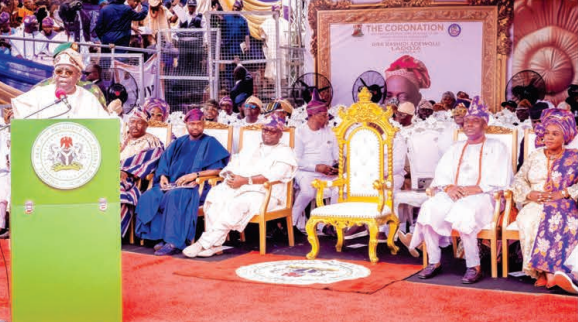
President Bola Tinubu, on Friday in Ibadan, Oyo State, said the economy of Nigeria has turned the corner for good, following the success of the economic reforms introduced by his administration over two years ago.

He assured Nigerians that they would soon begin to enjoy the fruits of the reforms and thanked them for their patience and support.

The President spoke at the coronation of his friend and political ally, His Imperial Majesty, Oba (Sen) Abdul-Rashidi Adewolu Akanmu Ladoja, as the 44th Olubadan of Ibadanland.

President Tinubu said the reforms have been successful because of the support, endurance and sacrifices of Nigerians.

“Today, I am honoured to bring the cheering news that our economy has turned around and there is now light at the end of the tunnel,” the President stated.

The President commended the Olubadan of Ibadan for his contributions to Nigeria’s democracy and for overcoming an illegal impeachment as a governor.
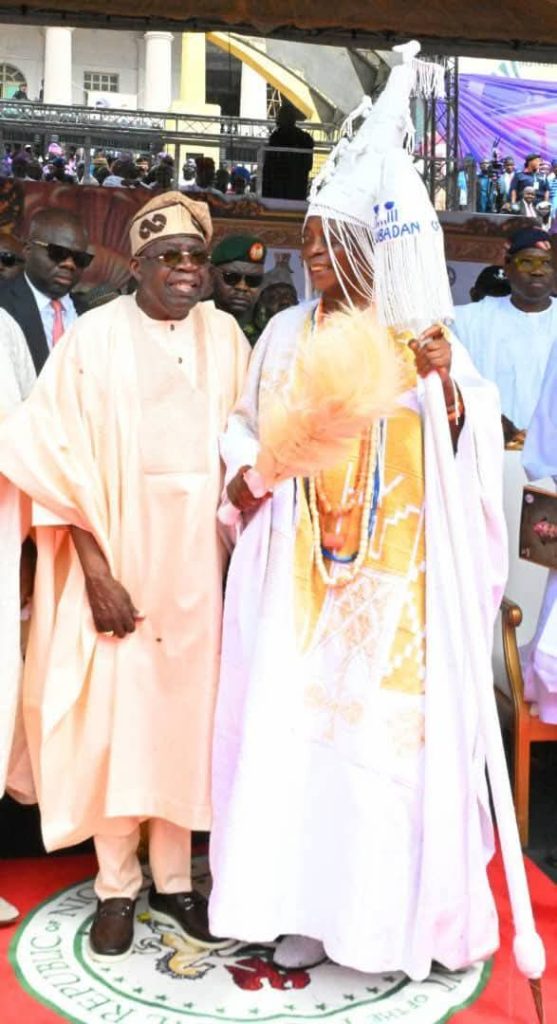

Tinubu and Ladoja

“Today is an exciting day for me, Kabiyesi. Happy birthday to you. It is also a happy day for you. As President of the Federal Republic of Nigeria, it is a great honour to witness this history unfold.

“All the things we started together with great expectations, and the history we shared are coming to pass. I pray that you will live long and be celebrated as one of the rare leaders in history to ascend the throne of your forefathers.Lagos property listings
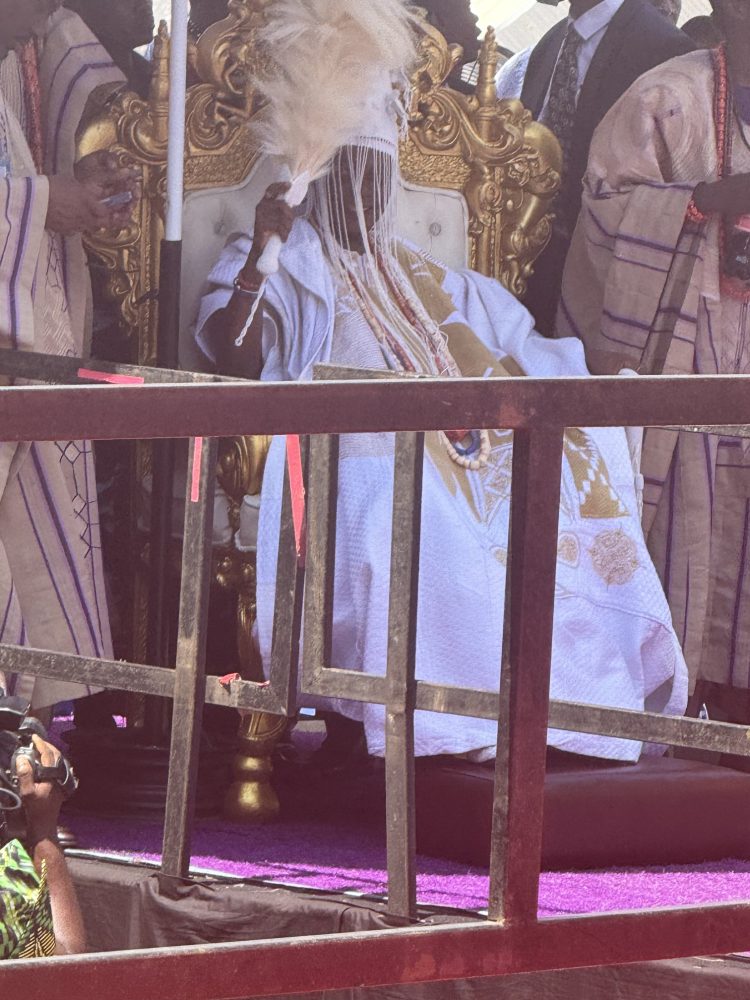

Oba Ladoja

“I pray that God will grant you more years of joy, prosperity and relevance,” the President said.

See also  Woman loses six children in Plateau fire

President Tinubu said that the Olubadan of Ibadanland played a significant role in Nigeria’s political history, and had remained a pillar of hope through the experiences of impeachment, perseverance and resilience as a former governor of the state.Lagos property listings

He thanked all former and serving governors, and traditional rulers for attending the coronation.
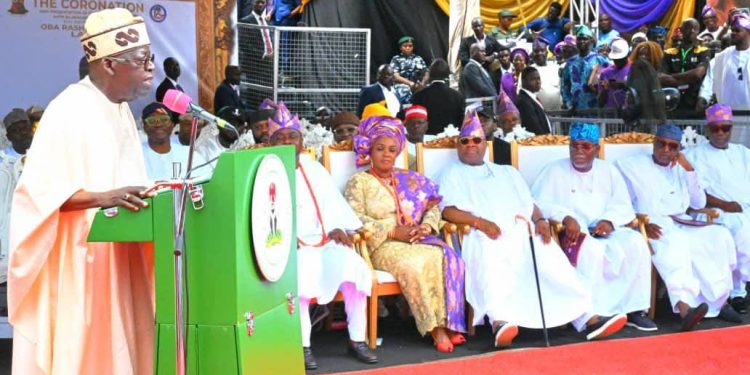

Tinubu

“It is a joy and great excitement for us. I appreciate you all. As for me, this is homecoming,” he stated.

Governor Seyi Makinde presented the new Olubadan, a former governor of the state and a senator, with the staff of office and a certificate.

Governor Makinde said Oba Ladoja’s coronation has ended the disputes among families regarding who occupies traditional thrones.

“It is a great honour to celebrate the 44th Olubadan of Ibadanland. All sons and daughters of the state at home and in the diaspora are proud of this historic moment. We must uphold our tradition.

“I also want to say all challenges associated with the Ibadan traditional institution are now over, and put behind us. This means that the process is now sacrosanct,” the governor said.

The Governor thanked the President for taking the time to honour the traditional ruler and the people.

“There is no more rancour about the kingship in Ibadanland, ” the governor added.

Oba Ladoja said his ascension to the throne reflected the race of life and place of destiny.

“I accept not just the paraphernalia of office but also the responsibilities attached to it
“I want to sincerely appreciate my brother and friend, President Bola Tinubu, for honouring me and all the sons and daughters of Ibadanland with his visit here today.

See also  FULL LIST: US stops Nigerians, others from applying for green card, citizenship

“It is not by power, influence, connection or money that we are here today. I appreciate God for taking me to the finishing line from the starting point as the Mogaji of the all-inclusive Arusa family, Isale Osi, Ibadan, in 1992 till date,” he added.

The Olubadan noted that he would uphold the trust the Olubadan Council members and kingmakers reposed in him while thanking the governor for ratifying his selection.

Some of the dignitaries at the event included the Governor of Ondo State, Lucky Aiyedatiwa; the Governor of Ekiti State, Biodun Oyebanji; and the Governor of Osun State, Sen. Ademola Adeleke. The former Governors were Donald Duke of Cross River, Olagunsoye Oyinola of Osun State, Rabiu Musa Kwankwaso of Kano State, Ibikunle Amosun of Ogun State, and Senator Gbenga Daniel of Ogun State.

President Tinubu was accompanied to the event by Minister of Power Adebayo Adelabu and Chairman of the Federal Inland Revenue Service Zacch Adedeji.

The Sultan of Sokoto and co-chairman of the National Council of Traditional Rulers of Nigeria, Alhaji Sa’ad Muhammad Abubakar III, the Alaafin of Oyo, Oba Abimbola Owoade and the Soun of Ogbomoso, Oba Ghandi Olaoye, were also at the ceremony.

FOLLOW US ON:

FACEBOOK

TWITTER

PINTEREST

TIKTOK

YOUTUBE

LINKEDIN

TUMBLR

INSTAGRAM

Continue Reading
Click to comment

Leave a Reply

Your email address will not be published. Required fields are marked *

News

‘If You’ve Removed Subsidy, Why Still Borrowing?’, Emir Sanusi II Queries Federal Govt’s Fiscal Strategy

Published

on

The 16th Emir of Kano, Muhammadu Sanusi II, has questioned the Federal Government’s continued reliance on borrowing despite the removal of petrol subsidy, warning that poor fiscal discipline could erode the gains of recent reforms.

Speaking in an interview with News Central TV on Friday, the former Governor of the Central Bank of Nigeria (CBN) said while the removal of fuel subsidy and the liberalisation of the exchange rate were necessary, their timing and implementation remained problematic.

“If you’re not paying the subsidy and you’ve got the money, why are we still borrowing and borrowing? What are we borrowing for?

“I have always said the subsidy regime was unsustainable. We cannot continue supporting foreign refineries. We’re an oil-producing country. Keeping refineries open abroad while we’re not doing our own,” Emir Sanusi II said.

He, however, expressed optimism over Nigeria’s shift toward domestic refining, noting that the country has moved from being a major importer of petroleum products to an exporter.

“Today, we have a situation where we have our own domestic refinery. We’re not importing petroleum products. We’re even exporting to Europe, and this is very good for the economy,” he added.

Despite supporting the reforms, Sanusi II raised concerns about sequencing, arguing that policy execution without proper monetary tightening contributed to the naira’s sharp depreciation.

“Artificial exchange rates, especially when you’re printing money, cannot work. There was going to be a devaluation,” he said.

“For me, removing subsidy or liberalising exchange rates, these are good interventions. Were they done at the right time? Those are certain questions.”

See also  Rivers elders appeal to Fubara, assembly to avoid further conflict

He explained that implementing exchange rate liberalisation in a “loose monetary environment” worsened currency instability.

“If you decide to remove subsidy and liberalise exchange rates… before you have tightened money supply, the naira drops to a bottomless pit. That was a timing issue,” he said.

The monarch further challenged the government’s fiscal direction, questioning the rationale behind continued borrowing.

“We’ve removed the subsidy… what we should now see is fiscal consolidation. You cannot remove wastages and continue borrowing,” he said.

His remarks came amid concerns over Nigeria’s rising debt profile. Reports indicated that the Federal Government has increased its 2026 borrowing plan by ₦11.31 trillion, bringing the total to ₦29.20 trillion.

President Bola Tinubu also recently sought Senate’s approval for a fresh $516 million loan to fund the Sokoto–Badagry Superhighway project, further fuelling debate over the country’s fiscal direction.

FOLLOW US ON:

FACEBOOK

TWITTER

PINTEREST

TIKTOK

YOUTUBE

LINKEDIN

INSTAGRAM

Continue Reading

News

FG raises allowances, boosts welfare for civil servants

Published

on

The Federal Government of Nigeria has approved a sweeping increase in peculiar allowances and other welfare benefits for civil servants, in a move aimed at improving take-home pay and boosting morale across the public service.

The announcement was made on Friday by the Head of the Civil Service of the Federation, Didi Walson-Jack, during a press briefing in Abuja, where she outlined key reforms endorsed by the Federal Executive Council.

According to Walson-Jack, the review affects workers under both the Consolidated Public Service Salary Structure (CONPSS) and the Consolidated Research and Allied Institutions Salary Structure (CONRAISS), ensuring a broad-based impact across all cadres.

She said the revised peculiar allowances have been structured to reflect across all grade levels, resulting in a meaningful increase in earnings for both junior and senior officers.

In addition, the government approved an upward review of several key allowances, including duty tour allowance (DTA), estacode, and book allowance. Walson-Jack noted that virtually all allowances listed under the Public Service Rules have now been revised.

A major highlight of the reform is the approval of 100 percent Duty Tour Allowance for civil servants attending approved training programmes, regardless of whether travel is involved.

“Even if you are based in Abuja and attend training within Abuja, you are entitled to full DTA,” she said.

Beyond salary-related adjustments, the government also introduced a new exit benefit scheme for retiring civil servants under the Contributory Pension Scheme. The scheme provides 100 percent of a retiree’s total annual emoluments as an exit package, in addition to their pension, effective January 1, 2026.

See also  FULL LIST: US stops Nigerians, others from applying for green card, citizenship

Walson-Jack described the move as a step toward ensuring dignity in retirement, stressing that no public servant should leave service without adequate financial support.

The government also confirmed the operationalisation of the Employee Compensation Scheme, designed to provide financial protection for workers who suffer job-related injuries or death.

The reforms come amid growing calls from labour unions for improved welfare, as rising living costs continue to put pressure on workers. Analysts say the combined measures could significantly enhance financial stability for civil servants and improve overall productivity in the public sector.

punch.ng

FOLLOW US ON:

FACEBOOK

TWITTER

PINTEREST

TIKTOK

YOUTUBE

LINKEDIN

INSTAGRAM

Continue Reading

News

Wiretapping: El-Rufai pleads not guilty, faces fresh charges

Published

on

The Federal Government, on Thursday, expanded the criminal case against former Kaduna State Governor, Nasir El-Rufai, introducing fresh allegations bordering on interference with critical national infrastructure and unauthorised access to classified information.

The new counts are contained in a further amended five-count charge filed on April 13, 2026, before the Federal High Court in Abuja, replacing an earlier three-count charge instituted on February 16, 2026.

At his arraignment on Thursday before Justice Joyce Abdulmalik, El-Rufai, however, pleaded not guilty to all counts after the court granted the prosecution’s request to substitute the initial charge.

The Department of State Services, through its counsel, Oluwole Aladedoye (SAN), told the court that the amended charge significantly revised the allegations against the former governor, urging the court to adopt the new processes.

Unlike the earlier charge, which focused mainly on alleged unlawful interception of communications, the fresh counts introduce a broader national security dimension.

In count one of the amended charge, the prosecution accused El-Rufai of “intentionally and unlawfully interfer[ing] with the communication” of the National Security Adviser, Nuhu Ribadu, describing the communication channel as part of Nigeria’s critical national information infrastructure.

The charge states that the alleged act contravenes provisions of the Designation and Protection of Critical National Information Infrastructure Order, 2024, and is punishable under the Cybercrimes (Prohibition, Prevention, etc) Amendment Act, 2024.

In a separate and newly introduced count, the prosecution alleged that El-Rufai, “without authorisation, intentionally secured access to classified information” relating to Ribadu, including details of his arrest and detention order issued on February 12, 2026.

This count marks a shift from the earlier framing of the case, which was limited to claims of intercepted communications, to a more serious allegation involving breach of classified state information.

The amended charge also retains and restructures earlier allegations. Count four accuses the defendant of unlawfully intercepting the NSA’s communications, while count five alleges that he and others still at large used technical systems that compromised public safety and national security, thereby instilling fear among Nigerians.

See also  Northern elders, govs plan regional development council

Part of count four reads, “That you, Mallam Nasir El-Rufai, adult, male, intentionally and without authorisation, intercepted the communications of the National Security Adviser, Nuhu Ribadu, as admitted by you on 13th February, 2026, while appearing as a guest on Arise TV Station’s Prime Time Programme in Abuja… and thereby committed an offence contrary to and punishable under Section 12(1) of the Cybercrimes Act.”

Count five further states, “That you… did use technical equipment or systems which compromised public safety, national security and instilling reasonable apprehension of insecurity among Nigerians… and thereby committed an offence contrary to and punishable under Section 131(2) of the Nigerian Communications Act, 2003.”

The February charge had contained only three counts, focusing on alleged admission of unlawful interception, failure to report individuals involved, and actions capable of undermining public safety.

However, the amended charge introduces two additional counts and separates previously combined allegations into distinct offences, effectively broadening the scope of criminal liability.

Defence counsel, Oluwole Iyamu (SAN), confirmed receipt of the amended charge and did not oppose its substitution.

Following this, the court struck out the earlier charge and proceeded with the fresh arraignment.

After the plea was taken, the prosecution applied for an accelerated hearing, seeking three consecutive trial dates.

The defence objected, arguing that El-Rufai’s access to legal counsel could be affected due to his custody under the Independent Corrupt Practices and Other Related Offences Commission.

The defence also drew the court’s attention to a pending bail application filed on February 17, noting that an earlier missing affidavit had been located.

The DSS informed the court that it was not opposing the bail request.

In another application, the prosecution sought to shield the identities of two witnesses, requesting that their names be replaced with pseudonyms in court records, citing security concerns.

See also  Return recovered N32.7bn and $445,000 loot to NSIPA - Falana tells EFCC

The defence opposed the request, insisting that it violated the defendant’s constitutional right to know his accusers and that no concrete threat had been demonstrated.

Further arguments arose over access to proof of evidence, with the defence urging the court to compel disclosure to enable proper preparation for trial.

The prosecution opposed the application, describing it as procedurally misplaced.

The defence also filed a motion seeking to quash the amended charge, while the prosecution asked the court to dismiss it as lacking merit.

After listening to both sides, Justice Abdulmalik adjourned the matter to May 18, 19 and 20, 2026, for hearing.

Bail bid fails

The PUNCH gathered that the Kaduna State High Court refused El-Rufai’s bail application on the grounds that the seriousness of the allegations against him, as well as concerns over possible interference with investigations, outweighed the arguments advanced for his release.

The ruling was delivered on 21 April 2026 by Justice D.H. Khobo of the Kaduna Judicial Division in Charge No: KDH/KAD/ICPC/01/2026, filed by the Federal Republic of Nigeria through the ICPC.

El-Rufai had approached the court via a motion dated 25 March 2026, seeking bail “either on self-recognisance or upon such liberal terms as the court may deem fit.”

His application, brought under Sections 35(4) and 36(5) of the 1999 Constitution (as amended) and provisions of the Kaduna State ACJL 2017, argued that the offences were not capital in nature and, therefore, carried a presumption in favour of bail.

He further contended that he had strong community ties, fixed addresses, and substantial assets, which, according to him, eliminated any risk of flight.

El-Rufai also told the court he voluntarily returned from Egypt on 16 February 2026 to honour an EFCC invitation, and argued that the amended charge was “fundamentally defective” and “unintelligible.”

He also raised health concerns, claiming he required specialist medical attention.

See also  PHOTOS: FCT police rescue 23 abducted foreigners, arrest 14 transnational kidnappers in Nasarawa

The ICPC opposed the application through a nine-paragraph counter-affidavit deposed to by Idris Abubakar, insisting that the offences were serious and “economically sabotaging.”

The anti-graft agency argued that the former governor posed a flight risk, adding that there was a likelihood he could interfere with witnesses and ongoing investigations involving other suspects.

It also alleged an incident at the Nnamdi Azikiwe International Airport, Abuja, on 12 February 2026, where El-Rufai allegedly obstructed law enforcement officers.

The ICPC further dismissed his medical claims, stating that no supporting medical report was provided.

In his ruling, Justice Khobo held that the gravity of the nine-count charge, coupled with allegations of interference and obstruction, made bail inappropriate at this stage.

The court stated, “In the instant application, given the gravity of the nine-count charge against the defendant/applicant, the respondent’s credible apprehension regarding the interference with the ongoing investigations linked to other persons still at large… the interest of justice is best served by ensuring the applicant remains available for an accelerated trial.”

The judge also faulted the defence on health grounds, noting, “The applicant in my view has failed to provide sufficient medical evidence to justify the grant of bail on health grounds.”

Consequently, the court held, “Accordingly, the defendant/applicant’s application for bail pending trial fails and is hereby refused.”

Justice Khobo ordered that El-Rufai “shall remain in the custody of the respondent (ICPC) pending the commencement of the trial,” while directing that proceedings be conducted on an accelerated basis.

The court also fixed June 1, 2, 3 and 4, 2026, for day-to-day hearing, following what it described as a consensus between prosecution and defence counsel.

For now, the former governor remains in ICPC custody as the substantive trial awaits commencement.

punch.ng

FOLLOW US ON:

FACEBOOK

TWITTER

PINTEREST

TIKTOK

YOUTUBE

LINKEDIN

INSTAGRAM

Continue Reading

Trending