Connect with us

Business

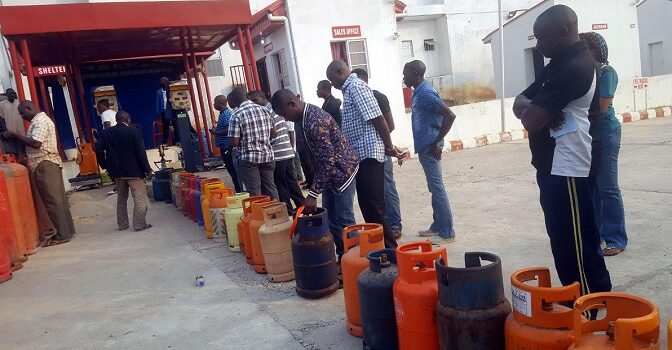
Why cooking gas prices are rising – Marketers

Published

on

Nigerians have expressed concern over another hike in the price of cooking gas, with a kilogram now selling for as high as ₦2,000 in some parts of the country.

According to gas marketers, the increase has little to do with any official price adjustment.

The Nigerian Association of Liquefied Petroleum Gas Marketers has attributed the surge in cooking gas price to temporary supply disruptions and market exploitation by some operators.

The association’s National President, Oladapo Olatunbosun, stated this on Wednesday while speaking on Channels Television’s The Morning Brief.

He said there had been no official increment in the price of Liquefied Petroleum Gas, blaming the hike on opportunistic marketers taking advantage of supply gaps caused by the recent strike by the Petroleum and Natural Gas Senior Staff Association of Nigeria against the Dangote Refinery.

He said, “I sympathise with Nigerians as the President of NALPGAM because we never intended to have a situation like this.

“I must say it categorically that prices of cooking gas have not gone up. No increment has been done officially.

“What is happening is that some marketers are taking advantage of the shortage in supply and the market forces that have increased demand. They are cashing up to make good money, which is wrong.

“We frown at this as an Association, and I’m happy that by the grace of God, normalcy will return in the next few days.”

Channels TV reports that prices of LPG, which previously averaged between ₦1,200 and ₦1,300 per kilogram, have in recent days risen to between ₦1,700 and ₦2,000, and as high as ₦3,000 in some areas.

See also  NNPCL appoints new heads of corporate communications, relations

Olatunbosun explained that the current situation was artificial and temporary, noting that normal supply and pricing were expected to stabilise in the coming days.

He said the problem began when Dangote Refinery, which had previously improved domestic supply by eliminating middlemen, embarked on maintenance and renovation that slowed truck loading.

He stated, “Before the strike, when you load from Dangote, he sends out about 50 trucks per day, which is good because it served the South West and some part of the North well, and if you add it to what you get from Apapa, and other depots in Lagos, because they also source their products from IOCs and other producers.

“Dangote came in with his own strategy, selling directly to offtakers. That made importation not to be attractive. You won’t be able to compete if you import because you are likely to incur losses.

“But at a time, Dangote also commenced renovation/maintenance, which affected loading. Trucks started spending like 14 days at Dangote yard before they could get products.

“So, marketers switched to Apapa, and nobody felt the impact.”

According to him, while the refinery was undergoing maintenance, marketers turned to Apapa depots for supply, but the subsequent PENGASSAN strike disrupted vessel discharges and inspections, drying up stocks.

“When Dangote finished renovation, and we were about to commence full loading, the strike came in. Although Dangote didn’t stop production, everybody had rushed to Apapa, and it was now out of product, and all the depots there were dry.

“The only vessel that came in from NOJ axes was meant to supply three depots could not berth because of the strike. And even when it berthed, the officers to inspect it weren’t on the ground because of the strike, and that caused about five days’ loss, and the real impact of the backlog became obvious.

See also  Non-oil revenue jumps 40% to N20.6tn – Presidency

“Now that the strike is off, the product has been discharged, and they are trucking out. But because everywhere is dry and the South West is the only place that consumes the largest amount of LPG in Nigeria,” he added.

He said the backlog from the delay worsened the scarcity, particularly in the South-West, which he said consumes the largest share of LPG in Nigeria.

Olatunbosun added that the country’s national LPG consumption had increased from about 1.2 million metric tonnes three years ago to nearly two million metric tonnes, further straining supply whenever there were disruptions.

He advised consumers to buy directly from registered gas plants, noting that those buying through middlemen or third parties were likely to pay inflated prices.

Olatunbosun said, “If you buy a product from a third party, fourth party, the chain has been extended, then the price is going up, which is quite illegal. Just like you buy petrol on the road for people who carry kegs, they will sell it at exorbitant prices. So if you go to gas plants, the price you can buy today is 1,300 maximum.

“People who are claiming to buy gas at 1700 did not disclose the source of their purchase. If you are buying from a third or fourth party, then catch on, and the prices increase.

“But if you buy from gas bottling plants, my members, you will not buy as high as that. Average price within my members in Southwest today is between N1000 to maximum of N1300, depending on the location and the kind of overhead they incur to get the gas into the plant. Before this artificial scarcity, the prices were being sold at 1,050 in some places, N950. So the highest you could get from a gas plant today is N1300, depending on if it’s a very remote area.”

See also  PHOTOS: Gov. Abiodun meets investors in China, seeks expansion of Ogun economic frontiers

The NALPGAM president assured Nigerians that the association was working with relevant authorities to stabilise supply.

punch.ng

FOLLOW US ON:

FACEBOOK

TWITTER

PINTEREST

TIKTOK

YOUTUBE

LINKEDIN

TUMBLR

INSTAGRAM

Continue Reading
Click to comment

Leave a Reply

Your email address will not be published. Required fields are marked *

Business

Nigeria’s World Bank debt to hit $9.65bn

Published

on

World Bank loans to Nigeria between 2023 and 2025 are projected to reach $9.65bn by the end of this year as fresh approvals, ongoing negotiations, and disbursements gather pace across key sectors.

The amount covers International Bank for Reconstruction and Development and International Development Association loans only, according to an analysis of data on the bank’s website by The PUNCH. When grants are added, total World Bank support rises to about $9.77bn within the three-year window.

The International Bank for Reconstruction and Development provides loans on commercial or near-commercial terms to middle-income and creditworthy low-income countries, while the International Development Association offers highly concessional loans and grants to the world’s poorest nations.

The figures show a steady build-up of commitments with government officials pushing ahead with digital infrastructure, social protection, power, education, and health programmes while defending the concessional nature of the borrowings.

The Federal Government is expected to secure another $500m facility on December 19, 2025, under the Fostering Inclusive Finance for MSMEs in Nigeria project. The operation is being prepared for Board consideration and will be implemented through the Development Bank of Nigeria.

The borrowing cycle under the administration of Bola Tinubu began with $2.7bn in loans in 2023 across four major projects. Financing that year was dominated by power sector recovery, renewable energy access, girls’ education, and women’s economic empowerment.

The Nigeria Distributed Access through Renewable Energy Scale-up project received $750m in IDA financing to expand private sector-led clean energy access. Another $700m IDA credit was approved for girls’ secondary education in participating states. Women’s economic empowerment attracted $500m IDA through the Nigeria for Women Programme Scale Up.

The AF Power Sector Recovery operation received $449m in IBRD financing and $301m in IDA to improve the reliability of the electricity supply and restore financial sustainability in the sector. There were no grant components in 2023, so the entire amount consisted of loans.

The volume of loans rose sharply in 2024 as new approvals reached $4.25bn, representing a 57.4 per cent increase compared with the preceding year. The increase was driven largely by two policy-based operations and three separate $500m IDA investment packages.

The Nigeria Reforms for Economic Stabilisation to Enable Transformation programme provided $1.5bn in loans, split between $750m IBRD and $750m IDA, as the government sought fiscal space and protection for vulnerable populations while reforms continued.

Another $750m IBRD loan was approved for the NG Accelerating Resource Mobilisation Reforms programme to boost non-oil revenues and safeguard oil and gas receipts.

The World Bank also cleared $500m IDA each for rural road access, primary healthcare strengthening, and dam safety and irrigation programmes. The primary healthcare programme included a $70m grant, which lifted total World Bank support for 2024, including grants, to about $4.32bn.

See also  Reps probes tax deductions, multiple charges by banks

For 2025, the data shows $2.695bn in loans at various stages of project processing alongside $52.18m in grants. Nine operations have already been identified across financial inclusion, digital broadband, health, education, social protection, and institutional capacity.

The largest facilities are tied to $500m IDA each for broadband expansion, basic education, and livelihood support for poor and vulnerable households. Health security, nutrition, and internally displaced communities account for another $630m, while procurement standards receive $65m from IDA.

A $400m IBRD component is included for the MSME finance programme, along with a $100m IDA portion. Also, the Central Bank of Nigeria is to receive a $6.8m grant to strengthen technology-enabled oversight of the banking sector and deepen understanding of payment and remittance systems.

Compared with 2024, the 2025 loan pipeline represents a decline of about 36.6 per cent, though it is broadly in line with the $2.7bn reached in 2023. Across the three years, IDA loans account for about $7.30bn while IBRD loans contribute roughly $2.35bn. Grants add another $122.19m, rising from zero in 2023 to $70.01m in 2024 before easing to $52.18m in 2025.

The portfolio highlights the scale of financing underpinning Nigeria’s reform programme as authorities continue to seek low-cost multilateral resources even as concerns persist over debt sustainability and the need to strengthen domestic revenue mobilisation.

The PUNCH earlier reported that Nigeria’s stock of World Bank International Development Association loans rose to $18.5bn, making it the largest IDA borrower in Africa and the third-biggest in the world.

Fresh data from the IDA’s unaudited financial statements for the third quarter of 2025 confirmed that the country has maintained the ranking it first attained in 2024, when it climbed to third place after overtaking India. The country was the fourth-largest borrower in 2023.

According to the report, Nigeria’s exposure increased from $17.1bn in September 2024 to $18.5bn in September 2025, representing a rise of $1.4bn or 8.2 per cent. The increase reflects the country’s heavier reliance on concessional financing to plug infrastructure gaps, stabilise its reform programme, and support social spending amid volatile oil earnings.

Economists warn that the rising loan pipeline, while potentially beneficial for long-term development, could deepen fiscal pressures if not matched with stronger domestic revenue mobilisation and prudent expenditure management.

Lagos-based economist, Adewale Abimbola, reacting to the rising World Bank commitments to Nigeria, said loans from multilateral institutions such as the World Bank are largely concessionary, with interest rates typically below market levels and longer repayment tenors.

He noted that the critical question is not whether Nigeria should be borrowing, but whether the loans are structured and deployed effectively. “If it’s concessionary and tied to viable projects with medium-term revenue prospects, I don’t think it’s a bad idea,” Abimbola explained. “Borrowing isn’t bad; what matters is utilisation.”

He stressed that the economic impact of such loans depends on how well they are channelled into projects that can generate sustainable growth, strengthen revenue, and improve public services over time.

See also  FG unveils N54.43tn budget as debt service gulps N15.91tn

Development economist and CEO of CSA Advisory, Dr Aliyu Ilias, has expressed strong reservations about Nigeria’s rising debt profile in light of the World Bank’s fresh commitments.

While acknowledging that borrowing is not inherently bad for an economy, he questioned the rationale for taking on more debt at a time when the government claims to have higher revenues. Ilias pointed out that following the removal of fuel subsidy, Tinubu had announced increased revenue inflows.

He added that both the Federal Inland Revenue Service and the Nigeria Customs Service had declared revenue surpluses, further suggesting the government should be able to fund projects without resorting to heavy borrowing.

According to him, the impact of the current borrowing spree is being felt in reduced public service delivery, particularly in capital expenditure, as debt servicing now consumes a significant portion of available revenue.

He warned that this crowding-out effect limits job creation, fuels inflation, and worsens Nigeria’s foreign-exchange imbalance, with the naira trading at historically low levels.

He argued that given the claimed revenue surpluses, the Tinubu administration should not have needed to borrow within its first two years in office, let alone at the scale currently being witnessed.

Economist and CEO of the Centre for the Promotion of Private Enterprise, Dr Muda Yusuf, said the rising World Bank commitments to Nigeria should be examined within the context of the country’s Medium-Term Expenditure Framework and annual budgets, which already provide for both domestic and foreign borrowing.

He noted that deficit financing is a common feature of budgets worldwide and is not inherently wrong, as it allows governments to make critical investments without waiting to generate all the required revenue upfront.

However, he stressed that borrowing should always be backed by sound economic reasoning and clear development priorities. Yusuf emphasised that the key issue is debt sustainability, which depends primarily on the country’s revenue capacity to service its obligations.

Without strong cash flow to meet repayment schedules, he warned, Nigeria risks falling into a vicious cycle of borrowing to service existing loans, thereby perpetuating fiscal vulnerability. He said it is essential that projects funded by loans directly support the economy’s capacity to repay.

According to him, Nigeria should be cautious with foreign loans due to the exchange rate risks they pose, noting that domestic debt is generally easier to manage. Excessive foreign borrowing, he warned, could put pressure on the country’s reserves and further weaken the exchange rate. He stressed that a disciplined approach to debt sustainability will be crucial for Nigeria to avoid long-term fiscal distress.

See also  FG scraps revenue collection deductions, pledges fiscal transparency

Meanwhile, data from the Debt Management Office showed Nigeria’s external debt stood at $46.98bn as of June 30, 2025. Of this amount, the World Bank Group accounted for $19.39bn—comprising $18.04bn from the International Development Association and $1.35bn from the International Bank for Reconstruction and Development.

This means the World Bank holds 41.3 per cent of the total, reinforcing its outsized role in funding Nigeria’s development programmes.

The Minister of Budget and Economic Planning, Senator Abubakar Bagudu, recently called on the World Bank to support Nigeria’s Renewed Hope Ward Development Programme, a grassroots initiative he described as central to achieving President Bola Tinubu’s target of building a $1tn economy by 2030.

The minister praised the World Bank for its consistent backing of Nigeria’s reforms, describing the last 28 months of partnership as both challenging and transformative. “The World Bank team has collaborated with us not just as partners but as members of the same team. We could not have achieved the results we have today without your support,” he said.

Speaking with the minister in August 2025, the World Bank Country Director, Matthew Verghis, commended Nigeria for making bold decisions that could reset its development trajectory.

“Nigeria’s recent decisions represent a critical moment. Such choices are not easy, but they create opportunities for a new path,” Verghis said. “The World Bank stands ready to continue supporting Nigeria in maintaining these reforms and increasing their impact.”

However, The PUNCH also reported in September 2025 that about six loans worth $2bn, signed for Nigeria by the World Bank in 2024, were yet to be disbursed nearly a year after the bank’s approval.

Responding to an enquiry by The PUNCH, the Senior External Affairs Officer at the World Bank, Mansir Nasir, noted that funds for projects financed by the institution were not disbursed at once but in instalments, depending on the nature of the project and financing instruments.

“Projects financed by the World Bank run for a certain time, which varies depending on the specific project. The total amount of the project is not disbursed as a one-off, but rather in instalments depending on the financing instruments—e.g., IPF or PforR—which require certain milestones for specific disbursement values.

“If you look at the portal, you will see the specific disbursement timelines and values,” Nasir added. He further stated that before a new project can begin disbursement, it must meet certain agreed conditions between the Federal Government and the World Bank.

punch.ng

FOLLOW US ON:

FACEBOOK

TWITTER

PINTEREST

TIKTOK

YOUTUBE

LINKEDIN

TUMBLR

INSTAGRAM

Continue Reading

Business

PENGASSAN-Dangote rift widens over salary suspension

Published

on

The Dangote Petroleum Refinery has stopped the monthly salaries of the engineers sacked in September during its face-off with the Petroleum and Natural Gas Senior Staff Association of Nigeria.

In a bid to address this, PENGASSAN said it is engaging the Dangote Group to resolve the matter amicably instead of resorting to another industrial action.

Findings by The PUNCH revealed that the salaries were halted following the refusal of many of the engineers to accept their redeployment to Zamfara, Borno, Benue, and Sokoto states, among others.

Some of the workers, who spoke on condition of anonymity because of the sensitivity of the issue, had earlier said individuals were sent to a coal mine in Benue, concrete road construction sites in Borno and Ebonyi states, as well as rice plants in Kebbi, Niger, Sokoto, and Zamfara.

While a few workers were said to have accepted the redeployment, many rejected it, relying on assurances from PENGASSAN that the crisis would be resolved through dialogue.

It was learnt that the Dangote Group issued a warning signal in October by slashing the wages of the affected workers before withholding their November salaries completely.

A senior official of the Dangote Group confirmed to our correspondent that the company would no longer continue paying those who rejected the redeployment offers.

While the affected workers described the non-payment of their salaries as “victimisation”, the official, who did not want his name in print due to the lack of authorisation to speak on the matter, wondered why the company should keep paying individuals who had refused the alternative placements offered.

“Those whose services were terminated were given an opportunity to work in our other projects, such as rice mills, concrete road construction, and coal mines.

See also  PENGASSAN-Dangote rift widens over salary suspension

All those who accepted have started working.

“If a newspaper terminates the services of an employee, and if it even goes out of its way to provide alternative employment, but the employee is not interested in availing the alternative employment, will it keep paying his/her salary?” the official said.

Recall that PENGASSAN had shut down oil and gas facilities in September over allegations that 800 refinery workers were fired for volunteering to be members of the union. However, the Dangote refinery said it only sacked a few workers who were sabotaging the facility, describing the exercise as a reorganisation.

The shutdown caused nationwide losses in oil and gas production and contributed to a drop in power generation until the Federal Government intervened and directed the redeployment of the affected workers.

In October, the sacked engineers were invited to pick up their letters at the Ikeja office of the Dangote Group. One of the letters sighted by our correspondent was titled ’Offer of Trainee Engagement’ and carried the letterhead of Dangote Projects Limited.

It reads partly: “Based on your performance at the assessment and subsequent interviews held with you, we are pleased to engage you as Engineer Trainee (Mechanical Engineering) for the coal project we are executing at Okpokwu, Benue State. This engagement shall be subject to the following conditions: You will report to your work location within 14 days upon receipt of this letter.

“You will undergo classroom training and hands-on training in the construction, commissioning, and operation of our Coal Project at Okpokwu, Benue State. Your training will be for a period of two years, and it will be reviewed periodically. You will be required to submit reports on your learning and progress. The objective of the training is to impart to you skills and to enable you to take up a position of responsibility in the organisation.”

See also  FG unveils N54.43tn budget as debt service gulps N15.91tn

Many of the engineers expressed concerns about the posting, especially to places perceived to be security hot spots. “The issue with the re-employment is that, firstly, there’s no address to report to on that letter. No office to report to in the states we were posted to. Secondly, those are security hot zones.

“Thirdly, in the letter, it is stated that if you don’t report within 14 days, your employment will be terminated, but no office location was given, and they don’t exist when we checked on Google Maps. So, if we accept the letters, we are basically terminating our employment by ourselves because there’s no office in those states to report to. PENGASSAN has basically told us not to accept the letters. We should let them continue with their talks,” they told The PUNCH.

Speaking during a briefing last week, the PENGASSAN President, Festus Osifo, said the union was still engaging the Dangote refinery to have the issues resolved.

Osifo said, “Since our last national industrial action, we have been engaging them in a lot of conversations, but the issues are not fully resolved. There are still a lot of pending issues. The NEC decided that, yes, let us still continue that process by pushing those issues by engaging in a dialogue to resolve the issues, and by also engaging all our social partners and stakeholders to get the issues resolved. And we hope and pray that these issues will be resolved at the table.

“These issues should be resolved in mere jaw-jaw so that we will not go back to Egypt. But as PENGASSAN, you know, we don’t shy away from doing what is right. But our preference is to get the subject resolved over the negotiation table.”

See also  NUPENG suspends strike as Dangote accepts union’s demands

A senior management officer told our correspondent on Sunday that PENGASSAN had the right to make its requests, but the company also had the liberty to make decisions that suited its business.

“They (PENGASSAN) have their privilege to ask. We can’t deny the opportunity to anyone to ask anything they wish. But we, too, have the privilege to state what we want,” the official said.

Some of the engineers lamented the turn of events. They disclosed that there was “an agreement that they would send us to oil and gas companies owned by Dangote.”

According to them, it was initially agreed that their salaries would be paid until the issue was resolved.

“But we noticed a reduction in our October salaries. We were not paid for November when others have been paid. That’s clear victimisation. It was agreed that Dangote would keep paying us until the matter is resolved, but it seems they have breached the agreement already,” they said.

As the stalemate lingers, the affected engineers said they are now caught between losing their livelihoods and accepting deployments they consider unsafe and irregular, while PENGASSAN continues to push for a negotiated settlement to prevent another nationwide shutdown.

With both sides holding firmly to their positions, the resolution of the dispute now hangs on the outcome of ongoing engagements between the union and the Dangote Group.

Continue Reading

Business

VIDEO: Stop Buying Rolls-Royce, Use The Money To Build Industries Instead – Dangote Tells Wealthy Nigerians

Published

on

Olarenwaju disclosed that Jonathan betrayed a gentleman’s agreement with Atiku, hence the former Vice President moved against him in 2015.

Aliko Dangote, Chairman of Dangote Group, has urged Nigeria’s elite to channel the money spent on luxury items like Rolls-Royce cars and private jets into building industries that boost economic growth and generate jobs.

Speaking with The PUNCH after a meeting with President Bola Tinubu at Aso Rock Villa on Saturday, Dangote lamented the culture of extravagant consumption, stressing that the nation’s development depends heavily on the responsibility of local investors.

“If you look at the Nigerian policy before, during the military, everybody from the president downwards used Peugeot 504. That was the highest. So, when a president is using 504, you cannot come as a commoner, as a businessman, or whoever you are, to be using Rolls-Royce,” he said.

Dangote criticised the proliferation of private jets at Nigerian airports, arguing that such wealth would be better invested in productive ventures.

“If you have money for a Rolls-Royce, you should go and put up an industry in your locality or anywhere in Nigeria where there is a need.

“It pains me when I go to the local airport, whether here or in Lagos, and even finding a parking space for your plane is impossible because everybody has a private jet. Those private jets could be in industries creating jobs,” he added.

Dangote emphasised that national development requires a strong focus on manufacturing and agriculture, supported by robust banking systems.

He also highlighted the urgent need for job creation, noting Nigeria’s population grows by 8.7 million babies every year, which demands significant investments in infrastructure and power.

See also  FG scraps revenue collection deductions, pledges fiscal transparency

“Some people may not know the position of the country as we speak. Population growth is 8.7 million babies every year. So we need to deliver power, infrastructure, and other essentials,” he said.

The billionaire also framed tax compliance as both a civic duty and a partnership with the government.

“When you have a company, the number one shareholder is the government. We need an enabling environment from the government, and as corporate citizens, we must pay our taxes. I cannot cheat my partner. If I pay tax, children can go to school and hospitals can function. The government has huge demands, and we must do our part,” he added.

The businessman dismissed what he described as over-reliance on foreign investors, insisting that no external investor would commit to Nigeria without strong domestic participation.

He said, “We should stop calling for foreign investors. No foreign investor will come here unless domestic investors are active. Good policies, governance, and rule of law attract local investors, and foreign investors follow to partner or establish their own operations.

Dangote reiterated that industrialisation must be led by Nigerians, saying “We must industrialise our country. Nobody will do it but us. Once we industrialise, foreigners will partner with us or invest in Nigeria. We must remove both real and perceived risks to investment.”

The businessman also revealed that the Dangote Refinery would soon produce surplus volumes, with projections indicating that by February, it will supply 15–20 million litres more than Nigeria needs.

This will allow exports to neighbouring countries, reducing fuel scarcity across West Africa.

See also  NNPCL appoints new heads of corporate communications, relations

“We are working to make Nigeria the refining hub of Africa. African countries import products, and we want to ensure that whatever we consume is produced locally,” he said.

Earlier in October, Dangote had also encouraged Nigerians to embrace homegrown products as a way to strengthen the economy and create jobs.

FOLLOW US ON:

FACEBOOK

TWITTER

PINTEREST

TIKTOK

YOUTUBE

LINKEDIN

TUMBLR

INSTAGRAM
Continue Reading

Trending