Connect with us

Lifestyle

Three nights Nigeria will not forget

Published

on

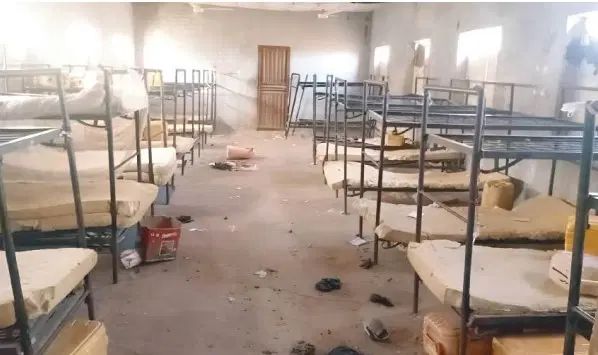
A hostel at Government Girls Comprehensive Senior Secondary School, Maga, Kebbi State, where bandits kidnapped 25 students, killing the vice-principal in the process.

ON three different days across three different states, Nigeria was pulled into the same widening circle of sorrow. A candlelit church was attacked in Eruku, Kwara State, on Tuesday.

Twenty-five schoolgirls were abducted from Maga, Kebbi State, before sunrise on Monday.

Brigadier General Musa Uba was ambushed and killed on the penultimate Friday in Borno.

Separate tragedies, yet bound by a single grim echo, the reminder that the country still walks through shadows long after midnight should have passed.

The night Eruku held its breath

Tuesday evening in Eruku began like a gentle hymn. Inside Christ Apostolic Church, candles flickered, voices blended in prayer, and worshippers leaned into the soft comfort of faith. The warm glow, the lifted hands, the familiar rhythm; all of it felt like a small pocket of peace. Then the doors burst open.

The first gunshot tore the hymn in half. Panic rippled through the sanctuary. Mothers threw themselves over their children. Candles toppled, casting frantic shapes across the walls. Screams clashed with the thunder of gunfire. Two worshippers fell dead where they stood. The pastor and several congregants were dragged into the night.

Eruku has lived on edge ever since. People speak in lowered tones now, as though the night itself leans in to listen. Some recall the sting of shattered glass against their skin; others cannot shake the memory of the ratatat of gunfire blending with the wails of women and children. The church remains suspended in its trauma; pews overturned, hymnals abandoned, dust settling softly on memories too heavy for anyone to lift.

See also  The History of the Alákétu of Kétu Kingdom

Yet as dusk falls each evening, Saturday Vanguard learnt that villagers still gather near the church, candles cupped carefully in their hands. They form gentle circles of prayer, their flames trembling but refusing to die.

A day earlier, in the early hours of Monday, another darkness was unfolding hundreds of kilometres away.

At Government Girls Comprehensive Secondary School in Maga, the girls slept in their hostel, unaware that their world was about to break open. They dreamed simple teenage dreams: assignments, parents, school gossip, futures that still felt close enough to touch.

Then came the motorcycles. The gunmen slipped through the fence with ruthless confidence. They stormed the hostel, jolting the girls awake with shouting, torchlight, and the cold bite of fear. Twenty-five were seized and dragged into the night. A vice-principal who tried to stop the attackers paid with his life.

Now the school carries an eerie silence. Beds remain rough and unmade. Notebooks sit untouched. Slippers rest beside bunks that should belong to giggling, restless teenager girls. The air itself feels held in place, waiting for footsteps that do not return.

Parents sit outside their homes long past midnight, whispering their daughters’ names into the wind. Some clutch photographs until the edges fray. Others rock gently in silence, trapped in the slow ache of suspended time. In Maga, every second feels like an eternity stretched thin by hope and fear.

The fall of a soldier

And then there was the tragedy of the penultimate Friday, the loss of Brigadier General Musa Uba in Borno.

See also  Throwback 1991: Alaafin Adeyemi's letter to military Governor against Ooni Sijuade and how Ooni was stopped from conferring Akinrogun of Yorubaland title on Chief Tom Ikimi

He was a soldier who believed leadership meant stepping into danger, not standing behind it. He carried the burdens of his men with quiet dignity, moving through each mission with the calm resolve of someone who understood both the cost and necessity of courage.

But the ambush that claimed him was swift and merciless. He was taken alive. Days later, the country learned that he had been killed.

In his home, his uniforms still hang where he left them. His boots sit by the doorway, their silence almost accusatory. His family moves through the house like people navigating sacred ground, touching his belongings with careful, trembling hands.

Among the ranks, his name is spoken with reverence, a reminder of the sacrifices that rarely make headlines but shape the fragile space between safety and chaos.

A nation holding its breath

Nigeria feels like a nation holding its breath. Three days, three states, and one sorrow that stretches across the map like a single unbroken thread. In Eruku, a farmer startles at every slamming door, his nerves still raw from Tuesday’s terror.

In Maga, a mother has not slept since Monday, her thoughts circling endlessly around the daughter who never came home. In Borno, a widow moves quietly through her house, her gaze lingering on medals she cannot yet bear to hold.

Across the country, nights have grown heavier. Parents walk their children to school with wary eyes fixed on distant horizons. Communities stay awake longer than they used to, listening for rustles in the dark that might signal danger. Even soldiers move differently; tighter, more deliberate, as though the air itself has changed.

See also  Some Anioma people deny Igbo origin because of Civil War – Akpabio’s aide

And yet, beneath all the fear, something stubbornly human refuses to fade.

The heart that refuses to stop beating

In Eruku, neighbours now escort each other home from evening errands, their footsteps forming a quiet shield. In Maga, young volunteers sweep through bushes and backroads, driven by nothing but determination and the aching need to bring the girls home. In Borno, soldiers straighten their backs in honour of the commander they lost, carrying his courage like a torch through the shadows.

Grief is here, heavy and undeniable, but resilience has arrived with it, rising from the belief that sorrow cannot be the final sentence in Nigeria’s story.

When the sun returns

One day, Eruku’s congregation will sing again without checking the doors. One day, the daughters of Maga will return, perhaps; older, changed, but home. One day, Brigadier Uba’s family will speak his name with steady voices instead of trembling ones.

For now, the night stretches on; long, uncertain, thick with memory. But dawn is already on its way. Slow, deliberate, unyielding. And when it breaks, Nigeria will rise once more, scarred but unbroken, carrying both the weight of these three days and the quiet, stubborn hope that simply refuses to die.

Source: Vanguard News

Continue Reading
Click to comment

Leave a Reply

Your email address will not be published. Required fields are marked *

Lifestyle

Nigeria’s ambassador-designate to Algeria, Lele, dies at 50

Published

on

The Federal Government has announced the death of Nigeria’s ambassador-designate to Algeria, Mohammed Mahmud Lele, who died at the age of 50.

The Ministry of Foreign Affairs disclosed this in a statement issued in Abuja on Wednesday by its spokesperson, Kimiebi Ebienfa.

According to the ministry, Lele died in the early hours of April 19, 2026, in Ankara, Türkiye, after a protracted illness.

The ministry described the late diplomat as a dedicated officer who served the country with distinction.

“The late Ambassador Lele, until his death after a protracted illness, was the Director in charge of the Middle East and Gulf Division in the Ministry of Foreign Affairs.

“Ambassador Lele, a career diplomat, was recently appointed by President Bola Ahmed Tinubu as Ambassador-designate to the People’s Democratic Republic of Algeria, following the Nigerian Senate’s confirmation of his nomination,” the statement said.

Born in Gamawa, Bauchi State, in 1976, Lele studied Economics at Bayero University, Kano, and went on to serve in Nigerian missions in Berlin, Lomé and Riyadh.

“Ambassador Lele was known for his intellectual depth, strategic insight and commitment to the advancement of Nigeria’s foreign policy objectives,” the statement added.

The Permanent Secretary of the ministry, Dunoma Umar Ahmed, who received the remains of the late diplomat at the Nnamdi Azikiwe International Airport, Abuja, described him as “a hardworking, humble and fine officer, who will be sorely missed by the ministry.”

The ministry added that his death “is a monumental loss not only to his immediate family but also to the entire Foreign Service community and the Federal Republic of Nigeria.”

See also  ‘You Made The Choice To Marry Your Grandfather’ – Onuoha Tells Regina Daniels

Lele was buried on Wednesday in Kano in accordance with Islamic rites.

The ministry extended condolences to his family, associates, and the government and people of Bauchi State, praying for the peaceful repose of his soul and strength for those he left behind.

Continue Reading

Lifestyle

Governor Amuneke reveals party officials offered him dollars to alter anti-govt skits

Published

on

Comedian Kevin Chinedu, popularly known as Kevinblak, has revealed that officials of a political party offered him dollars to change his satirical skits criticising politicians and governance.

He made the disclosure on Monday in an interview on ARISEtv’s Arise 360 programme, where he spoke about the pressures facing content creators who hold public officials accountable through humour.

Chinedu, known for his character Governor Amuneke, said the approach came at a particularly vulnerable moment, shortly after his wife had a Caesarean section and he was under financial strain.

“They said they were going to change my life, that I’m earning crumbs, you know, give me dollars. They mentioned that my colleagues are in the game and all of that,” he said.

He declined to name the party, saying only that it was “Amuneke’s party”, a reference to the fictional political figure in his skits, and cautioned against any attempt to identify it publicly.

“Don’t mention names, trust me, don’t mention names,” he said.

Despite the financial pressure, the comedian said he turned down the offer, recalling how the officials had tried to lure him to Abuja with the promise of a life-changing sum.

“I had a lot of bills on my head and I just heard come, come to Abuja, let’s change your life. Dollars upon dollars,” he said.

He said he ultimately held firm, guided by a personal code he had maintained throughout his career.

“I looked at it, I said, no, I am who I am. I’ve been here for a long time, and I’ve never been in any illegal thing, and I’ve never been somewhere, you know, I’m doing something because I’m being influenced, because of money.

See also  ‘You Made The Choice To Marry Your Grandfather’ – Onuoha Tells Regina Daniels

“If I want to do it, it should be something I’m doing because I want to do it. So, you know, it is what it is,” he said.

When asked whether friends had urged him to accept the money, Chinedu said his inner circle was equally principled, and had themselves been approached and refused.

“I don’t have friends that are easily overwhelmed with money. I have people who have principles because they have, you know, approached them, they themselves. So, we always have that conversation,” he said.

punch.ng

FOLLOW US ON:

FACEBOOK

TWITTER

PINTEREST

TIKTOK

YOUTUBE

LINKEDIN

INSTAGRAM

Continue Reading

Lifestyle

Over 4,600 Nigerian doctors relocate to UK in three years – Report

Published

on

Nigeria’s already fragile healthcare system is facing renewed strain as no fewer than 4,691 doctors have relocated to the United Kingdom since President Bola Tinubu assumed office on May 29, 2023, fresh data from the General Medical Council shows.

The UK GMC is a public official register detailing the number of practising doctors in the UK alongside other details such as their areas of speciality, country of training, among others.

The mass migration represents not just a human resource crisis but a significant economic loss.

With the Federal Government estimating that it costs about $21,000 to train a single doctor, Nigeria has effectively lost at least $98.5m in training investments within less than two years.

The figure put the total number of Nigeria-trained doctors currently practising in the UK to about 15,692, making Nigeria one of the largest sources of foreign-trained doctors in Britain, second only to India.

As of May 28, 2025, official records showed that the number of Nigerian-trained doctors in the UK was a little over 11,000. The figure has grown significantly since then.

The exodus of doctors comes as Nigeria’s doctor-to-population ratio hovers around 3.9 per 10,000 people, far below the minimum threshold recommended by the World Health Organisation.

For many health experts, the numbers confirm what has long been visible: a system gradually losing its most critical workforce.

The Nigerian Medical Association has repeatedly warned that poor remuneration, unsafe working conditions, and inadequate infrastructure are pushing doctors out of the country.

“Our members are overworked, underpaid and exposed to unsafe environments daily. Many are simply burnt out,” the NMA said in one of its recent statements addressing workforce migration.

See also  Some Anioma people deny Igbo origin because of Civil War – Akpabio’s aide

Similarly, the National Association of Resident Doctors has consistently highlighted the toll on younger doctors, who form the backbone of Nigeria’s tertiary healthcare system.

“Doctors are leaving because the system is failing them—irregular salaries, excessive workload, and lack of training opportunities,” NARD noted during one of its nationwide engagements.

Ironically, the doctor exodus persists even as Nigeria continues to spend heavily on healthcare abroad.

While official foreign exchange data shows only modest spending on medical tourism in recent years, broader estimates suggest Nigerians still spend hundreds of millions of dollars annually seeking treatment overseas.

For instance, a recent report by The PUNCH revealed that foreign exchange outflow for health-related travel by Nigerians surged to $549.29m in the first nine months of 2025, a 17.96 per cent increase from $465.67m in the same period of 2024, according to official data by Nigeria’s apex bank.

A public health expert, Dr David Adewole, noted that the Federal Government’s national policy on health workforce migration, aimed at curbing the growing trend of health professionals leaving the country—commonly referred to as ‘Japa’—is a good initiative, but may not do much to address the fundamental problems of the shortage of skilled healthcare professionals in Nigeria, particularly in rural and underserved areas.

According to him, many of the push factors for health professionals emigrating to greener pastures, like insecurity, emolument and lack of basic amenities like potable water, health facilities, cost of living and constant electricity, persisted.

He stated: “To make healthcare workers stay here, let the salaries be enough so that what you earn will be much more than the multiples of what you need for basic needs, like food, power supply, housing, and so forth.

See also  ‘You Made The Choice To Marry Your Grandfather’ – Onuoha Tells Regina Daniels

“People still look at life after retirement. You might have a good policy, but its implementation is the issue. For example, you are retired, and for your retirement package, you don’t need to know anyone for it to be processed promptly.

“Then subsequently, your monthly pension, without pressing anybody, should be paid. Those things are not here.

“And when you go to the hospital abroad, if you tell them that you are in a hurry, you go to your home; they’ll bring the medicines to your doorstep.”

Continue Reading

Trending