Connect with us

News

Big money, small impact: Governors face fire over N9tn FAAC windfall

Published

on

Despite receiving an estimated N9tn in Federation Account Allocation Committee inflows in 2025, state governors are facing mounting criticism from labour unions, civil society groups and opposition parties over what many describe as a widening gap between soaring revenues and limited improvements in citizens’ welfare.

FAAC allocations to states surged by over N2tn in one year, according to an analysis of Federation Account disbursement data published by the National Bureau of Statistics and collated by The PUNCH, highlighting the scale of the revenue windfall that flowed to subnational governments in 2025 amid higher federation inflows.

The sharp rise has triggered criticism from organised labour and opposition political parties, with the Nigeria Labour Congress warning that higher allocations have failed to deliver meaningful improvements in citizens’ welfare due to weak governance, misplaced priorities, and corruption at the state level.

Civil society organisations have also faulted state governments, accusing them of mismanaging the inflows and failing to translate increased revenues into visible development outcomes, while calling for stronger accountability and oversight.

Economists, meanwhile, say the surge has expanded states’ fiscal space but caution that heavy dependence on federally shared revenue and poor revenue management continue to undermine sustainable development at the subnational level.

The Federation Account disbursement data show that state governments received a total of N7.315tn from the Federation Account Allocation Committee in 2025, compared with N5.186tn in 2024. The year-on-year increase of roughly N2.13tn represents a jump of about 41 per cent in direct FAAC allocations to states.

When the constitutionally mandated 13 per cent derivation revenue is added, total inflows attributable to states climbed to N8.934tn (about N9tn) in 2025, up from N6.533tn in 2024, a rise of N2.4tn or 36.74 per cent.

This surge came against the backdrop of a sharp expansion in total FAAC distributions. Aggregate allocations to the three tiers of government, including derivation, rose from N15.259tn in 2024 to N21.897tn in 2025.

States therefore captured a substantial share of the overall increase, both in absolute terms and as a proportion of total federation revenues. Without the 13 per cent derivation component, states’ N7.315tn allocation in 2025 accounted for about 33.4 per cent of the N21.897tn total FAAC disbursement for the year, compared with roughly 34.0 per cent in 2024.

When derivation revenue is included, total state-linked receipts of N8.934tn represented about 40.8 per cent of total FAAC disbursements in 2025, down from around 42.8 per cent in 2024, indicating that while inflows grew in nominal terms, their relative share declined as allocations to all tiers expanded.

A closer look at monthly disbursements shows that state allocations improved steadily throughout 2025. States received N498.50bn in January, well above the N396.69bn recorded in January 2024.

Monthly allocations continued to trend higher, peaking at N727.17bn in October before easing to N601.73bn in December. By contrast, only two months in 2024 recorded allocations above N500bn, with the highest monthly figure being N549.79bn in December.

By the end of June 2025, states had already received over N3.32tn, compared with about N2.33tn in the first half of 2024, easing short-term liquidity pressures, particularly for states with heavy wage bills and debt service obligations.

Derivation revenue also played a critical role. In 2025, derivation payments rose to N1.619tn from N1.347tn in 2024, an increase of about N272bn or just over 20 per cent. Monthly derivation inflows were especially strong in September 2025, when oil-producing states shared N183.01bn, compared with N99.47bn in September 2024.

See also  Nigeria won’t accept Trump’s deportee deal like Rwanda, S’Sudan – FG

Despite the surge, states did not disproportionately outpace other tiers. Federal Government allocations rose from N4.951tn in 2024 to N7.613tn in 2025, while local government allocations increased from N3.774tn to N5.351tn.

Nevertheless, the impact on states is particularly significant given their responsibility for delivering education, healthcare, and infrastructure. The additional N2.4tn received in 2025 alone is equivalent to nearly half of what states received from FAAC in total in 2024.

The 10th edition of the BudgIT State of States Report, titled ‘A Decade of Subnational Fiscal Analysis: Growth, Decline and Middling Performance’, revealed that over 30 states rely heavily on FAAC allocations.

An executive of BudgIT said on Channels Television’s Politics Today programme, “At least thirty states, excluding Lagos, Ogun, and Enugu, relied on FAAC for more than sixty per cent of their recurrent revenue. Lagos remains an outlier, but Ogun and Enugu also seem to be performing quite well.

“In total, 31 states depended on FAAC for at least 80 per cent of their current revenue, which shows just how challenging the fiscal situation has become for many of them.

“For example, Lagos’s FAAC allocation rose from N4.24bn to N11.38bn, a massive increase that highlights how significant federation account transfers have become within a single fiscal year. Still, credit should go to the states that recorded strong year-on-year growth, as well as those that grew consistently over the ten-year period we reviewed.”

The report added that 29 states relied on FAAC receipts for at least half of their total revenue, 28 relied on it for at least 55 per cent, and 21 relied on it for over 70 per cent.

The BudgIT executives expressed concern that rising FAAC inflows were discouraging states from expanding internally generated revenue. This is “concerning because the more FAAC money states receive, the less incentive some of them have to develop their own internal revenue sources”.

They noted that “the proportion of IGR within total recurrent revenue declined slightly from 25.27 per cent in 2023 to 20.27 per cent in 2024, indicating continued dependence on federal transfers”.

The Managing Director of Optimus by Afrinvest, Dr Ayodeji Ebo, said, “These revenues are volatile and largely outside state control, making budgets vulnerable to oil price shocks. Over time, this approach also discourages ingenuity, as states become dependent on external inflows rather than building durable local revenue sources.”

A development economist and Chief Executive Officer of CSA Advisory, Dr Aliyu Ilias, said subnational governments are creating challenges for the federation through how they manage FAAC allocations.

He suggested “counterpart funding,” where states that increase their IGR receive proportional benefits, warning that without incentives, states would continue to rely heavily on Abuja. Ilias said, “While FAAC allocations are at unprecedented levels, they are not necessarily translating into improved living standards.”

NLC speaks

The country’s biggest labour union said rising FAAC allocations have failed to deliver meaningful benefits to citizens, blaming weak governance, misplaced priorities, and persistent corruption at the state level.

“Very few states are doing well in terms of how they deploy what they receive,” Assistant Secretary-General of the NLC, Onyeka Christopher, told The PUNCH. “The idea behind federal allocations is to bring the government closer to the grassroots, but unfortunately, in many states, this has not translated into the desired results for well-known reasons.”

See also  How Bandits Negotiator Spent Ransom Share On Luxury Cars, Trips – DSS

The NLC added that, “Once people know there are no consequences, they will continue to steal public funds,” warning that kleptocracy continues to undermine development. “For FAAC to truly benefit the people, the issue of kleptocracy must be addressed. What are the EFCC and ICPC doing?” it asked.

CSOs react

Chairman of the Centre for Accountability and Open Leadership, Debo Adeniran, described subnational governments as “meddlesome interlopers”.

“Because we have been so complacent, we in the civil society, and maybe the media, have not been following the money from the point of release to the point of expenditure,” he said.

“The increase in allocations to states has just increased the financial opportunity for the state governors, not percolating to the level of the people that are supposed to be the final recipients of government charities,” Adeniran added.

The Executive Director of CISLAC, Auwal Musa Rafsanjani, said, “There’s no physical, verifiable, tangible evidence to show that the monies the governments are receiving are touching lives in terms of healthcare, electricity, physical infrastructure, or even agriculture.”

“What you see in the states is that these monies are collected, but it is about decamping, defections, and strategising for 2027,” he said.

Opposition parties lament

As federal allocations to states continue to rise, opposition parties, civil society actors and government officials across several states have expressed sharply differing views on whether the increased revenue has translated into tangible development and improved living conditions for citizens.

In Lagos State, the Chairman of the opposition African Democratic Congress, George Ashiru, said rising federal allocations and internally generated revenue had failed to ease hardship among residents.

According to him, inflationary pressures triggered by federal policies have outweighed gains from increased funding.

“Rents have gone up between 200 and 400 per cent in many areas. Social services have not matched inflationary trends, while infrastructure development still focuses on legacy projects instead of overcrowded inner-city areas,” Ashiru said.

He added that ongoing demolitions appeared to favour high-end housing projects, while public schools, healthcare facilities, intra-city roads and the overall cost of governance continued to suffer neglect.

The Peoples Democratic Party in Sokoto State rated the current development in the state as zero when compared to the huge allocations received from the federal government.

The spokesman of the party in the state, Hassan Sahabi Sanyinnawal, while speaking with our correspondent on the telephone, said the state government, led by Governor Ahmad Aliyu of the All Progressives Congress, only concentrates on two out of the 23 local government areas in the state.

“There is nothing on the ground to show for the huge allocation. We have 23 LGs in the state, but there is absolutely nothing going on in 21 LGs. In the two LGs within the metropolis, they are busy doing roundabouts, street fencing, and beautification.

“They did not do anything that the people of the state needed. Water is no longer running in the metropolis, the health sector is not getting attention, our education is not getting the necessary attention, among many others, but they are beautifying the metropolis.

“The beautification has no economic impact on the people of the state. They need to do better when you compare it with the money being received now,” he added.

See also  Failed coup: Presidential Villa worker admits role in alleged 2025 plot to overthrow Tinubu

On his part, the Kano State Chairman of the Social Democratic Party, Ali Shettima, said the absence of clear information on state allocations made it difficult to carry out a fair assessment of the government’s performance.

“I don’t even know how much is allocated to the state. I can’t give an accurate assessment based on something I don’t know,” he said.

In Plateau State, the Chairman of the Alternative Democratic Party (ADP), Bitrus Boyi, questioned the visibility of development projects despite claims of increased federal allocation.

“If truly there has been an increment in federal allocations, it has not translated to development. Most of the projects we see are funded by development partners,” he said, urging the state government to ensure that increased revenue benefits residents.

Similarly, the Peoples Redemption Party (PRP) in Bauchi State accused the state government of prioritising “luxury and white elephant projects” over education and healthcare.

The party’s chairman, Abbas Abba, described the condition of schools and hospitals as “poor and alarming,” alleging that government spending focused more on propaganda than sustainable impact.

However, the ruling Peoples Democratic Party in Bauchi rejected the claims, insisting that development was evident in regular salary payments, road projects, healthcare revitalisation and school renovations across the state.

In Zamfara State, politicians Alhaji Musa Yankuzo and Mohammed Sani said the state had little to show despite higher federal allocations, accusing governors of mismanaging funds for selfish interests rather than development.

The ADC in Kebbi State also dismissed the achievements of Governor Nasir Idris, with the party’s chairman, Sufiyanu Bala, citing unemployment, dilapidated schools, out-of-school children and weak healthcare services as evidence that increased allocations had failed to improve living standards.

In Gombe State, the PDP said development remained “one-sided,” alleging that the ruling APC focused mainly on capital projects with little direct impact on citizens’ welfare.

“The essence of democracy is to improve education, health, water supply and security. That is not what we are seeing,” PDP spokesman Abdulkadir Ahmad said.

Contrasting views

In contrast, the Labour Party in Nasarawa State commended the Governor Abdullahi Sule-led APC government for infrastructure development, particularly the completion of the over N16bn Lafia flyover and ongoing projects in Akwanga, Keffi and Karu.

LP chairman Alexander Ombugu praised the administration’s prudence and commitment, urging the governor to do more. President Bola Tinubu had commissioned the Lafia flyover in June 2025 alongside other projects, including roads, a new secretariat complex and a solar mini-grid.

In Kwara State, the PDP and APC traded blame over the impact of rising federal revenue.

The PDP accused the state government of concentrating spending in limited areas of Ilorin, the capital city, and neglecting insecurity, workers’ welfare and rural communities.

“We have had huge allocations since 2019, yet the people have benefited close to nothing,” PDP spokesman Olusegun Adewara said, calling for improved security, better wages and investment in the informal sector.

The APC dismissed the claims, insisting that the AbdulRahman AbdulRazaq administration had deployed resources across infrastructure, education, healthcare and social investment programmes in all senatorial districts.

punch.ng

FOLLOW US ON:

FACEBOOK

TWITTER

PINTEREST

TIKTOK

YOUTUBE

LINKEDIN

TUMBLR

INSTAGRAM

Continue Reading
Click to comment

Leave a Reply

Your email address will not be published. Required fields are marked *

News

Makinde signs executive order regulating vigilante, security groups

Published

on

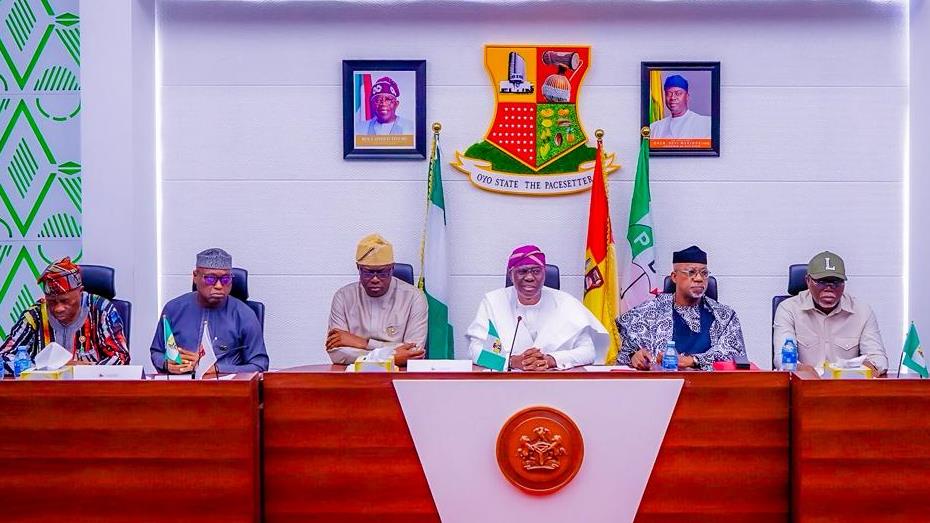
Oyo State Governor, Seyi Makinde, on Wednesday, signed into law the Executive Order 001 of 2026 on the Regulation of Associations, Groups and Organisations offering Security and Allied Services in the state.

He said the move was necessary to ensure that all groups and associations involved in security-related activities, such as vigilante and other community-based security groups, operate within a clear legal and operational framework that supports peace, order and rule of law in the state.

At the signing ceremony on Wednesday in Ibadan, the state capital, Makinde stressed that the executive order became necessary in view of the growing security challenges confronting communities and the increasing number of groups engaging in security-related activities without proper coordination.

While noting that security remains a collective responsibility of both the government and citizens, he explained that the order was designed to ensure that all organisations involved in security and allied services are properly registered, documented and monitored by the state government.

The governor equally stressed that the people must avoid any action that could lead to ethnic tension, while cautioning socio-cultural groups to desist from narratives that could result in ethnic profiling, discrimination or confrontation as the state government would not tolerate any form of criminality under the guise of security operations.

Makinde also used the occasion to address the recent abduction of students and teachers in Oriire Local Government Area of the state, assuring residents that the government, in collaboration with security agencies and relevant stakeholders, are working to ensure the safe return of the victims.

See also  Senate confirms Amupitan as INEC chairman

He also lauded the security agencies and residents for their patience and restraint during the difficult period, reaffirming his administration’s commitment to strengthening security coordination across the state.

The governor urged citizens to report suspicious activities to security agencies rather than resorting to self-help or unlawful reprisals.

Earlier, the state Attorney-General and Commissioner for Justice, Abiodun Aikomo, explained that all associations, groups and organisations offering security-related services with a membership strength above five persons must notify and register with the government through the Office of the Special Adviser on Security.

He added that existing groups must notify the office within 72 hours of signing the Executive Order and comply with the directive for documentation and certification.

Aikomo further stated that the regulation would enable the government to identify and monitor individuals or groups carrying weapons or operating in security uniforms across the state.

He warned that failure to comply with the executive order constitutes a violation of the law and would attract punishment accordingly.

He added that the Office of the Special Adviser on Security, the Commissioner of Police and the Nigeria Security and Civil Defence Corps have been directed to enforce full compliance with the order, which became effective immediately after it was signed by the governor.

punch.ng

FOLLOW US ON:
FACEBOOK

TWITTER

PINTEREST

TIKTOK

YOUTUBE

LINKEDIN

INSTAGRAM

Continue Reading

News

Coup trial: Accused colonel rejects military court

Published

on

The second accused person in the charges brought against 36 persons accused of alleged mutiny and plot to overthrow the government of President Bola Tinubu, Col Mohammed Ma’aji, has challenged the jurisdiction of the Defence Headquarters Garrison General Court Martial sitting in Asokoro, Abuja, to hear the case.

Ma’aji, in a preliminary objection filed before the court martial in charge No: DHQ/GAR/ABJ/49/ADM, between the Armed Forces of Nigeria and Brig Gen M.A. Sadiq, Col Ma’aji, alongside 35 others, urged the court martial to strike out the charges instituted against him, arguing that the military tribunal lacked the jurisdiction to entertain the case.

Ma’aji, in the objection, contended that the charges were fundamentally defective and incompetent in law.

The objection, brought pursuant to Rules 36(1) and 37(1) of the Rules of Procedure Army 1972, urged the tribunal to make an order striking out and/or dismissing the charges against the 2nd Accused.

“Take notice that the 2nd accused hereby objects to the jurisdiction of the General Court Martial to entertain Counts One to Nine of the charges preferred against the 2nd Accused in Charge No: DHQ/GAR/ABJ/49/ADM, namely ARMED FORCES OF NIGERIA V. BRIG. GEN. M. A. SADIQ (N/10321) & 35 ORS and hereby prays the General Court Martial for the following reliefs:

“An Order striking out and/or dismissing the charges against the 2nd Accused in Charge No: DHQ/GAR/ABJ/49/ADM for lack of jurisdiction. An order declining jurisdiction to entertain the charge as constituted.

“And for such further order(s) as the Honourable General Court Martial may deem fit to make in the circumstances.”

The second accused in the charge also argued that the complainant, listed as the Armed Forces of Nigeria, lacked the legal capacity to institute criminal proceedings.

According to Ma’aji, “The complainant (Armed Force of Nigeria) is not a juristic person and thereby lacks the requisite competence to initiate and prosecute the criminal proceedings in Charge No: DHQ/GAR/ABJ/49/ADM.”

See also  Suspected bandits nabbed near Akure airport

Ma’aji further maintained that because the complainant allegedly lacked legal personality, the General Court Martial was equally deprived of jurisdiction to hear the matter.

Citing several Supreme Court and Court of Appeal authorities, including Green v. Green, Fawehinmi v NBA, and Mothercat Nig Ltd v Reg. Trustees of the Full Gospel Assembly Nig, the defence argued that only natural persons or entities expressly recognised by law could sue or be sued.

The written address submitted in support of the objection stated, “The name ‘Armed Forces of Nigeria’ described as ‘complainant’ in Charge No: DHQ/GAR/ABJ/49/ADM is unknown to law and destitute of any legal capacity to exercise Prosecutorial powers in respect of the charges preferred against the 2nd Accused.”

The second accused also challenged the competence of counts one to nine of the charge, which allegedly accused him of inciting other officers to join a plot to overthrow President Tinubu.

Ma’aji insisted that the allegations contained in the particulars of the charges did not fall within the offence of mutiny as contemplated under Section 52(1)(b) of the Armed Forces Act, 2004.

He argued that the particulars of the charge “disclose offences against the Sovereign State otherwise known as the Federal Republic of Nigeria and constitutional order rather than offences relating to military or service discipline or command structure.”

He maintained that the phrase “plot to overthrow the government of the Federal Republic of Nigeria” contained in the charge could not be equated with “lawful authority in the Federation” as envisaged under Section 52(3) of the Armed Forces Act.

“It is submitted that the Federal Republic of Nigeria does not fall within the phrase ‘a lawful authority in the Federation’ as used in Section 52(3) of the Armed Forces Act, Laws of Federation, 2004,” Ma’aji contended.

Relying on constitutional provisions and judicial precedents, he argued that the court-martial, being a tribunal of limited jurisdiction, could not extend its powers beyond what was expressly granted by statute.

See also  Kenyan opposition leader Raila Odinga dies in India

Ma’aji also cited the Supreme Court’s warning against judicial expansion of statutory provisions, insisting that any ambiguity in penal legislation must be resolved in favour of the accused persons.

Quoting the Supreme Court decision in Nigerian Navy v. Lambert, the second accused submitted: “It is settled law that penal statutes are to be construed strictly to the benefit of the accused person and that where there is a reasonable construction that avoids the penalty in any particular case, the court must adopt that construction.”

The preliminary objection further contended that for a charge of mutiny or incitement to mutiny to stand, there must be allegations of concerted insubordination, defiance of military authority or refusal of lawful command or organised military rebellion against superior military command.

According to the defence, the particulars supplied by the prosecution failed to disclose those essential ingredients.

On this ground, he urged the General Court Martial to uphold his preliminary objection and dismiss the charges against him for want of jurisdiction.

Meanwhile, a witness in the ongoing trial of six alleged coup plotters before the Federal High Court in Abuja, on Wednesday, told investigators that Ma’aji allegedly threatened to force his way into the Presidential Villa, even if insiders refused to cooperate.

The fourth defendant, Zekeri Umoru, made the allegation in a video previewed in court during proceedings in the trial-within-trial over the admissibility of the defendants’ extrajudicial statements.

Umoru and five others in April were arraigned before Justice Joyce Abdulmalik on 13 counts of criminal charges over alleged complicity in an alleged coup plot to overthrow Tinubu’s government.

The six defendants: Maj Gen Mohammed Ibrahim Gana (retd), Capt Erasmus Victor (retd), Insp Ahmed Ibrahim, Zekeri Umoru, Bukar Kashim Goni and Abdulkadir Sani, however, pleaded not guilty to all the counts after the charge was read to them.

See also  Trump says ‘not a big fan’ of Pope Leo after his anti-war message

At the resumed sitting, Umoru, who worked with Julius Berger on the Presidential Villa clinic project, alleged that Ma’aji, through the third defendant, Insp Ibrahim, asked him to recruit between 18 and 19 persons working inside the Villa, including soldiers, Department of State Service personnel and Julius Berger staff.

According to the video evidence played in court, Umoru alleged that plans were discussed to switch off electricity within the Presidential Villa to aid the operation, but he warned that such an action would immediately trigger investigations and lead to the detention of workers on duty.

He further claimed that Insp Ibrahim later demanded N100m from Ma’aji to facilitate access into the Villa through an ambulance route, but Ma’aji allegedly rejected the amount as excessive, insisting he could still gain entry by force, although “there would be bloodshed.”

The witness also told investigators that he became uncomfortable with the alleged plan and repeatedly attempted to return the money given to him, insisting that the Presidential Villa “was not child’s play.”

He denied having access to the Villa’s solar power plant, despite allegations that he intended to sabotage the electricity supply within the complex.

The court further heard that Umoru did not immediately report the alleged plot to authorities because Insp Ibrahim allegedly advised him to delete messages and avoid contacting Ma’aji due to an ongoing audit in their office.

Following the screening of the video evidence, Justice Abdulmalik adjourned the matter until May 21 for continuation of the trial-within-trial.

punch.ng

FOLLOW US ON:

FACEBOOK

TWITTER

PINTEREST

TIKTOK

YOUTUBE

LINKEDIN

INSTAGRAM

Continue Reading

News

Nigerians have constitutional right to self-defence from insecurity — Bwala

Published

on

The Special Adviser to President Bola Tinubu on Policy Communication, Daniel Bwala, says Nigerians are constitutionally empowered to self-defence themselves against attackers, including in situations involving lethal threats, while maintaining that the government is working to address insecurity across the country.

Bwala stated this during an interview on Arise Television on Wednesday.

He was reacting to recent violent incidents in the country, including the killings in Esiele community in Orire Local Government Area of Oyo State and the abduction of teachers and pupils of LA Primary School.

The presidential aide said the Nigerian Constitution guarantees citizens the right to self-defence.

“The constitution has guaranteed to every citizen of Nigeria the right to self-defence; you have the right to defend yourself,” he said.

“When your right, my right, and that of my neighbour is put together, it becomes collective rights to defend ourselves and Nigerians have the right to defend themselves.

“If you come to my house to try to kill me, any lethal weapon I use to defend myself is guaranteed by the Constitution,” he added.

Bwala, however, noted that firearm possession remains regulated by law.

He said, “Nigerians don’t have the right to bear certain arms unless those arms are permitted but the collective people can come together to apply to the government for the right to coordinate themselves.”

Explaining the government’s position on insecurity, Bwala said criminality is a global challenge but insisted that collective action is necessary to address it.

“Solution is what we all look to; evil men operate anywhere in the world, no matter how tight you are as a government.

See also  US says Nigerian students with valid F1, J1 visas safe from restrictions

“You do your best and expect that with the help of God and collective participation of the people through collective intelligence, we will be able to put an end to it,” he said.

On public reactions to recurring attacks, he said citizens will continue to express frustration.

“I know the Nigerian people will continue to complain. For example, no matter how we say that we are sorry and the incident happens again, people will complain, cry and mourn because it’s the lives of the Nigerian people that are taken away by the evil element. We will put an end to this as a people,” he said.

Bwala also linked rising insecurity to election cycles and societal pressures.

“Every eve of elections in Nigeria from 2014, 2018, 2022, and now 2026, you will see that crisis increases because of the idea of a crisis economy. A lot of people take advantage of that but the will and spirit of the collective people is what will put an end to this situation,” he said.

He further noted the role of local vigilance groups and security collaboration.

“As a people, we have vigilantes, and in Borno State, we have paramilitary organisations that provide intelligence to law enforcement,” he said.

punch.ng

FOLLOW US ON:

FACEBOOK

TWITTER

PINTEREST

TIKTOK

YOUTUBE

LINKEDIN

INSTAGRAM

Continue Reading

Trending