Connect with us

Education

FG targets 20m pupils in school feeding programme by 2026

Published

on

The Federal Government has set a target of reaching 20 million children through the Homegrown School Feeding Programme by 2026, describing it as both an educational investment and a national security strategy.

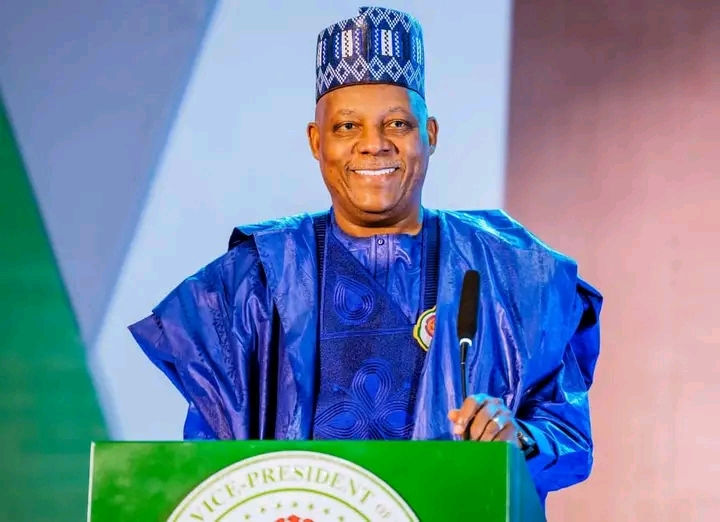
Vice President Kashim Shettima, announced this on Friday at the National Policy Forum on the Institutionalisation and Implementation of the Renewed Hope National Home Grown School Feeding Programme, held in Abuja.

The forum was hosted by the Presidential Committee on Economic and Financial Inclusion, in collaboration with ActionAid Nigeria and other stakeholders.

Represented by the Special Adviser to the President on Economic Affairs, Office of the Vice President, Dr. Kolade Fasua, Shettima said the expansion under President Bola Tinubu’s Renewed Hope Agenda, was the boldest yet in the history of the intervention.

He explained that the programme, relaunched earlier this year, is designed to improve school enrollment and learning outcomes while creating a guaranteed daily market for smallholder farmers, women entrepreneurs, and local processors.

“This year, the federal government relaunched the Renewed Hope National Homegrown School Feeding Programme, signalling a decisive return to scale and systemisation. The programme is designed to boost enrollment and attendance, improve academic performance, and raise smallholder incomes through stable local procurement.

“Alongside the core programme, the government has inaugurated the Alternate Education and Renewed Hope School Feeding Project, an expansion that targets out-of-school and highly vulnerable children, with the ambition of reaching up to 20 million by 2026”, he said.

With the integration of the National Identity Management Commission system, Shettima added, transparency would be assured so that “real pupils receive real meals, and every naira spent works twice—once for the child, and once for the local economy.”

See also  Rethinking the Mathematics exemption for art students

While acknowledging that sustaining nationwide coverage could cost as much as one trillion naira, the Vice President argued that the initiative should not be seen as a drain on public finances but as a nation-building investment.

“Ambition requires investment, and the federal government has acknowledged that sustaining national coverage may require around one trillion naira.

“But this is not a cost. It is a nation-building investment with high social, economic, and security return. This is why the school feeding must be understood not just as a social intervention but as a national security investment”, he stressed.

According to him, every hot meal served in a classroom also acts as a barrier against recruitment into violent groups, a reinforcement of the state’s presence, and a source of hope in conflict-prone communities.

“A child with knowledge is less vulnerable to exploitation. A farmer linked to a market is less vulnerable to despair. Communities where youth are engaged are less vulnerable to insecurity

“By bringing MSMEs, women, and vulnerable households into the financial system, we shrink the shadows in which insecurity grows. When local markets thrive, when farmers see guarantees in demand, when cooks receive fair and timely pay, and when women micro-entrepreneurs build assets, the drivers of conflict weaken,” Shettima said.

He urged development partners, private investors, and state governments to align with the federal government’s vision, saying the success of the scheme would be measured not just in hunger-free classrooms but also in safer, more resilient communities.

In his keynote address, the Minister of State for Humanitarian Affairs and Poverty Reduction, Dr Tanko Sununu, represented by Director, Social Development, Mr. Valebtine Ezulu, called for a National Home Grown School Feeding Act that will provide legal backing for the programme.

See also  See the ‘billionaire’ scheme driving students into debt, prostitution

He further recommended the development of a nutrition guideline, in line with global best practices, to ensure safe and healthy feeding for the children.

“We must work towards enacting a National Home Grown School Feeding Act that guarantees continuity across political cycles, while clearly defining federal, state, and local roles within a cost-sharing framework.

“A National Nutrition Guideline for Home Grown School Meals, aligned with international best practices, must be developed and enforced to guarantee safe, balanced, and quality meals for every child”, Ezulu said.

FOLLOW US ON:

FACEBOOK

TWITTER

PINTEREST

TIKTOK

YOUTUBE

LINKEDIN

TUMBLR

INSTAGRAM

Continue Reading
Click to comment

Leave a Reply

Your email address will not be published. Required fields are marked *

Education

OAU has fulfilled founding fathers’ vision, says TETFund boss

Published

on

The executive secretary, Tertiary Education Trust Fund, Sonny Echono, has said the Obafemi Awolowo University (OAU), Ile-Ife, Osun State, has lived to the ideals of its founding fathers, breeding experts in various fields of human endeavors.

Echono, while delivering a lecture to mark the 65th anniversary of Obafemi Awolowo University, Ile-Ife, Osun State, also said investment in research and innovation systems will generate practical solutions suited to local realities.

The TETFUND boss, in the copy of the paper obtained in Osogbo on Friday, paid glowing tributes to the pioneer and successive Vice Chancellors of the university for sustaining the legacies of the university’s founding fathers.

“The Great Ife has remained a symbol of commitment and purposeful leadership. Expectedly, the university has lived to the ideals of its founding fathers as the breeding ground for erudite scholars, legal luminaries, successful businessmen, diplomats, accomplished technocrats and administrators, including its legion of Nigerian National Merit Award Winners, who are contributing to national development, and have continued to uphold the reputation of the university,” he said.

Speaking on the concept of research and innovation, Echono noted that research and innovation remain key drivers of national development, saying nations that have achieved sustained economic growth and technological advancement have done so through deliberate investment in knowledge generation, scientific inquiry, and practical innovation.

He added that in present day global economy, development does not depend on natural resources, but on the capacity to create, apply, and commercialize knowledge.

“Research and innovation remain key drivers of national development. Nations that have achieved sustained economic growth and technological advancement have done so through deliberate investment in knowledge generation, scientific inquiry, and practical innovation.

See also  See the ‘billionaire’ scheme driving students into debt, prostitution

“In today’s global economy, development does not depend on natural resources but on the capacity to create, apply, and commercialize knowledge. Nigeria’s developmental challenges, though significant, also present opportunities for innovation-driven transformation.

“Addressing issues such as unemployment, insecurity, hunger, healthcare limitations, industrial underdevelopment, and technological dependence requires sustained investment in research and innovation systems that generate practical solutions suited to local realities,” Echono said.

Commending President Bola Tinubu for focusing on research and innovation that can provide solutions to challenges peculiar to the country and her people, Echono also stressed that building a fully functional and innovation-driven economy requires deliberate efforts to address issues of funding constraints, insufficient infrastructure, inadequate motivation, limited academia-industry collaboration, and challenges in commercialising research outputs.

He emphasised that the role of TETFund in enhancing the capacity of tertiary institutions in the country for research and development through its interventions activities has become increasingly strategic for strengthening Nigeria’s research and innovation ecosystem.

He further said that by supporting research funding, academic capacity development, innovation hubs, commercialisation initiatives, and entrepreneurship programmes, TETFund has been repositioning institutions in the country as active contributors to national development.

He declared that Nigeria’s “Sustainable development largely depends on how effective we are at leveraging knowledge, innovation, and technology to grow national economy, expand opportunities, create jobs and wealth, develop new products and services and improve the well-being of its people. This is essential for national growth, competitiveness, and long-term stability.”

Earlier, the Vice Chancellor of the university, Prof Simeon Bamire, said the institution has been recording steady growth since it’s establishment about 65 years ago and commanded the sacrifices and commitment of staff members and students towards sustaining legacies of excellence OAU is reputed for.

See also  Land grabbers, illegal occupants taking over Osun varsity land – Vice-Chancellor

The PUNCH reports that Bamire announced plans to unveil the N10bn President Bola Ahmed Tinubu Centre of Excellence in Intercultural Dialogue and Youth Empowerment on June 8 as part of activities marking the institution’s 65th anniversary.

Bamire said the centre was designed to serve as a platform for research, dialogue, leadership development, innovation and youth empowerment.

punch.ng

FOLLOW US ON:

FACEBOOK

TWITTER

PINTEREST

TIKTOK

YOUTUBE

LINKEDIN

INSTAGRAM

Continue Reading

Education

UNIPORT names ex-Rivers health commissioner new vice-chancellor

Published

on

The University of Port Harcourt has approved the appointment of Professor Princewill Chike as the 10th Vice Chancellor of the institution.

Chike was the Rivers State Commissioner for Health during the administration of Governor Nyesom Wike.

He will succeed the outgoing Vice Chancellor, Prof. Owunari Georgewill, whose tenure will elapse on July 13.

Georgewill, who is the 9th VC of UNIPORT, will preside over his last convocation ceremony scheduled for Friday, June 5 and Saturday, June 6, 2026.

The university, in a statement issued in Port Harcourt on Thursday, said Chike’s appointment was approved by the institution’s governing council following a selection process.

The statement titled ‘University of Port Harcourt Appoints Professor Princewill R. Chike as 10th Vice-Chancellor was signed by the Public Relations Officer of UNIPORT,  Dr  Sam Kpenu.

The statement reads, “The Governing Council of the University of Port Harcourt has approved the appointment of Professor Princewill R. Chike as the 10th Vice-Chancellor of the University.

“The appointment was made by the 17th Governing Council following the successful conclusion of the selection process.

“The process was conducted in strict compliance with the provisions of the Universities (Miscellaneous Provisions) Act and the University of Port Harcourt Act.

“It involved the constitution of a Search Team and a Joint Council-Senate Selection Board, which carried out their responsibilities in accordance with the extant laws and regulations governing the appointment of Vice-Chancellors in Nigerian universities.

“The Pro-Chancellor and Chairman of the Governing Council, Senator Mao Ohuabunwa, congratulated Professor Chike on his appointment and expressed confidence in his ability to provide visionary leadership for the continued growth and development of the university.

See also  Reps seek urgent upgrade of ABU, UI, UNN

“Professor Princewill R. Chike is expected to formally assume office as the 10th Vice-Chancellor of the University of Port Harcourt on 13 July 2026.”

Continue Reading

Education

ASUP gives 21-day ultimatum to poly over poor welfare

Published

on

The Academic Staff Union of Polytechnics (ASUP), Federal Polytechnic Ngodo-Isuochi chapter, Abia State, has issued a 21-day ultimatum to the institution’s management over alleged non-implementation of staff welfare demands and breach of statutory obligations.

The ultimatum was contained in a letter addressed to the Rector Dr. Pdi Ndubuisi, dated May 26, 2026, which was jointly signed by the ASUP chairman in the institution, Mr Ador Osundu; and secretary, Mr Onyeneke Arrhenius.

In the letter sighted on Monday, the union’s executive stated that repeated efforts through dialogue, congresses, and official correspondence to draw the attention of the institution’s management had failed to yield action, creating “industrial tension, eroding trust, and threatening the stability of the institution”.

ASUP warned that failure to resolve the issues within 21 days would compel it to activate “all lawful trade union mechanisms, including industrial action”.

The body added that the ultimatum, adopted at the union’s congress on May 22, 2026, takes effect from the date of receipt of the letter (May 26).

ASUP listed six unresolved issues, citing violations of Nigerian labour, health, and anti-corruption laws.

The union accused management of failing to invite the National Housing Fund (NHF) officials for staff sensitisation and enrolment in violation of the National Housing Fund Act, which mandates employer cooperation in deductions and remittances.

Management was also faulted for not facilitating the National Health Insurance (NHIA) enrolment for staff, denying access to affordable healthcare guaranteed under the National Health Insurance Authority Act 2022 and the National Health Act 2014.

ASUP equally raised concerns over alleged diversion of funds approved for a borehole project into a personal account.

See also  2025 WASSCE: Stakeholders blast WAEC, demand investigations, sanctions

“We call for an independent audit of the project fund, failure to do that will force us to petition the Independent Corrupt Practice Commission and the Economic and Financial Crimes Commission,” the lecturers stated.

The union decried what it called a chronic shortage of essential drugs and medical supplies at the health centre, describing it as a failure of the institution’s duty of care. It demanded immediate restocking and engagement of competent medical personnel.

The union expressed dissatisfaction over management’s failure to remit deducted check-off dues from February 2026 till date, calling it a violation of the Trade Unions Act and Section 40 of the 1999 Constitution.

“The union remains open to negotiation until the ultimatum expires, should management invite its leadership for talks.

“As we await management’s action, ASUP reaffirms its commitment to industrial peace, staff welfare, and institutional progress,” the letter stated.

When contacted the Public Relations Officer of the Polytechnic Dr Mrs Anukaenyi Blessing, said she cannot comment on the petition because she is not a member of the management board of Institutions.

punch.ng

FOLLOW US ON:

FACEBOOK

TWITTER

PINTEREST

TIKTOK

YOUTUBE

LINKEDIN

INSTAGRAM

Continue Reading

Trending