
Connect with us

News

US sending 3 warships, 2,500 Marines to Middle East amid escalating Iran conflict

Published

on

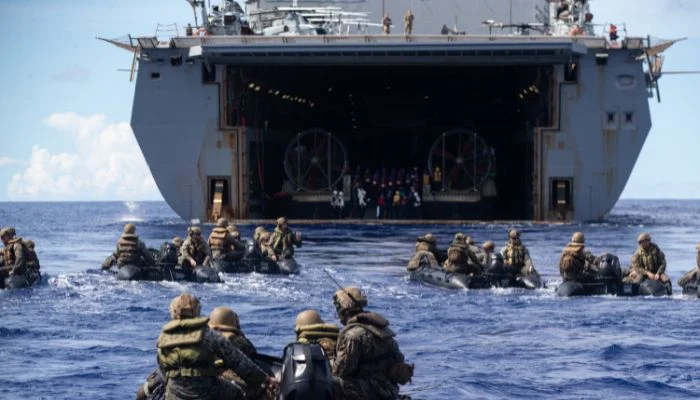
The United States is deploying an amphibious assault ship along with thousands of Marines and sailors to the Middle East, according to U.S. officials, as tensions with Iran continue to escalate.

The move comes amid efforts by Washington to respond to the ongoing conflict involving Iran and Israel, which is approaching its fourth week.

Officials said the additional troops are being sent aboard a large naval vessel, though their exact mission has not been disclosed.

The deployment follows earlier reports that the U.S. was considering various military options, including possible operations aimed at reopening the Strait of Hormuz, which has been effectively shut by Iran since the conflict began.

Oil prices have surged significantly since the start of the war, raising concerns about global economic stability.

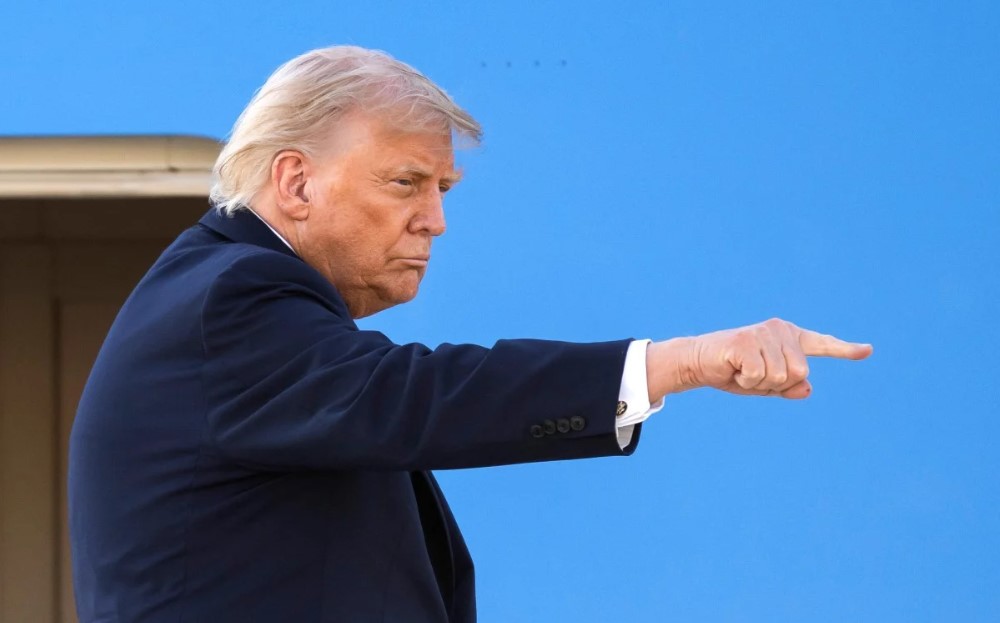
U.S. President Donald Trump also criticised allied nations for declining to assist in reopening the vital waterway, warning that their stance would not be forgotten.

Meanwhile, Iran’s new supreme leader, Mojtaba Khamenei, called for national unity and resistance in a message marking the Persian New Year, known as Nowruz.

Despite the ongoing conflict, the region continues to observe major celebrations, including Eid al-Fitr, marking the end of Ramadan.

Energy markets remain volatile, with Brent crude trading near $110 after earlier surges driven by fears of prolonged disruption.

FOLLOW US ON:

FACEBOOK

TWITTER

PINTEREST

TIKTOK

YOUTUBE

LINKEDIN

See also  See how FG moves to recover unremitted funds before April
Continue Reading
Click to comment

Leave a Reply

Your email address will not be published. Required fields are marked *

News

Iran Warns UK That Allowing US To Use British Bases Is Participation In Aggression

Published

on

Iran’s foreign minister has warned the United Kingdom that Tehran considers Britain’s decision to allow the United States to use British military bases as “participation in aggression.”

Seyyed Abbas Araghchi criticised the UK’s “negative and biased” stance toward the US-Israeli assault on Iran during a call with his British counterpart.

Araghchi warned that granting America access to UK bases “will certainly be considered participation in aggression.”

However, in response to the allegation, a spokesperson of the UK Prime Minister told reporters the UK granted the United States access only “for a specific defensive and limited purpose” in response to Iran’s strikes across the Middle East.

“Our position has been crystal clear from the outset. We didn’t participate in the initial strikes, and we’re not getting drawn into the wider war,” the spokesperson said.

According to reports, the British Prime Minister Keir Starmer initially refused Washington’s request to use UK military bases for its attacks on Iran, with the PM considering the strikes illegal.

However, Starmer joined the defence against Iran’s retaliation after Iranian forces attacked British military assets in the Middle East.

It was reported earlier that Starmer said his country accepted a United States request to use British bases for defensive strikes against Iranian missiles in storage depots or launchers.

“The United States has requested permission to use British bases for that specific and limited defensive purpose. We have taken the decision to accept this request to prevent Iran firing missiles across the region,” Starmer said at the time.

See also  Borno terror attack victims hospitalised in Cameroon

Tehran’s warning escalates diplomatic tensions between Iran and Britain as the conflict between Iran and the United States and Israel enters its fourth week.

FOLLOW US ON:

FACEBOOK

TWITTER

PINTEREST

TIKTOK

YOUTUBE

LINKEDIN

Continue Reading

News

British Government Gives US Permission To Strike Iranian Missiles Sites Targeting Ships From UK Bases

Published

on

The British government authorised the United States on Friday to use military bases in Britain to strike Iranian missile sites attacking ships in the Strait of Hormuz, a decision that prompted Iran to warn the move constitutes “participation in aggression.”

According to a British spokesperson, ministers met on Friday to discuss the war with Iran and Iran’s blocking of the Strait of Hormuz.

“They confirmed that the agreement for the US to use UK bases in the collective self-defence of the region includes US defensive operations to degrade the missile sites and capabilities being used to attack ships in the Strait of Hormuz,” the statement said.

It was reported earlier that Iran’s foreign minister, Seyyed Abbas Araghchi, warned the United Kingdom that Tehran considers Britain’s decision to allow America to use British military bases as “participation in aggression.”

Araghchi criticised the UK’s “negative and biased” stance toward the US-Israeli assault on Iran during a call with his British counterpart following Friday’s authorisation.

Starmer Reverses Earlier Position On Base Use
Prime Minister Keir Starmer said earlier this week Britain would not enter a war over Iran. He initially rejected an American request to use British bases for strikes on Iran, saying he needed confirmation that any military action was legal.

However, Starmer changed his stance after Iran conducted strikes on British allies across the Middle East, allowing America to use RAF Fairford and Diego Garcia, a joint US-UK base in the Indian Ocean.

It was gathered that President Donald Trump has repeatedly attacked Starmer since the conflict started, complaining he was not doing enough to help America.

See also  See how FG moves to recover unremitted funds before April

On Monday, Trump said there were “some countries that greatly disappointed me” before he singled out Britain, which he said had once been considered “the Rolls-Royce of allies.”

Meanwhile, the British spokesperson’s statement on Friday called for “urgent de-escalation and a swift resolution to the war.”

The authorisation now expands Britain’s involvement in the Middle East conflict beyond defensive operations. The UK previously limited its participation to intercepting Iranian missiles and drones threatening British military assets and allies in the region.

In response to what Iran tagged “agression “ it has effectively halted oil passage through the Strait of Hormuz, sparking a global energy crisis as the waterway serves as the route for roughly one-fifth of the world’s oil supplies.

The conflict between Iran and the United States and Israel enters its fourth week with casualties mounting on both sides.

FOLLOW US ON:

FACEBOOK

TWITTER

PINTEREST

TIKTOK

YOUTUBE

LINKEDIN

Continue Reading

News

Why Military Alone Can’t Solve Nigeria’s Insecurity Problem – Buratai

Published

on

A former Chief of Army Staff, Lt.-Gen. Tukur Buratai (rtd), has warned that depending only the Nigerian Army to address the insecurity situation in the country is not a wholesome approach.

Speaking in a recent interview on Channels Television, he argued that the fight against insurgency must involve every sector of the country.

Buratai pointed out that while troops have remained consistent in their field operations across various flashpoints, their efforts must be backed by improved governance, economic growth, and social programs from other government institutions and stakeholders.

According to him, although troops have continued operations in affected areas, efforts from government agencies, communities and other sectors are needed through governance, development and social programmes.

“The whole country is over-relying on the military,” he said, noting that several agencies and tiers of government have specific responsibilities in tackling insecurity.

The former army chief recalled that Nigeria’s National Security Strategy 2019 had already provided a broad plan that includes economic, social and infrastructure-based solutions.

However, he questioned whether the strategy has been consistently implemented over time.

He pointed out that ending insurgency goes beyond combat, adding that issues such as unemployment, poverty and poor infrastructure contribute to instability.

According to Buratai, the keys to defeating insurgency lie in fixing the root causes of unrest, such as poverty, unemployment, and the lack of basic amenities. He specifically mentioned that the dilapidated state of roads in conflict zones is a major setback for the military.

“In some instances, an operation that should take two hours could take up to five hours due to bad roads,” he said, adding that such delays create opportunities for insurgents to plant explosives and stage ambushes.

See also  Oyo Obas Back Ladoja As Council Chairman

He noted that improving infrastructure, especially roads, would boost military effectiveness and reduce risks faced by personnel in the field.

Buratai also urged state governments to take stronger steps in addressing the root causes of insecurity by focusing on youth development.

He said engaging young people through job creation, skills training, and economic empowerment is important in preventing their involvement in violent activities.

FOLLOW US ON:

FACEBOOK

TWITTER

PINTEREST

TIKTOK

YOUTUBE

LINKEDIN

Continue Reading

Trending