Connect with us

Lifestyle

When the dock boils over: Rise of unruly defendants in court

Published

on

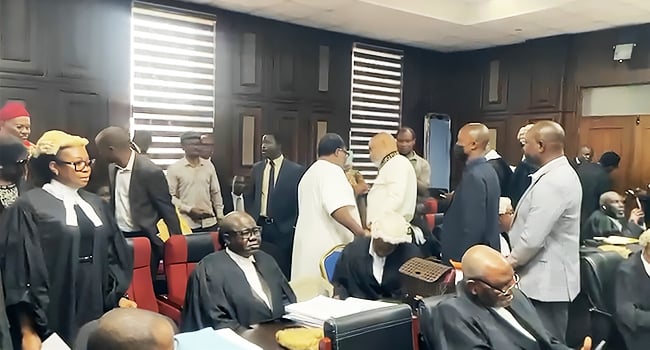
On a humid Thursday morning in Abuja, the atmosphere inside the Federal High Court was unusually tense.

Security operatives from the Department of State Services and the courtroom security, alongside lawyers, journalists, and a few friends and family of the defendant, were present in the courtroom.

In the witness box, the leader of the proscribed Indigenous People of Biafra, Nnamdi Kanu, was standing, awaiting the court’s decision regarding the 10-year-long trial on terrorism-related charges preferred against him by the Federal Government.

As soon as the judge made his entrance and sat on his chair, Kanu yelled, “There is no judgment here today. There is not going to be judgment here.”

The trial judge, Justice James Omotosho, however, responded by calling for decorum. He asked Kanu to wait for the case to be called before making any arguments.

After the case was called, Justice Omotosho addressed applications filed before the court and delivered a ruling dismissing three fresh motions filed by Kanu on the ground that they were unmeritorious.

After delivering the ruling, Justice Omotosho declared readiness to proceed with the judgment

However, Kanu interjected, insisting that the court could not continue because he had not filed his final written address.

The defendant suddenly erupted in anger, charged at the trial judge, and accused him of being biased and not knowing the law, among other utterances.

Kanu said, “Which law states that you can charge me on a repealed law? Show me. Omotosho, where is the law? Show me the clause in the Constitution that says so. Show me, but you can’t show me, and you claim to be a judge. Any judgment declared in this court is complete rubbish! You don’t know the law.”

At this point, the court froze, and surprise was registered on the faces of the journalists who looked up from their notepads.

The trial judge momentarily paused.

Kanu’s rage did not allow the proceedings to continue as he would not let the judge speak.

Of course, the judge could not engage in a shouting match with him, so the court rose, and Justice Omotosho went into his chamber.

Upon his return to the courtroom after about 20 minutes, the prosecution prayed the court to deliver the judgment in the absence of the defendant, citing his misconduct in the temple of justice.

While Justice Omotosho noted that it was the constitutional right of a defendant for trial to be conducted in his or her presence, he, however, noted that in a situation where the defendant misconducted himself or acted in an unruly manner during the course of the trial, the trial could be conducted in the defendant’s absence.

See also  Olabisi Ajala and Jawaharlal Nehru: A Meeting of Wanderlust and World Leadership (PHOTOS)

He proceeded to order that Kanu be taken out of the courtroom for the rest of the proceedings.

“I hereby make an order because of the unruliness of the defendant. I hereby declare that the judgment and other proceedings be made in his absence,” he said.

After the order was given, as the operatives attempted to lead Kanu out of the courtroom, he barked at them, “Don’t touch me, don’t touch me!”

Pushing their hands away and further threatening, “If you touch me!”

Scenes like this, once unthinkable in Nigeria’s traditionally solemn courtrooms, are becoming increasingly common.

From the outbursts of IPOB leader Nnamdi Kanu, to the theatrics of high-profile politicians, to lesser-known suspects defiantly resisting their arraignment, courtroom misbehaviour is turning trials into public spectacles, raising questions about legal order, state power, mental strain, and the evolving nature of justice in the media age.

This is a deep dive into the trend, rich with examples. In the past, Kanu has had similar outbursts in the court of Justice Binta Nyako.

He yelled and demanded her recusal, stating that he had lost faith in her as a presiding judge over his matter and that he should be assigned another one. He shoved and pushed security operatives, slapped his counsel to keep quiet and not speak while he was speaking, among other actions.

Even in October, Kanu shouted over the judge, repeatedly refusing to take his plea. At one point, he attempted to walk out of the dock until armed officials physically returned him.

Court insiders say the outburst may have been calculated to delay proceedings, create sympathy narratives online, or challenge the legitimacy of the charges.

Kanu’s court appearances have repeatedly attracted controversy. His refusal to appear properly in court, clashes between security personnel and his supporters, and his public disagreements with legal procedures have contributed to one of the most dramatic courtroom sagas in Nigeria.

In several instances, judges warned him and his supporters for disruptions ranging from chants outside the courtroom to verbal protests inside it.

It is not only high-profile defendants who exhibit these unruly tendencies. Magistrate courts in Lagos, Port Harcourt, and Kano have also reported cases of defendants fighting police officers during arraignments; individuals spitting on magistrates; suspects stripping themselves in protest; and family members charging at court officials.

See also  Queen Salawa Abeni: The Life, Family, and Legacy of Waka Music’s Crowned Monarch

A particular case from a Lagos magistrate court showed a robbery suspect screaming and rolling on the floor, shouting, “They forced me to confess!” as proceedings struggled to continue.

Legal psychologists and criminologists identify several overlapping factors contributing to this trend. They point to high emotional pressure, tactical disruption, mental health strain, and media-driven behaviour.

Nigeria is not alone. Courtroom misbehaviour is a global phenomenon, even though the context differs.

In Chicago, United States of America, a murder suspect in 2021 had to be gagged and cuffed after repeatedly insulting the judge.

In Florida, a defendant physically attacked his attorney during trial, prompting enhanced security nationwide.

In South Africa, the Marikana trial was disrupted by family protests, shouting bouts, and walkouts during several hearings connected to the killings.

In the United Kingdom, the “No-Law Movement” defendants, also known as “sovereign citizens,” disrupted hearings by refusing to recognise court authority and shouting scripted arguments.

During the trials of Alexei Navalny in Russia, defendants and supporters regularly staged gestures of defiance inside courtrooms to attract international media attention.

Nigeria, experts say, is experiencing its own version, shaped by politics, public distrust, and a highly charged information ecosystem.

As Nigeria’s politics intensify, economies strain, and social distrust deepens, the courtroom has become not just a legal arena, but a stage.

A stage where defendants attempt to sway public narratives, challenge authority, or simply release pent-up frustration.

For judges and attorneys, the challenge is maintaining dignity and order. For society, it is understanding that justice requires calm, something increasingly rare inside Nigeria’s courtrooms.

Yet, despite the theatrics, one truth remains: the courtroom must never become a battleground.

As stressed by Justice Omotosho, the court is a temple of Justice. Institutions must be respected.

Some Senior Advocates, speaking on defendants becoming unruly during trial, stated that it is contempt of court, adding that in the case of Kanu on Thursday, the judge acted within the law.

Lekan Ojo (SAN) said Kanu’s conduct was a valid ground in law to exclude him from the courtroom during proceedings.

“The unruly behaviour of the defendant… where a defendant in a criminal case behaves in an unruly manner, that has always been a valid reason to dispense with his presence,” Ojo said.

See also  PHOTOS: The Shocking and Unbelievable Story of Jesu Oyingbo – Lagos’ Self-Proclaimed Messiah

He explained that the Administration of Criminal Justice Act 2015 permits trial in absentia in exceptional circumstances, noting that Justice Omotosho acted within the law.

Another senior lawyer, Adedayo Adedeji (SAN), described Kanu’s actions as contempt in the face of the court.

“No matter the reservations you have about the proceedings or the judge, there is a lawful procedure to follow. Not coming out, insulting the judge, or insulting the court… that’s contempt,” he said.

Adedeji praised the judge for handling the situation with maturity. “He is the master of his court… and acted within his inherent powers,” he added, warning that justice must be done not only for the defendant, but for the state and the public.

Kunle Adegoke (SAN) said defendants sometimes act unruly to win public sympathy, stressing that such conduct ultimately works against them.

“The one that happened yesterday has been quite unfortunate… it has been the attitude of the defendant to be unruly in court, and that does not promote his interest,” he said.

Adegoke dismissed suggestions of mental instability, adding that Kanu’s behaviour was a continuation of what he described as “outrageous, unguarded, and unruly” conduct.

Also commenting, Simon Lough (SAN) attributed Kanu’s outburst to frustration, arguing that the delays in the case resulted largely from multiple applications filed by his legal team.

“He feels frustrated… but those delays were caused by his lawyers,” Lough said.

He noted that many Nigerians were unaware of the scale of the offences alleged against Kanu, which, according to him, included the killing of 128 police officers, the destruction of 180 police stations, and the theft of thousands of arms and ammunition.

“So, his outburst was unnecessary… you don’t misbehave in court. The court is a sacred place,” Lough said, commending the judge for acting as an “unbiased umpire.”

Justice Omotosho went on to convict Kanu on all terrorism-related charges and sentenced him to life imprisonment. The court ordered that he be removed from the courtroom while judgment was being delivered after he repeatedly shouted at the judge and disrupted proceedings.

The senior lawyers agreed that the judge showed restraint and acted within his constitutional and statutory powers.

punch.ng

FOLLOW US ON:

FACEBOOK

TWITTER

PINTEREST

TIKTOK

YOUTUBE

LINKEDIN

TUMBLR

INSTAGRAM

Continue Reading
Click to comment

Leave a Reply

Your email address will not be published. Required fields are marked *

Lifestyle

Emir of Ilorin greets Muslims on Islamic New Year

Published

on

The Emir of Ilorin and Chairman of the Kwara State Traditional Rulers Council, Alhaji Ibrahim Sulu-Gambari, CFR, has congratulated the Muslim Ummah on the occasion of the Islamic New Year, 1st Muharram, 1448 A.H.

He noted that the migration of Prophet Muhammad (SAW) from Makkah to Madinah established the foundation for justice, brotherhood, and community building, as well as values that are urgently needed for global peace.

Sulu-Gambari stated this in a goodwill message issued on Tuesday by his spokesman, Abdulazeez Arowona, describing the Hijrah as a timeless reminder of sacrifice, perseverance, and faith in Allah’s divine plan.

The monarch noted, “Hijrah teaches us that hard times do not last forever. As we enter 1448 A.H., I urge Muslims to renew their commitment to piety, peaceful coexistence, and service to humanity.”

He appealed to Nigerians to use the new year to pray for peace, unity, and economic prosperity at all levels, while urging religious and political leaders to avoid divisive utterances capable of causing rancour in society and to promote messages that strengthen national cohesion.

The Emir further commended Governor AbdulRahman AbdulRazaq for his administration’s support for religious harmony and urged youths to emulate the discipline and courage of the early Muslims by shunning violence, drug abuse, and other social vices.

Sulu-Gambari also offered special prayers for the repose of the soul of the late Prof. Yusuf Lanre Badmos, whose relentless efforts, scholarship, and devotion to the National Hijrah Organisation, Kwara State Chapter, significantly advanced the commemoration of Hijrah and the propagation of Islamic values during his lifetime.

See also  PHOTOS: The Shocking and Unbelievable Story of Jesu Oyingbo – Lagos’ Self-Proclaimed Messiah

He prayed that Almighty Allah (SWT) forgive his shortcomings, accept his good deeds, and grant him Al-Jannatul Firdaus.

“May the New Year inspire us to be our brother’s keeper. I pray Almighty Allah (SWT) grants us good health, abundant blessings, and accepts our acts of worship,” the Emir added.

punch.ng

FOLLOW US ON:

FACEBOOK

TWITTER

PINTEREST

TIKTOK

YOUTUBE

LINKEDIN

INSTAGRAM

Continue Reading

Lifestyle

One year after 272 massacred, fear still rules Yelewata

Published

on

How much has changed since that tragic night of June 13, 2025? Have the survivors of the massacre found healing and security, or are they still trapped by fear, poverty and painful memories? JOHN CHARLES visited Yelewata on Saturday and reports on a community still searching for answers

In Yelewata, memories do not live in photographs alone; they stand in burnt walls, empty compounds and the tears of survivors who still struggle to understand why hundreds of their neighbours never lived to see another sunrise.

The tears came without warning.

Standing before the charred remains of a house in Yelewata, Saaondo, a middle aged man, could no longer hold back the memories. Around him, prayers echoed from a memorial Mass organised to honour victims of the June 13, 2025 massacre. But for him, the tragedy was not history; it was a wound that reopened with every glance at the ruins.

A year ago, fate spared him. He had travelled out of the community just hours before armed attackers stormed Yelewata, killing hundreds and setting homes ablaze. Those he left behind never escaped.

Last Saturday, as the community marked the first anniversary of the attack, the sorrow was unmistakable. Behind the speeches, prayers and unveiling of a monument bearing 272 names was a painful reality: while the dead are being remembered, many survivors say they are yet to rebuild their lives.

One of the leaders of Yelewata community, Matthew Mnyan, noticed Saaondo standing alone and quietly approached him. Concerned, he asked why he had stepped away from the memorial Mass and appeared deeply troubled.

The man’s response was enough to melt even the hardest heart.

‘I would have died too’

Pointing to the burnt remains of a house nearby, Saaondo said, “I left this particular house for Makurdi on the eve of June 13. But all the occupants of the house were killed and burnt when the marauders invaded Yelewata. If I had been around that night, I would have been among those being remembered at this memorial today.”

His grief reflected the mood in Yelewata last Saturday as the once-sleepy community again played host to visitors from different walks of life. They had not come to celebrate a festival or honour a prominent figure. Rather, they had gathered to mark the first anniversary of the deadly attack that left the community devastated.

Yelewata, located along the Lafia-Makurdi Federal Highway in Guma Local Government Area of Benue State, came under a brutal attack on June 13, 2025. The assault, which reportedly lasted about four hours, drew national and international attention. Initial reports put the death toll at about 200.

See also  Olabisi Ajala and Jawaharlal Nehru: A Meeting of Wanderlust and World Leadership (PHOTOS)

However, with the unveiling of a memorial monument in honour of the victims during the first anniversary commemoration, the number of those killed was officially put at 272, including 67 children.

According to Franc Utoo, a native of the community and Director of Advocacy for the US-based non-profit organisation, Equipping The Persecuted, which funded the Yelewata Genocide Memorial Monument, the project was conceived to ensure that the victims are never forgotten.

“By choosing to erect this monument, the organisation affirms that those slain in Yelewata must never be reduced to a passing headline or anonymous casualty figures. They must be remembered with dignity, permanence and honour,” he said.

He added, “As the first monument of its kind in Benue State, it occupies a historic place in the moral landscape of remembrance. It preserves the names of the 272 members of the Yelewata community who were killed — 67 children, 83 women and 122 men — and places before the world a solemn record of lives violently taken.”

As residents and visitors marked the anniversary, it became evident that Yelewata is still struggling to recover from the tragedy. Twelve months after the attack, the scars remain visible and the pain is far from over.

Memorial service

Delivering his homily at the memorial Mass, the Catholic Bishop of Makurdi Diocese, Most Rev. Wilfred Anagbe, called on government at all levels to adopt a deliberate policy of resettling displaced persons in their ancestral communities rather than keeping them indefinitely in makeshift Internally Displaced Persons camps.

According to the bishop, the continued confinement of displaced persons in camps for fear of further attacks amounts to a defeatist approach and projects the government as powerless in the face of insecurity.

He argued that keeping otherwise productive members of communities in camps where they depend largely on charity is counterproductive to their physical and psychological well-being and ultimately undermines their dignity.

Anagbe also faulted the Benue and Nasarawa State governments for what he described as negligence, accusing them of failing to act on intelligence reports that allegedly warned of the impending attack on Yelewata.

Despite the tragedy, the bishop commended the resilience of the people of Yelewata, noting that they have remained steadfast in the face of immense physical and psychological trauma.

See also  Queen Salawa Abeni: The Life, Family, and Legacy of Waka Music’s Crowned Monarch

He assured them that the Christian community across the world continues to stand with them in prayer and solidarity.

Moro blasts FG

In his remarks, Senate Minority Leader Abba Moro criticised the Federal Government and Nigeria’s political class for what he described as their failure to fully appreciate the magnitude of the insecurity confronting the nation.

Moro accused the government of avoiding uncomfortable truths and warned that refusing to confront the problem head-on would not make it disappear.

Taking a swipe at the country’s political elite, he asked: “Can we, in all honesty, go around during campaigns and ask the people to vote for us again when the mandate already entrusted to us has not been effectively deployed for their well-being? We need to wake up.”

How are survivors faring?

For many residents, the first anniversary of the attack was not only a time to remember the dead but also an opportunity to draw attention to the plight of the living.

A community leader, Matthew Mnyan, painted a grim picture of life in Yelewata one year after the tragedy, lamenting that many survivors are still struggling to rebuild their lives.

According to him, poverty has deepened in the community, while insecurity remains a major concern.

He said residents still live in fear and cannot venture far from the community or freely access their farms because of persistent security threats.

Mnyan cited the case of a young girl who was allegedly sexually assaulted while fetching firewood in a nearby bush.

“People of Yelewata and neighbouring communities, especially Udei, are still living in fear. They cannot access their farms because of recurring attacks in the area,” he said.

“There is a case involving a young girl that I am still pursuing. She was sent to fetch firewood from a nearby bush and was allegedly molested by four suspected herders. Incidents like this show that our people are still vulnerable.

“The level of poverty has also increased because many people who relied on small-scale businesses and other means of livelihood have not been able to recover from the attack.”

Mnyan also criticised the Technical Committee on Donations for Internally Displaced Persons, headed by the Secretary to the Benue State Government, Deborah Aber, accusing it of not doing enough to alleviate the suffering of survivors.

“While the government may believe it has done a lot, many people in the community feel otherwise,” he said.

The community leader said residents had advised the state government on how best to utilise donations received from individuals and organisations, including the contribution made by the First Lady Oluremi Tinubu, but alleged that the funds had not been effectively deployed for the benefit of victims.

See also  Funsho Williams: The Man Who Could Have Become Governor of Lagos

In March this year, the Secretary to the State Government announced that the committee had received about N1.25bn in donations from various sources, including N1bn donated by the First Lady following the attack.

Mnyan said the community had proposed that a substantial part of the funds be used to resettle displaced residents and support their economic recovery.

“We suggested that some of the money should be given to affected persons as start-up capital for small businesses, while markets and other facilities that would help restore livelihoods should also be provided,” he said.

He further alleged that some of the beneficiaries selected by the committee were not among the names submitted by the community.

According to him, residents raised concerns that the list used for the distribution of assistance did not accurately reflect those affected by the attack.

Mnyan also questioned the quality of some of the housing projects being executed for displaced persons, alleging that some of the buildings had already begun to develop cracks.

He called on Governor Hyacinth Alia to personally visit the community and assess the situation on the ground.

“I am not sure the governor is fully aware of what is happening. I urge him to come and see things for himself, inspect the projects and hear directly from the people of Yelewata,” he said.

Mnyan further expressed concern that several directives issued by President Bola Tinubu during his condolence visit to Benue State had yet to be implemented.

However, the Benue State Emergency Management Agency presented a different account of the situation.

The agency’s Information Officer, Tena Ager, said some displaced persons from Yelewata had already been resettled, while others remained at the International Market IDP camp.

According to him, more than 1,000 completed housing units have been allocated to displaced persons, while the government has acquired additional land in the community for the development of social infrastructure, including a mosque, church, hospital and market.

“Government has also provided cash assistance and other relief materials to the people of Yelewata,” Ager said.

punch.ng

FOLLOW US ON:

FACEBOOK

TWITTER

PINTEREST

TIKTOK

YOUTUBE

LINKEDIN

INSTAGRAM

Continue Reading

Lifestyle

Actor Baba Ijesha welcomes baby boy

Published

on

Actor Olanrewaju Omiyinka, popularly known as Baba Ijesha, has announced the birth of his son.

The actor disclosed this in an Instagram post on Monday, sharing a maternity photoshoot featuring himself and his wife.

Expressing gratitude to God, Baba Ijesha revealed that the couple welcomed a baby boy named King Kagar Omiyinka.

He wrote, “In quiet ways, in unseen ways, God has been writing a story only He could tell. We thank the Almighty for blessing us with a healthy baby boy.

“God gave me more than I prayed for. My ever beautiful wife, strong Jagaban, Abikese de mi owo, @ceolumineeofficial, who became the mother of my son, King Kagar Omiyinka.”

The announcement attracted congratulatory messages from fans and colleagues in the entertainment industry.

Baba Ijesha was released from prison in November 2025 after serving a jail term following his conviction in a child sexual assault case.

See also  PHOTOS: The Shocking and Unbelievable Story of Jesu Oyingbo – Lagos’ Self-Proclaimed Messiah
Continue Reading

Trending