

Connect with us

Education

EU-Funded Shs1.64Bn Project to Equip Over 3,000 Accounting Students in Uganda,Nigeria with Real-World Skills

Published

on

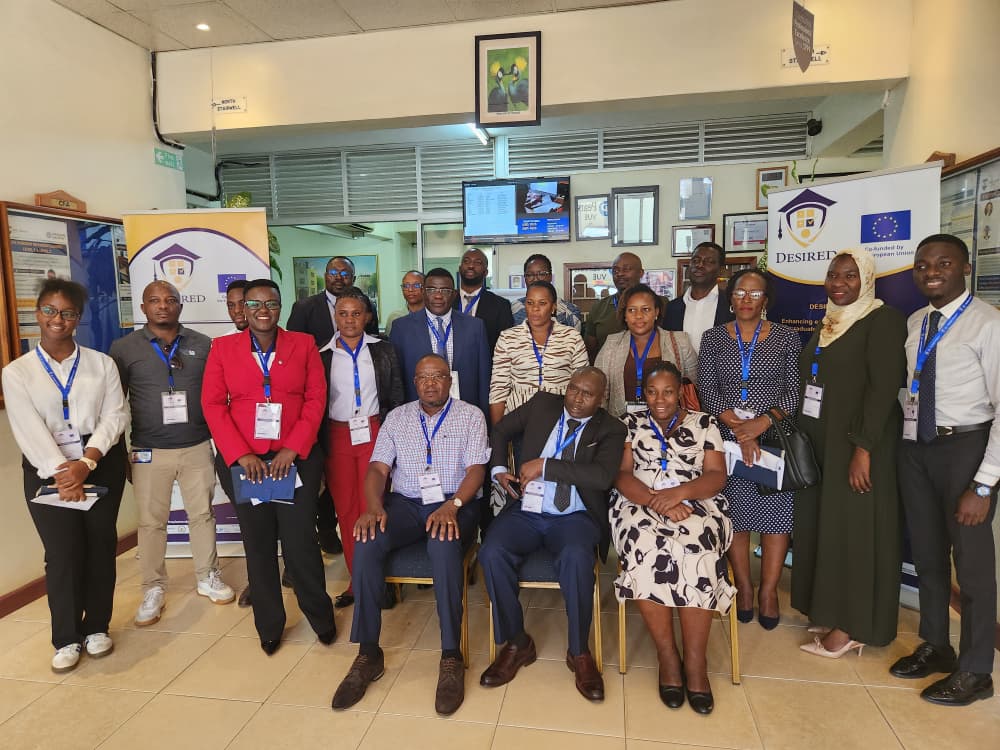
At least 3,000 students and academic staff across Uganda and Nigeria are set to benefit from the Developing Employability Skills in Accounting Education (DESIRED) project, a European Union-funded initiative aimed at ensuring accounting graduates are “work-ready” as they enter the labor market.

The project funded up to a tune of shs1.64billion( €400,000) was launched on Tuesday at MAT-Abacus Business School as part of the Erasmus+ Capacity Building in Higher Education (CBHE) Programme.

It brings together universities from Uganda, Nigeria, Portugal, and the Netherlands to integrate Work-Integrated Learning (WIL) into accounting education.

Speaking at the launch, Samuel Ssejjaaka, the project chair, highlighted the critical gap between university training and practical workplace demands.

“The idea is to ensure that when accountants finish their training, they have also acquired enough practical experience to take up jobs. We want them to be work-ready” he said.

He explained that the project will develop a framework for teaching students the real experience of the workplace.

“When we train students here, we train them on standards preparing books of accounts and so forth. But in the workplace, there are many other skills they are required to have, which are not necessarily part of the syllabus.”

Ssejjaaka also emphasized the impact of the project on employability rates among accounting graduates.

“With the funding we have received from the European Union, we can increase the employability of accountants. Right now, about 35% of graduates are not getting employed, and that all has to do with the issue of employability.”

See also  Nigeria emerges fifth-best English-speaking country in Africa

The DESIRED Project will employ internships, case studies, and experiential learning to give students exposure to real workplace scenarios, decision-making, and practical skills.

Twaha Kawaase, a certified accountant and project partner, highlighted the international collaboration underpinning DESIRED.

“We are here to launch a project which brings together countries in Europe – Portugal, Netherlands – and countries in Africa – Uganda and Nigeria – to ensure that accountants coming out of universities are work-ready.”

Kawaase explained the importance of preparing graduates for a changing workplace shaped by technology.

“This is a century where we are talking about artificial intelligence, where machines are trying to replace human beings, but human beings are irreplaceable. Therefore, we need to ensure that accountants are relevant in terms of accounting skills, communication skills, and other soft skills required by employers.”

He also spoke about the role of competency-based training in Uganda and the project’s role in standardizing practical skills.

“Universities must be ready, the training must be ready, and institutions like MAT-Abacus and various universities must ensure that students coming out are competent to work as expected by employers.”

Ayeza Mutegeki, a student at MAT-ABACUS, welcomed the project, highlighting its potential impact on students’ careers.

“I think that it would be very beneficial to every single accounting student. Why? Because of the kind of benefits that it provides in that it integrates work and study.”

She pointed out a major challenge facing students today. “The most common problem we have among students is that we do not have jobs. And why do we not have these jobs? It is because we do not have the expertise.”

See also  The First Graduating Set of Medical Doctors from University College, Ibadan, 1951

Ayeza emphasized how the program could bridge the gap between education and practical work experience.

“Yes, we have studied them. But the reality is that in the workplace, it is not exactly the same scenario. So I believe that this desired program will actually change the course of accounting students and furthermore enhance their education and work standards.”

The project consortium is led by MAT-Abacus Business School (Uganda) and includes Makerere University Business School (Uganda), Nnamdi Azikiwe University (Nigeria), Chukwuemeka Odumegwu Ojukwu University (Nigeria), Vrije Universiteit Amsterdam (Netherlands), and the University of Lisbon (Portugal). Key industry partners include the Uganda Chapter for Corporate Social Responsibility Initiatives (UCCSRI) and Sejjaaka, Kaawaase & Co., Certified Public Accountants.

The DESIRED Project seeks to bridge the gap between academic knowledge and practical skills, strengthen university-industry linkages, and ultimately ensure that graduates are employable and ready to thrive in a competitive labor market.

Source: Nilepost

FOLLOW US ON:

FACEBOOK

TWITTER

PINTEREST

TIKTOK

YOUTUBE

LINKEDIN

TUMBLR

INSTAGRAM

Continue Reading
Click to comment

Leave a Reply

Your email address will not be published. Required fields are marked *

Education

FG threatens closure of Almajiri centres violating standards

Published

on

The Federal Government has tightened enforcement measures in Almajiri learning centres nationwide, warning that non-compliance with newly established operational standards will attract sanctions, including closure.

Details of the measures are contained in the National Policy on the Enhancement of Almajiri Education in Nigeria, released by the Federal Ministry of Education last month and obtained by our correspondent on Tuesday.

The policy covers operations and management of all Almajiri learning centres, males and females, across the country.

At the centre of the policy is a set of mandatory standards that all learning centres must meet or risk suspension after a probation period of three to six months.

The framework, to be implemented by the National Commission for Almajiri and Out-of-School Children Education, introduces stricter regulation of the system, long criticised for neglect and abuse.

Under the new rules, all Almajiri centres are required to register with relevant state or local authorities and maintain comprehensive records of learners, including biometric data, to enhance monitoring and accountability.

Operators must also submit periodic reports and allow routine inspections by government agencies.

“Any learning centre that fails to comply with the provisions of this policy shall be given a probation period of three to six months; thereafter, appropriate action shall be taken, such as sanction from operation,” the policy report stated.

It explicitly bans the practice of sending learners to beg on the streets, a long-standing feature of the system.

“Any registered learning centre that sends learners out to beg shall face appropriate action, such as a sanction from the operation,” it added.

See also  Benin varsities, Nigerian polys in NYSC fraud

In addition, the government has set minimum welfare and health standards.

Learners and facilitators are now required to undergo periodic medical checks at recognised public health facilities, while centres must be linked to nearby healthcare providers and equipped with basic first aid kits.

“New entrants shall have the following basic needs as conditions for enrolment: a minimum of three items of clothing; two pairs of footwear; an eating plate and cutlery; writing materials as applicable or appropriate,” the policy outlined.

Clear age limits have also been introduced, restricting enrolment in day centres to children aged four to 18, while boarding facilities are limited to those between 12 and 18 years.

Adult learners, the policy states, must be taught separately.

To address concerns over poor learning outcomes, the government has mandated a uniform but expanded curriculum.

“Literacy and Numeracy shall be infused into the curriculum of the Almajiri teaching and learning. Relevant digital skills shall be included in the training of the facilitators and learners.”

Infrastructure requirements have also been standardised.

“At least one toilet for a population of not more than 25 Almajiri/Almajira learners. Adequate water supply to the Learning Centre. Learning centre shall be adequately ventilated,” it added.

The policy also introduces gender-sensitive provisions, mandating separate learning spaces for male and female learners.

“There shall be a separate learning space for male and female learners,” it stated, adding that operational guidelines now require centres to adhere to approved academic calendars and open their operations to oversight.

“Learning centres shall open doors for supervision and monitoring by the appropriate LGA, state/FCT or federal authority as may be required.”

See also  Secondary Schools with unqualified teachers to lose WAEC and NECO accreditation – FG

Officials said failure to comply with any of these provisions would trigger enforcement actions, stressing that the sanctions regime is designed to compel adherence and eliminate exploitative practices.

The government noted that the reforms build on earlier interventions by the National Commission for Nomadic Education and the Universal Basic Education Commission, but acknowledged that gaps in regulation and implementation have allowed the system’s challenges to persist.

It added that while the policy does not seek to take over Almajiri learning centres, strict enforcement of the new standards is necessary to safeguard learners, improve education quality and address the growing number of out-of-school children linked to the system.

The Almajiri system, which dates back several centuries in northern Nigeria, traditionally involves young boys leaving their homes to study the Quran under the guidance of a Mallam (teacher).

Learners often live with their Mallam or in small communal hostels, relying on alms or contributions from the community for food and basic needs.

Over time, the system has faced widespread criticism for exposing children to poverty, neglect, street begging, and exclusion from formal education.

Previous attempts to regulate Almajiri centres have met with limited success due to inconsistent oversight, inadequate funding, and, in some areas, cultural and religious resistance. Advocates for reform argue that formalising the system, integrating modern education, and enforcing welfare standards are essential to protect vulnerable children and reduce the number of out-of-school youths across northern Nigeria.

Continue Reading

Education

Over 10,000 register for teachers’ qualifying examination

Published

on

No fewer than 10,000 teachers across Nigeria have registered on the Teachers Registration Council of Nigeria digital portal for the May 14–16, 2026, Batch A Professional Qualifying Examination.

The Registrar and Chief Executive of TRCN, Dr Ronke Soyombo, told The PUNCH on Tuesday that the development reflected growing acceptance of the platform and its capacity to handle nationwide registration and licensing processes.

The TRCN digital portal was launched in September 2025 with the support of the Minister of Education, Dr Maruf Alausa.

It represents a major milestone in the modernisation of teacher registration, licensing, and certification processes in Nigeria.

Soyombo explained that although some users experienced difficulties at the early stage of the portal’s rollout, the issues were mainly due to high traffic and increased demand, as well as system upgrades and users adjusting from manual to digital processes.

The registrar said, “The initial challenges experienced were largely attributable to high user traffic and increased demand following nationwide rollout; ongoing system upgrades aimed at enhancing performance and security, which were duly communicated to users across all teacher platforms; and user adaptation issues associated with transitioning from manual to digital processes on the part of users.”

The TRCN boss maintained that the platform now operates smoothly and efficiently, adding that the volume of successful registrations confirms its effectiveness.

“The TRCN digital registration portal is running smoothly and has continued to serve teachers nationwide without interruption,” she said.

Soyombo added, “Over 10,000 teachers successfully registered for the May 14–16, 2026, Batch A Professional Qualifying Examination.”

See also  JAMB anchors CBT promotion exam for 6,000 federal directors

She emphasised that the registration record served as proof that the system is functional and reliable.

“This verifiable record shows clearly that the system is functional and effective,” she added.

Soyombo further clarified that the initial challenges were part of a normal adjustment process and not a sign of failure of the digital initiative.

According to her, the portal remained the only approved and transparent channel for teacher registration, licensing and certification in Nigeria.

She also commended teachers for their patience and cooperation, assuring that efforts are ongoing to further strengthen and improve the digital platform.

The council further clarified that it had never authorised any bank to sell registration forms since its inception.

“Registration is exclusively conducted through the official TRCN portal, ensuring transparency and eliminating fraudulent practices,” she explained.

punch.ng

FOLLOW US ON:

FACEBOOK

TWITTER

PINTEREST

TIKTOK

YOUTUBE

LINKEDIN

Continue Reading

Education

Nigeria’s out-of-school crisis demands $345m yearly – Alausa

Published

on

The Federal Government on Tuesday revealed that Nigeria requires an annual investment of $345m to effectively re-integrate and provide essential skills to the approximately 15 million out-of-school children across the country.

The Minister of Education, Dr Tunji Alausa, made this disclosure during the inaugural Federal Ministry of Education Private Sector Breakfast Convening held in Lagos.

According to the minister, the $345m figure is based on current per capita spending required to address the needs of the 15 million children currently outside the formal school system.

He disclosed that 25 per cent of children aged 5-14 were out of school in the country, with the figure rising to 41 per cent in the North-East and North-West regions.

Alausa emphasised that while the government had made significant strides through the Nigeria Education Sector Renewal Initiative, substantial additional investment is needed to complement public efforts.

“The challenges in the Nigerian education sector present a marked opportunity to increase access, improve quality, and enhance systems,” the minister stated.

He noted that education remains a central pillar of the “Renewed Hope” development plan, which targets a $1tn economy by 2030.

Alausa said to address the challenge of skilled labour, the government had so far disbursed N10.6bn to Technical and Vocational Education and Training centres across the country, and paid N3.4bn to trainees.

He explained that the government received 1.3 million applications for the TVET programme, 160,000 students matched to training centres nationwide and 72,000 students currently enrolled using verifiable biometrics.

The Federal Government has invested over N156bn to rehabilitate 18 medical schools and some engineering schools across the country, according to the minister.

See also  The First Graduating Set of Medical Doctors from University College, Ibadan, 1951

“N70bn has been spent on laboratory and technology workshop rehabilitation, and N100bn on new hostels across 50 institutions,” he said.

Alausa also revealed that the government had set up the Student Venture Capital Grant, which is aimed at supporting innovation by Science, Technology, Engineering, Mathematics, and Medicine/Medical Science students.

He added that the Federal Government had set aside N50m equity-free grant, and 65 STEMM students had been shortlisted.

Alausa disclosed that the Federal Government was partnering with the Italian government to organise an educational conference, where $15bn will be raised to fund foundational learning in 90 countries across the world.

“And this conference is going to raise $5bn with another catalytic funding of about N10bn, with a total of $15bn to support foundational learning in 90 countries across the world,” he asserted.

The minister urged private sector leaders to align their resources with national education priorities through the upcoming Education Sector Wide Approach, which promises transparent reporting and strong governance.

The Minister of State for Education, Prof Suwaiba Ahmad, described the convening as a strategic platform to deepen engagement with the private sector.

“Government alone cannot achieve the scale of transformation required. The private sector remains a critical partner in driving innovation, expanding infrastructure, and supporting skills development,” she said.

The ministry highlighted several achievements under the NESRI framework, including: the integration of 1 million children into formal education systems and the training of 1,400 Tsangaya teachers for Almajiri education, the mapping of 32 million students and 221,000 schools across 21 states to improve data and digitisation and the disbursement of N128bn in institutional fees through the Nigeria Education Loan Fund, benefiting over 1.1 million students.

See also  Benin varsities, Nigerian polys in NYSC fraud

To bridge the funding gap, the government is promoting the Global Partnership for Education Multiplier, an innovative tool that matches private contributions 1-to-1 with GPE and partner funds.

Evidence presented at the roundtable suggested that every additional year of schooling in Nigeria leads to a 5.7 per cent increase in earnings and a 6 per cent increase in productivity, underscoring the economic imperative of the proposed investments.

punch.ng

FOLLOW US ON:

FACEBOOK

TWITTER

PINTEREST

TIKTOK

YOUTUBE

LINKEDIN

Continue Reading

Trending