Connect with us

News

Names, profiles of 16 Nigerian military officers detained for alleged coup plot. . .

Published

on

Profiles of officers in detention over alleged coup plot

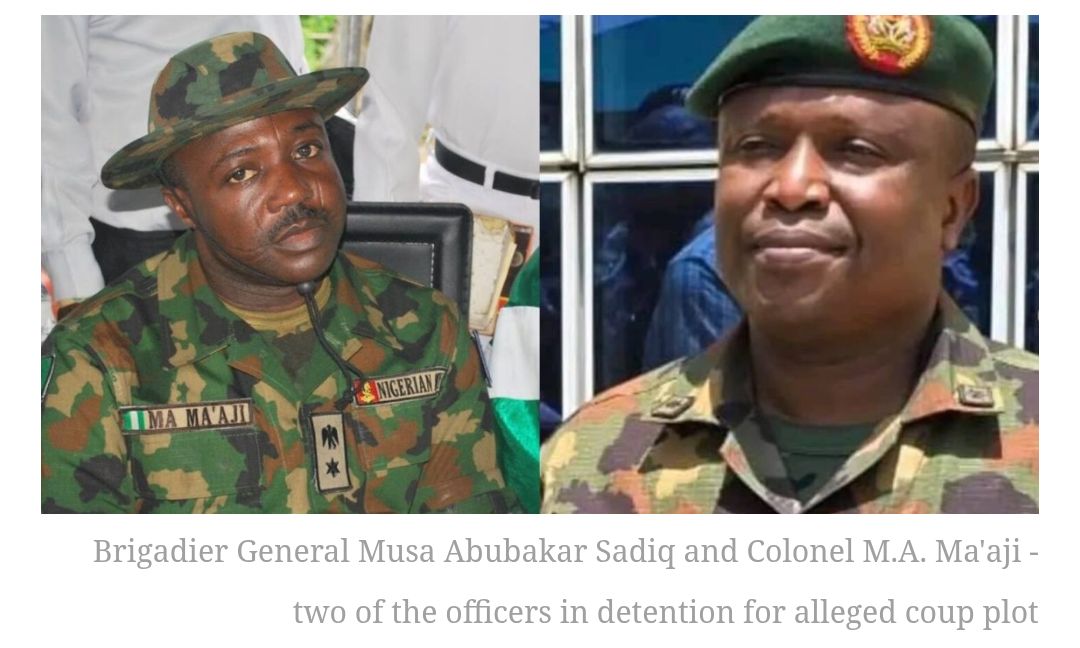
1.Brigadier General Musa Abubakar Sadiq
Born on 3 January 1974, Mr Sadiq is a brigadier general with service number N/10321, trained as an NDA cadet between 14 August 1992 and 20 September 1997. He is suspected to be the leader of the coup plot.
As a member of Regular Course 44, Mr Sadiq, an indigene of Nasarawa State, rose through the ranks, becoming a colonel in 2015 and a brigadier four years later. He belongs to the infantry corps.

This is not the first time Mr Sadiq has made headlines for alleged gross misconduct. In October 2024, he was reportedly detained for “alleged diversion of rice palliatives, selling of military equipment, including generator sets and operational vehicles to scrap yards.” Among other postings, the officer served as Commander of the 3rd Brigade in Kano and Garrison Commander of the 81 DivisionArmythe Army in Lagos.

2. Colonel M.A. Ma’aji
Mr Ma’aji is a colonel with service number N/10668. Born on 1st March 1976, the Nupe native from Niger State started training on 18 August 1995 and finished on 16 September 2000. Investigators suspect he played the role of a key strategist for the coup plot

A member of the infantry corps, Mr Ma’aji was promoted to the rank of lieutenant colonel in 2013, becoming a full colonel four years later. The 49-year-old officer was the Commanding Officer of the 19 Battalion of the Nigerian Army based in Okitipupa, Ondo State.
He took part in Operation Crocodile Smile II, a Nigerian Army military exercise conducted in 2017 to address security challenges in the Niger Delta and parts of the South-west. He also served at Depot, Nigerian Army and later as Commander, Operation Delta Safe.
He was a member of the 47 Regular Course of the NDA.

See also  Trump orders US withdrawal from 66 international organisations

3. Lt. Colonel S. Bappah
Mr Bappah, a member of the Nigerian Army Signals Corps, with service number N/13036, is from Bauchi State in North-East Nigeria. He was born on 21 June 1984.
The 41-year-old officer started his cadet training on 27 September 2004 and completed it on 4 October 2008.
He is a member of the 56 Regular Course of the NDA

4. Lt Colonel A.A. Hayatu
Mr Hayatu, now a lieutenant colonel with service number N/13038, hails from Kaduna State.
Born on 13 August 1983, he underwent his cadet training between 27 September 2004 and 04 October 2008.

A member of the infantry corps, Mr Hayatu also belonged to the 56 Regular Course.

5. P. Dangnap
Mr Dangnap is from Plateau State. He was born on 1 April 1986. In 2015, he was court-martialed alongside 29 others for offences related to the fight against Boko Haram.
The 39-year-old officer, with service number N/13025 began his cadet training on 27 September 2004 and completed it on 4 October 2008.
An infantry corps officer, Mr Dangnap is also a member of the 56 Regular Course of the NDA.

6. Lt. Colonel M. Almakura
A member of the 56 Regular Course, Mr Al Makura, a lieutenant colonel from Nasarawa State, was born on 18 March 1983.
The infantry corps officer with service number N/12983 trained as a cadet at the NDA from 27 September 2004 to 4 October 2008.

7. Major A. J Ibrahim
Mr Ibrahim, a major with service number N/13065, hails from Gombe State.
Born on 12 June 1987, the Infantry Corps officer trained between 27 September 2004 and 4 October 2008.
He was a member of the 56 Regular Course, and he became a captain in 2013.

See also  Failed peace talks: You can’t dictate terms to Iran – Javad Zarif to US

8. Major M.M. Jiddah
An indigene of Katsina State, Major Jiddah, was born on 9 July 1985.
He trained between 27 September 2004 and 4 October 2008.

Mr Jiddah is an infaArmy officer and a member of the 56 Regular Course.
His service number is N/13003.

9. Major M.A. Usman
Mr Usman is a Nigerian Army major with service number N/15404.

He was born on 1 April 1989. He hails from the Federal Capital Territory, in North-central Nigeria.
A member of the 60th Regular Course, the infantry officer trained as a cadet at the NDA between 16 August 2008 and 14 September 2012.

10. Major D. Yusuf
Mr Yusuf, a major with service number N/14753, is a member of the Ordnance Corps.
He was born on 26 May 1988. As a member of the 59th Regular Course, Mr Yusuf trained at NDA between 7 July 2007 and 8 September 2012.
The officer hails from Gombe State.

11. Major I. Dauda
Mr Dauda joined the army through the Direct Short Service Commissions.
Born on 26 November 1983, the infantry officer with service number N/13625, trained between 5 June 2009 and 27 March 2010.
Mr Dauda, who hails from Jigawa, is a member of Short Service Commission Course 38.

As of press time, details about the remaining five officers listed below are sketchy. They are also being detained for alleged involvement in the coup plot. Below is a little information about them:

12. Captain Ibrahim Bello
Mr Bello is a captain with service number N/16266. He was born on 28 July 1987. He is a member of the Direct Short Service Commission Course 43.

See also  55 Ghanaians k!lled while fighting for Russia in Ukraine

13. Captain A.A Yusuf
He is an army captain with service number N/16724.

14. Lieutenant S.S Felix
A lieutenant with service number N/18105.

15. Lieutenant Commander D. B. Abdullahi
He is a Nigerian Navy personnel with service number NN/3289.

16. Squandron Leader S. B Adamu
An Air Force squadron leader with service number NAF/3481.

Source: Premium Times 

FOLLOW US ON:

FACEBOOK

TWITTER

PINTEREST

TIKTOK

YOUTUBE

LINKEDIN

TUMBLR

INSTAGRAM

Continue Reading
Click to comment

Leave a Reply

Your email address will not be published. Required fields are marked *

News

Nigerian Air Force airstrikes destroy terrorist hideouts in Borno, read details

Published

on

The Nigerian Air Force says its airstrikes have successfully destroyed terrorist hideouts in the Southern Tumbuns area of Borno.

This is contained in a statement by the Director of Public Relations and Information, NAF, Air Commodore Ehimen Ejodame, on Saturday in Abuja.

Ejodame said the operation was conducted on Friday at about 1850 hours over Ali Sheriffti, a known terrorist enclave, following credible intelligence on insurgent activities.

“The NAF air assets carried out a focused surveillance sweep, during which several insurgents were sighted moving along concealed tracks and were trailed to structures hidden under dense foliage.

“Following positive identification, the NAF executed a precise strike, engaging the structures with onboard munitions.

“The operation achieved the desired effect, with terrorist structures destroyed, further degrading their capability and freedom of movement in the area,” he said.

Ejodame said the strike underscored NAF’s sustained commitment to intelligence-led and precision-driven operations aimed at denying terrorists safe havens.

He quoted the Chief of the Air Staff, Air Marshal Sunday Aneke, as reaffirming the force’s resolve to sustain pressure on terrorist networks.

He added that operations would continue with increased intensity to safeguard the nation and its citizens.

“The Nigerian Air Force will continue to pursue and dismantle terrorist networks with unwavering precision and relentless force, ensuring no enclave remains beyond our reach,” he said.

(NAN)

See also  19 more Nigerians face US deportation
Continue Reading

News

FG, Oyo lawmaker empower 210 youths with digital skills, laptops

Published

on

The Federal Government on Friday trained about 210 youths in Oyo State on digital marketing, cybersecurity basics, remote work, and technology-enabled entrepreneurship.

The digital literacy and empowerment programme was facilitated by a lawmaker representing Ibadan North-West/Ibadan South-West Federal Constituency and a Governorship aspirant under the Peoples Democratic Party in the state, Stanley Olajide, in collaboration with the National Information Technology Development Agency.

The event was held at Dapo Aderogba Hall, Nigeria Union of Journalists state Secretariat, Iyaganku Government Reserved Area, Ibadan, the state capital.

Olajide, popularly called Odidiomo, explained that his priorities include establishing tech and innovation hubs to position Ibadan as the technology capital of the South-West.

The chairman of the House Committee on Digital, Information Communication Technology and Cybersecurity described the practical as a response to the challenge of youth unemployment and the urgent need to bridge the digital divide.

He said, “I serve as a representative and remain actively engaged in committees related to ICT, cybersecurity, and other areas of technology. Technology is not just a field for me; it is a passion.

“A key priority is how we can empower our youth, both men and women, by equipping them with the skills they need to succeed. This is central to everything I do, because the future of Nigeria depends on them,” he said.

The lawmaker indicated that the programme is being expanded in phases, with additional cohorts already scheduled to scale its impact beyond the current beneficiaries.

“Regarding this programme, we have about 210 beneficiaries participating today, with an additional 150 set to begin next week. This will bring the total to approximately 360 participants in this phase. We plan to run up to ten phases before the end of the year; this is the second phase, following an earlier one held late last year.

See also  Atiku denies giving SUV to naval officer in face-off with Wike

“Beyond training, participants received financial support ranging between N30,000 and M50,000 to help them launch digital ventures. This move was deliberately structured to ensure immediate access and transparency.

“Each participant is receiving financial support, between N30,000 and N50,000, to help them get started. I made it a point that these funds be given in cash to avoid any issue related to network failures or delays in transfers, ensuring transparency and that everyone receives what they are entitled to,” he explained.

Olajide stressed that the programme represented only a foundational step in a longer-term plan to integrate Nigerian youths into emerging global technology ecosystems, including artificial intelligence and blockchain.“We must provide young people with the right tools and knowledge to prepare them for what lies ahead. This training programme is only a starting point.

“We intend to build on it with more advanced opportunities, including areas like artificial intelligence, blockchain, and other emerging technologies. However, for these to be effective, there must be a strong foundation, and that is what we are laying now,“ Olajide said.

Drawing comparisons with global best practices, he pointed to India’s transformation through sustained investment in technology training, noting that similar efforts could reposition Nigerian cities as innovation hubs.

“I often reflect on how countries like India addressed youth unemployment by investing in technology training, eventually transforming cities like Bangalore into global tech hubs. In the same way, we can position Ibadan and the state as leading technology hubs in West Africa and beyond,” the lawmaker stated.

The lawmaker added that the broader objective is to provide participants with practical skills, entrepreneurial support and the tools required to compete in a rapidly evolving digital economy.

See also  Trump orders US withdrawal from 66 international organisations

“Our goal is to give participants baseline skills, startup support, and the tools they need to begin their journey. Stay focused, embrace what you have learned with passion, continue to develop your skills, and use the resources provided wisely. The future is in your hands,“ he said.

He, therefore, urged the beneficiaries to make use of the training and tools judiciously.

Earlier, the NITDA representative, Eedris Faruk, said the participants were equipped with skills in digital literacy, AI, responsible platform use, and online business setup to drive education, entrepreneurship, and employment.

punch.ng

FOLLOW US ON:

FACEBOOK

TWITTER

PINTEREST

TIKTOK

YOUTUBE

LINKEDIN

INSTAGRAM

Continue Reading

News

EFCC warns content creators against unauthorised use of name, logo

Published

on

The Economic and Financial Crimes Commission (EFCC) has warned content creators to stop using its name, logo and likeness in skits and other media productions without approval, saying such portrayals misrepresent its operations and warning that violators will be prosecuted.

In a video message shared on Saturday via its X page, the commission said, “It has come to the attention of the Economic and Financial Crimes Commission that some individuals and content creators are using the name, logo and likeness of EFCC in skits and other media content.

“Many of these skits misrepresent our values and standard operating procedures. We wish to inform the general public that the EFCC has not authorised any such use.”

The agency added, “The EFCC does not endorse, sponsor or approve any comedy, drama or online content that uses our identity without written consent.”

It further directed the public to comply immediately, stating, “Therefore, the public is hereby advised to cease and desist from using our name, logo, uniforms or any identifying elements in skits or promotional content without prior written approval. Be warned, all who violate these instructions shall be prosecuted.”

The warning comes amid earlier concerns by the commission over rising cases of impersonation and fake sting operations by individuals posing as its officers.

The EFCC had said intelligence available to it indicated that fraudsters were deploying “ingenious but fraudulent means” to tarnish its image, including tactics involving gangs operating around popular eateries and fun spots in major cities, where unsuspecting youths are targeted.

Continue Reading

Trending