





Connect with us

Business

NUPENG suspends strike as Dangote accepts union’s demands

Published

on

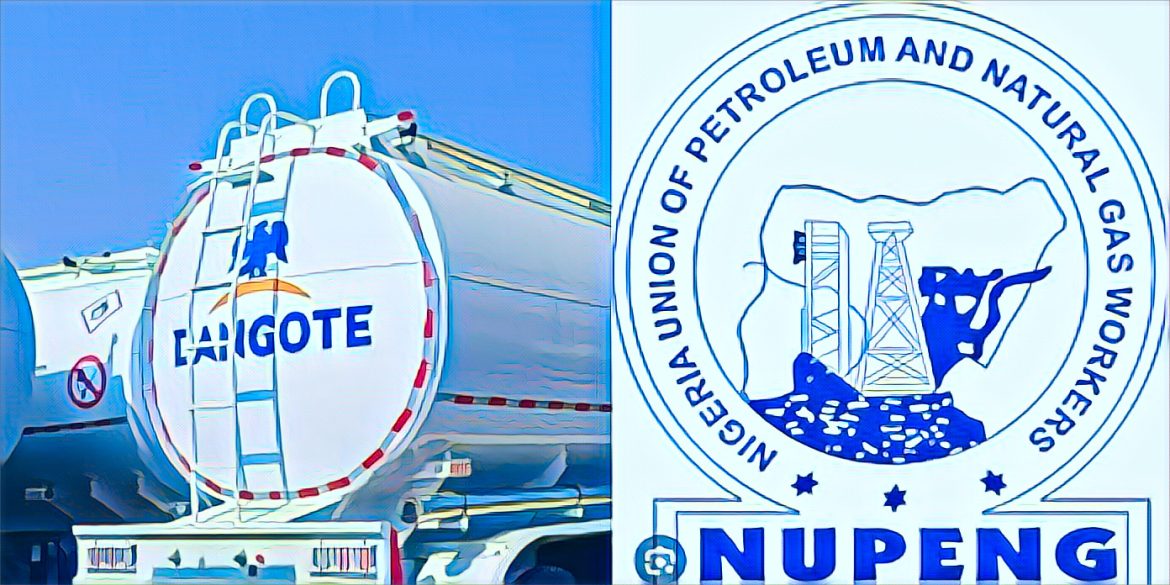
The Nigeria Union of Petroleum and Natural Gas Workers suspended its two-day strike on Tuesday following a meeting with officials of the Federal Government and the Dangote Group, amid fuel supply disruptions in different locations across the country.

The National President of NUPENG, Williams Akporeha, confirmed this to one of our correspondents. After the failure of the Monday meeting, the Ministry of Labour summoned another meeting on Tuesday with more stakeholders in attendance.

Those in attendance included representatives of the Dangote Group led by Sayyu Dantata, officials of the Nigerian Midstream and Downstream Petroleum Regulatory Authority, and others. An agreement signed after the meeting showed that the Dangote refinery agreed to unionise its members.

“Following the threat to embark on industrial action by the Nigeria Union of Petroleum and Natural Gas Workers over the refusal of the management of the Dangote Refinery and Petrochemical Limited to allow their employees to be unionised by registered labour unions, a conciliation meeting was held at the instance of the Minister of Labour and Employment, and it was revealed in the course of the meeting that:

“The management agreed with this fact and responded that they are not averse to the unionisation of their employees by labour unions in tandem with the provisions of the extant labour laws. After exhaustive deliberations, the following resolutions were reached by both parties: That since workers’ unionisation is a right in line with the provisions of the extant laws, the management of Dangote Refinery and Petrochemicals agreed to the unionisation of employees of Dangote Refinery and the unionisation of employees of Petrochemicals who are willing to unionise.

“That the process of unionisation shall commence immediately and be completed within two weeks (9th-22nd September, 2025), and it was agreed that the employer will not set up any other union.

Arising from the strike notice, no worker or employee of Dangote Refinery and Petrochemical will be victimised,” the agreement read.

Parties are to revert to the Minister of Labour a week after the conclusion of the engagement. Based on the MoU, NUPENG agreed to suspend the industrial action with immediate effect.

The MoU was signed by Dangote’s Sayyu Dantata; NUPENG’s Akporeha and his Secretary, Afolabi Olawale; an official of the NMDPRA, OK Ukoha; a director of the labour ministry, Amos Falonipe; and representatives of the Nigerian Labour Congress and the Trade Union Congress.

However, as the strike entered the second day before its suspension on Tuesday, Nigerians in different parts of the country felt the impact as many filling stations were shut. NUPENG had on Friday declared its intention to stop loading fuel this week over allegations that the Dangote refinery planned to ban the drivers recruited for its 4,000 trucks from joining the union.

See also  Health minister, manufacturers clash over sugary drink levy

Recall that the Dangote refinery planned to start direct fuel distribution from August 15 with its 4,000 Compressed Natural Gas-powered trucks. But the scheme was delayed due to a lack of enough ships to bring the trucks to Nigeria. While the refinery is still receiving the trucks as they arrive in Nigeria, the Petroleum Tanker Drivers branch of NUPENG accused the refinery management of anti-labour practices for not allowing its drivers to join the union.

They also accused Alhaji Aliko Dangote of plans to render them useless with his direct fuel distribution scheme. NUPENG President Akporeha on Sunday confirmed that the Federal Government had reached out to the union on the need to avert the strike, but he refused to call off the strike.

Following the inability of the Federal Government to broker peace between NUPENG and the Dangote refinery at the Monday conciliation meeting organised by the Minister of Labour and Employment, Muhammad Dingyadi, the union continued the strike, shutting down depots and some filling stations. The suspension of the strike later in the evening was a relief in areas where its impact was felt.

In states like Cross River and Kaduna, many filling stations were under lock and key on Tuesday, while some adjusted pump prices in Sokoto and Enugu. It was also gathered that vehicle owners engaged in panic buying in parts of Lagos and Ogun States.

The National President of the Petroleum Products Retail Outlet Owners Association of Nigeria, Billy Gillis-Harry, told The PUNCH that “PETROAN members joined the strike on Tuesday, as the Monday meeting with the labour minister yielded no result.” Gillis-Harry, who described the strike as a looming danger, however, appreciated the Federal Government for its prompt intervention.

Fuel supply disruptions

In Calabar, the capital of Cross River, commuters and residents lamented the hike in fares following the fuel scarcity in the state on Tuesday. Commuters said that the fuel scarcity triggered a hike in transport fares, leaving many commuters stranded and frustrated.

Explaining how the fuel scarcity affected transport costs, a resident, Mary Archibong, said, “The fuel scarcity has affected everyone in one way or another. Before now, from Watt to Calabar Roundabout, it used to be N300, but now it’s N500. It is very bad because the drivers are now buying from the black market at N1,500 per litre,” she said.

It was learnt commercial activities in Kaduna were on Tuesday crippled as the now-suspended strike forced major filling stations in the metropolis to shut down their operations. A visit to several parts of the state capital revealed that virtually all major filling stations had locked their gates, leaving motorists and residents stranded.

At the Barnawa area in Kaduna South Local Government Area, Future View Filling Station and the NNPC Mega Filling Station along Aliyu Makama Road were under lock and key. Residents expressed frustration as the strike entered its first day. “I drove around for over an hour looking for fuel. Nowhere is selling,” lamented Musa Lawal, a commercial tricycle operator.

See also  World Bank unveils $510m deal to boost investments

The situation was the same across other parts of the city. At the busy Station Roundabout, the AA Rano and Shema filling stations remained shut, while at the Ahmadu Bello Stadium Roundabout, Total, MRS, and the NNPC Mega Station all closed shop. The stations were deserted.

Similarly, the Total and Mobil filling stations along Ahmadu Bello Way and Muhammadu Buhari Way (formerly WAFF Road) were not dispensing fuel when our correspondent visited.

Some motorists who managed to find fuel at smaller independent stations complained of arbitrary price hikes. A motorist, Sani Ibrahim, told The PUNCH that he bought fuel at N950 per litre, up from N860 the previous day.

In Enugu, commuters were stranded on Tuesday due to fuel scarcity. Many petrol stations closed shops at noon. Motorists were unable to access petrol, so they were left idling on major roads, while some resorted to black-market vendors charging up to N1,500 per litre.

It was observed that busy roads such as Ogui Junction, Abakpa Junction, IMT, Emene, and Holy Ghost were unusually scanty on Tuesday, with few vehicles moving around to pick passengers. The strike led to immediate fare hikes . Buses raised fares from N300 to N500 from Garriki to New Market.

The PUNCH reports that there were long queues in many filling stations across Anambra State on Tuesday, resulting in the sharp increase in transportation fares for both interstate and intrastate movement. The queues built up in some parts of Onitsha, Awka and Nnewi, as only a few filling stations were seen dispensing the product.

As a result, commuters had a hectic time going to their various destinations as commercial transport operators hiked transport fares by over 50 per cent. Many motorists hiked their fares as a result of the development. It was observed that a journey of N200 cost as much as N400, while that of N300 became N600.

In Gombe, fuel prices climbed to between N910 and N1,000 per litre. At a filling station along Gombe-Bauchi Road, an attendant, who pleaded anonymity, confirmed the increment, saying marketers were reacting to “uncertain developments in the sector.”

He added, “We are still selling because supply is steady, but once depots are locked, the price will go up further. That is why our managers adjusted the pump price early.”  Meanwhile, there was not much impact felt in states like Jos, Kano, Zamfara and Ilorin. There was a marginal price increase in Sokoto State.

Speaking on national television earlier on Tuesday, the NUPENG boss, Akporeha, said the union had no choice but to press on with industrial action after Dangote’s management rejected recognised oil and gas unions and allegedly claimed to have a separate association for its workers.

See also  NNPC laments losses as PENGASSAN halts strike

Akporeha alleged that the representative of the Dangote refinery, Dantata, walked out of the Monday meeting when the labour minister told him that the Dangote refinery could not have a separate union for its workforce. The labour leader alleged that the Dangote refinery created an alternative drivers’ association to weaken NUPENG, describing the move as illegal.

He insisted that the law only recognised existing unions such as NUPENG, PENGASSAN and others in the oil and gas sector. While clarifying that strike action was a legitimate industrial tool, Akporeha stressed that dialogue remained open.

“Strikes are part of industrial relations. But under my leadership, it has never been the first option, but no employer has the right to enslave workers,” he said. He dismissed allegations that NUPENG was attempting to sabotage the refinery or frustrate local production.

“Everybody wants Dangote to succeed, including NUPENG. But he must play by the rules. Nigeria cannot afford investors who act like dictators or slave drivers,” he said. On Monday, depots and filling stations were also closed by NUPENG members. The Aradel refinery in Obele, Port Harcourt, was shut. The Kwale Hydrocarbon facility in Delta State was shut.

Checks by one of our correspondents confirmed that activities at petroleum depots were paralysed across the country. NUPENG officials visited the depots on Monday and the early hours of Tuesday to enforce compliance. In various states across the country, especially those in Lagos and Warri, Delta State, drivers parked their trucks to wait for the next directive as far as fuel lifting was concerned.

Our correspondent reports that NUPENG officials shut down some depots to prevent the movement of trucks. The National President of NUPENG, Williams Akporeha, told our correspondent that there was “100 per cent compliance across the nation.” Some members of the union accused Dangote and MRS of having plans to take over their jobs with the recruitment of new drivers.

At Aiteo, RainOil, Shell+, First Royal, MAO, Hensmor, One Terminals, Africa Terminals, Integrated Oil and Gas, and other depots in Lagos, the gates were locked as workers stayed away to comply with the strike action. Also, A&E, Matrix, Parker AY Shafa, and other depots in Warri joined the strike on Monday. The PUNCH reports that with the suspension of the industrial action, loading of fuel is expected to resume on Wednesday.

(Additional reports by: Raphael Ede, Ikenna Obianeri, Chima Azubuike, James Abraham, Hussaini Ibrahim, Maiharaji Altine, Animasahun Salman, and Dare Akogun)

FOLLOW US ON:

FACEBOOK

TWITTER

PINTEREST

TIKTOK

YOUTUBE

LINKEDIN

TUMBLR

INSTAGRAM

Continue Reading
Click to comment

Leave a Reply

Your email address will not be published. Required fields are marked *

Business

NNPC April crude supplies to Dangote cross 1bn barrels

Published

on

Crude oil supply from the Nigerian National Petroleum Company Limited’s trading arm surged in April 2026, with shipment records indicating that more than 1.03 million metric tonnes, equivalent to about 6.8 million barrels or over 1.08 billion litres, were delivered to the Dangote Oil and Gas Company Limited within the month.

An analysis of tanker vessel movements obtained by The PUNCH on Tuesday shows that the deliveries were executed through eight crude cargoes handled by NNPC Trading, reinforcing the state oil firm’s role as a major feedstock supplier to the 650,000 barrels-per-day Dangote refinery.

The shipments, sourced from key Nigerian crude streams including Anyala, Bonga, Odudu, Forcados, Qua Iboe, and Utapate, were routed through the refinery’s Single Point Mooring systems, SPM-C1 and SPM-C2.

The document shows that out of the eight cargoes, five have been fully discharged, while three others are still awaiting berthing or completion, indicating a steady pipeline of crude inflows into the refinery.

This development comes amid the refinery’s continued complaints of supply inadequacies, with a total requirement of 19 cargoes monthly, and a recent report that the country imported 55.39 million barrels in January and February 2026.

A breakdown of the deliveries showed that Sonangol Kalandula initiated the supply chain, delivering 123,000 metric tonnes of crude from Anyala. The vessel arrived on April 5, berthed on April 8, and sailed on April 9.

This was followed by Advantage Spring, which supplied 128,190 metric tonnes from Bonga, arriving on April 11 and completing discharge by April 13.

See also  Health minister, manufacturers clash over sugary drink levy

Similarly, a vessel code-named Barbarosa delivered 125,000 metric tonnes from Odudu, while Sonangol Njinga Mban transported 129,089 metric tonnes from Bonga.

Another completed shipment, handled by Nordic Tellus, brought in 139,066 metric tonnes from Forcados, completing discharge on April 17.

However, three additional cargoes remain in progress. Advantage Sun, carrying 142,327 metric tonnes from Bonga, has arrived but is yet to berth. Also pending are Advantage Spring from Utapate with 120,189 metric tonnes, and Sonangol Kalandula from Qua Iboe with 126,471 metric tonnes.

In total, the NNPC Trading cargoes account for 1,033,332 metric tonnes of crude, underscoring what industry analysts describe as a “strong and sustained supply commitment” to the Dangote refinery.

Further findings show that, beyond crude deliveries, the Dangote refinery also received multiple shipments of refined products and blending components from international markets during the period.

Among them, Seaways Lonsdale delivered 37,400 metric tonnes of blendstock gasoline from Immingham, United Kingdom, handled by Vitol, between April 18 and 19.

Another vessel, Augenstern, supplied 37,125 metric tonnes of Premium Motor Spirit from Lavera, France, discharging between April 8 and 9.

From Norway, Emma Grace brought in 37,496 metric tonnes of PMS from Mongstad, while LVM Aaron delivered 36,323 metric tonnes from Lome, Togo.

Similarly, Egret discharged 35,498 metric tonnes of naphtha from Rotterdam between April 16 and 18, providing critical feedstock for gasoline blending.

A pending shipment, Mont Blanc I, carrying 36,877 metric tonnes of blendstock gasoline from Antwerp, Belgium, is yet to berth, while Aesop is expected to deliver 130,000 metric tonnes of residue catalytic oil from Singapore later in April.

See also  Hamzat, Yayi, Alli may emerge APC consensus gov candidates

In addition to NNPC Trading volumes, other crude cargoes from international and domestic traders also supported refinery operations.

Notably, Yasa Hercules delivered 273,287 metric tonnes of crude from Corpus Christi, United States, while Front Orkla brought in 264,889 metric tonnes from Ingleside, US.

A major cargo, Navig8 Passion, supplied 496,330 metric tonnes of crude from Cameroon, highlighting regional supply integration.

Domestic contributions included Harmonic, which delivered nearly 993,240 barrels from Ugo Ocha, and Aura M, which supplied 1 million barrels from Escravos, alongside an additional 651,331 barrels of cargo from Anyala.

Operational data indicate that most vessels berthed within one to two days of arrival and departed shortly after discharge, suggesting improved efficiency at the refinery’s offshore terminals.

The Dangote refinery, located in Lekki, Lagos, is Africa’s largest single-train refinery, with a nameplate capacity of 650,000 barrels per day.

The facility is expected to significantly reduce Nigeria’s dependence on imported petroleum products by refining domestic crude and supplying petrol, diesel, aviation fuel, and other derivatives to the local market.

NNPC Limited, through its trading arm, has remained a central player in supplying crude to the refinery under evolving commercial arrangements, amid ongoing reforms in Nigeria’s downstream oil sector.

Earlier this month, Africa’s richest man and President of the Dangote Group, Aliko Dangote, revealed in a report by Bloomberg that the refinery received 10 cargoes of crude oil from the state-owned oil firm in March, compared to an average of about five cargoes monthly since late 2024.

Dangote said the shipments included six cargoes paid for in naira and four in dollars, under the crude supply arrangement between the refinery and the NNPC.

See also  Electricity Act (Amendment) Bill: FG may sell 11 Discos to new investors

“Nigeria doubled crude supply to Dangote Refinery in March as Africa’s top oil producer moved to shore up fuel availability after the Iran war disrupted Middle East shipments. Last month, they gave us six cargoes with payments in naira and four cargoes with payments in dollars,” he stated.

Continue Reading

Business

CBN, NCC to combat SIM-related fraud

Published

on

The Central Bank of Nigeria and the Nigerian Communications Commission on Monday signed a memorandum of understanding to tackle SIM-related fraud and strengthen consumer protection across Nigeria’s digital ecosystem.

The agreement, signed at the CBN headquarters in Abuja, aims to improve coordination between the financial and telecommunications sectors, focusing on combating electronic fraud linked to mobile numbers, enhancing payment system integrity, and protecting consumers.

Speaking at the event, the CBN Governor, Olayemi Cardoso, said the pact was a “practical statement of national interest”, noting that the increasing reliance on digital channels for payments and financial services required stronger collaboration between both regulators.

He said, “This MoU is not merely an administrative document; it is a practical statement of national interest,” adding that the agreement would reinforce the stability and integrity of Nigeria’s payment system while supporting innovation and consumer safety.

Cardoso explained that the deal would strengthen coordination on approvals, technical standards, and innovation trials, including sandbox testing, to ensure that financial services remain reliable and scalable.

He noted that the partnership would also improve the response to rising electronic fraud, stressing that “addressing these threats requires joined-up action, shared intelligence, clearer escalation paths, stronger operational readiness across regulated entities, and consistent public education”.

A key component of the agreement is the rollout of the Telecom Identity Risk Management Portal, a data-sharing platform designed to detect fraud linked to recycled, swapped, or blacklisted phone numbers.

According to Cardoso, the platform would enable real-time verification of mobile number status across banks and fintech firms, providing an additional layer of protection for consumers and the financial system.

See also  Electricity Act (Amendment) Bill: FG may sell 11 Discos to new investors

He said strict compliance with data protection laws, including encryption and consent protocols, would guide the use of the platform.

Also speaking, the Executive Vice Chairman of the NCC, Aminu Maida, described the agreement as a major step in strengthening Nigeria’s digital economy.

He said, “The signing of this Memorandum of Understanding marks an important milestone in the regulatory stewardship of Nigeria’s digital economy,” adding that collaboration between both institutions was “not optional; it is imperative.”

Maida noted that the initiative would give financial institutions better visibility into the status of phone numbers used in transactions, including whether a line had been swapped, recycled, or flagged for fraudulent activity.

“This ensures that our financial services industry is better equipped with timely and relevant information to effectively combat e-fraud, particularly those perpetrated using phone numbers,” he said.

He added that the agreement would also improve consumer protection, assuring Nigerians that issues such as failed airtime recharges would be resolved more quickly under the new framework.

Earlier, the Director of Payment System Supervision at the CBN, Dr Rakiya Yusuf, said the partnership between both regulators had evolved over the years from separate oversight roles into a more integrated collaboration focused on securing Nigeria’s digital and financial systems.

She traced the relationship back to earlier efforts to align mobile payment regulations and telecom licensing frameworks, including the 2018 MoU that enabled telecom operators to participate in mobile money services through special purpose vehicles.

She also highlighted joint interventions such as the resolution of the USSD pricing dispute and the introduction of a N6.98 per session fee, as well as recent efforts to address failed transactions through a proposed 30-second refund framework.

See also  Wage arrears: Labour issues Friday ultimatum to FG

Under the new agreement, two joint committees will be established to drive implementation. These include the Joint Committee on Payment Systems and Consumer Protection and the Joint Committee on the telecom risk management platform.

The agreement is expected to deepen digital financial inclusion, reduce fraud risks, and strengthen trust in Nigeria’s rapidly expanding digital economy.

The PUNCH earlier reported that the CBN and the NCC unveiled a joint framework to tackle the growing problem of failed airtime and data transactions, which have left consumers frustrated after payments are processed but service delivery is not provided.

The 20-page draft, published on the CBN’s website, was developed by the CBN’s Consumer Protection & Financial Inclusion Department and the telecom regulator, with input from banks, mobile operators, payment providers, and other stakeholders.

The regulators seek to clarify accountability, standardise complaint-resolution timelines, and create a coordinated system for addressing grievances across the financial and telecommunications sectors.

punch.ng

FOLLOW US ON:

FACEBOOK

TWITTER

PINTEREST

TIKTOK

YOUTUBE

LINKEDIN

INSTAGRAM

Continue Reading

Business

Electricity reforms: Rivers, Kano, 19 others delay takeover

Published

on

Twenty-one states, including Rivers and Kano, are yet to assume regulatory control of their electricity markets nearly three years after the enactment of the Electricity Act 2023, even as 15 states have already transitioned to independent market oversight.

The Nigerian Electricity Regulatory Commission disclosed that the states that have completed the transition have established their own electricity regulatory frameworks and are now responsible for market development, investment attraction, tariff oversight, and customer protection within their jurisdictions.

According to the commission, the shift follows the decentralisation provisions of the Electricity Act 2023, which empower subnational governments to regulate electricity generation, transmission and distribution within their territories after completing the necessary legal and administrative processes.

NERC noted that 15 states have so far completed the transition to state-level regulation. These include Enugu, Ekiti, Ondo, Imo, Oyo, Edo, Kogi, Lagos, Ogun, Niger, Plateau, Abia, Nasarawa, Anambra and Bayelsa.

However, the remaining 21 states yet to assume regulatory control are Adamawa, Akwa Ibom, Bauchi, Benue, Borno, Cross River, Delta, Ebonyi, Gombe, Jigawa, Kaduna, Kano, Katsina, Kebbi, Kwara, Osun, Rivers, Sokoto, Taraba, Yobe and Zamfara.

Industry analysts said the slow pace of transition in some states could delay the expected benefits of decentralisation, including improved power supply, localised tariff structures, and accelerated investments in embedded generation and mini-grid projects.

Under the new framework, once a state completes its transition, the state electricity regulator takes over licensing of intrastate electricity operations, enforcement of technical standards, tariff setting for local distribution, and protection of electricity consumers within the state.

See also  NNPC laments losses as PENGASSAN halts strike

NERC, in turn, retains oversight only on interstate and national grid-related activities.

The commission emphasised that state regulators are expected to drive local electricity market growth by encouraging private sector participation, promoting renewable energy deployment, and ensuring service quality standards for distribution companies operating within their jurisdictions.

The timeline released by the commission shows that the earliest transitions occurred in October 2024, when Enugu and Ekiti states assumed regulatory authority, followed by Ondo shortly after. The pace accelerated in 2025, with several states, including Oyo, Edo, Lagos and Ogun, completing their transitions. The most recent additions include Nasarawa, Anambra and Bayelsa between January and February 2026.

It was observed, however, that some of the 15 states have not set up their regulatory commissions.

Power sector stakeholders argue that states yet to transition risk missing opportunities to attract investments in off-grid electrification projects, particularly in underserved rural communities.

They also note that state-level regulation could help address longstanding distribution challenges by enabling more flexible tariff structures, targeted subsidies, and enforcement mechanisms tailored to local conditions.

With less than half of the states having completed the transition, many argued that the effectiveness of the Electricity Act reforms will largely depend on how quickly the remaining states establish their regulatory institutions and operational frameworks.

Apparently overwhelmed by the country’s power woes, the Federal Government recently pushed the challenge to the 36 states, asking them to take over power generation, transmission, and distribution.

The Federal Government said this was the only solution to the power crisis in the country.

See also  Petrol may hit N1,000/litre as Dangote hikes price

The Minister of Power, Adebayo Adelabu, said at an energy summit in Lagos that the Electricity Act’s impact includes decentralisation and liberalisation.

“In a country as big as Nigeria, with almost a million square kilometres of landmass, over 200 million people, millions of businesses, thousands of institutions (health and educational institutions), 36 states plus the Federal Capital Territory, and 774 local governments—centralisation cannot work for us. The responsibility of providing stable electricity can never be left in the hands of the Federal Government.

“At the centre, you cannot, from Abuja, guarantee stable power across the country. So, this is one thing that the Act has achieved—decentralisation. That has now allowed all the states or the subnationals to play in all segments of the power sector value chain—generation, transmission, distribution, and even service industries supporting the power sector,” he stated.

He called on the remaining 21 states to set up their electricity market.

“I believe other states will follow suit in operationalising the autonomy granted, with full collaboration of the national regulator. We are working actively with these states to ensure strong alignment between the wholesale market and the retail market.

“In this regard, we believe the active involvement of the state governments, particularly in the off-grid segment, is critical, given the series of roundtable engagements held with governors by the Rural Electrification Agency, as well as ongoing efforts to closely track the distribution companies’ performances within their respective jurisdictions,” Adelabu emphasised.

punch.ng

FOLLOW US ON:

FACEBOOK

TWITTER

PINTEREST

TIKTOK

YOUTUBE

LINKEDIN

INSTAGRAM

Continue Reading

Trending