Connect with us

Lifestyle

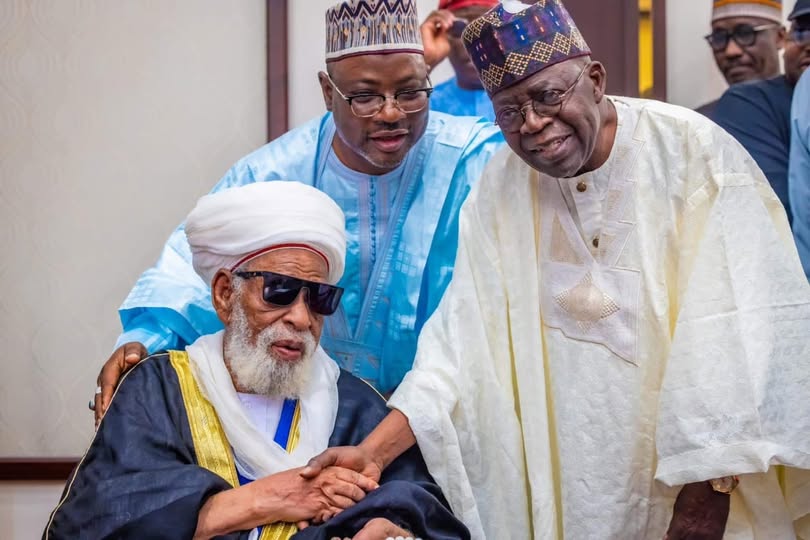
Tinubu, Kaduna gov, Saraki mourn Sheikh Dahiru Bauchi

Published

on

Tributes continue to pour in across Nigeria following the passing of the revered Islamic scholar, Sheikh Dahiru Usman Bauchi, with prominent political leaders describing his death as a monumental loss to the Muslim world.

The late scholar died in the early hours of Thursday.

President Bola Tinubu says he received the news of the death of Sheikh Dahiru Usman Bauchi “with profound sadness and a deep sense of loss.”

The President noted that the revered cleric, who died at 101, was “a moral compass who dedicated his life to teaching and preaching.”

A Thursday statement signed by presidential spokesperson, Bayo Onanuga, revealed this.

Describing the loss as “monumental not only to his family and teeming followers but also to the nation,” Tinubu recalled “the blessings and moral support he received from the late Sheikh Dahiru Bauchi in the run-off to the 2023 election.”

He further said, “Sheikh Dahiru Bauchi was a teacher, a father and a voice of moderation and reason. As both a preacher and a notable exegete of the Holy Quran, he was an advocate of peace and piety. His death has created a huge void.”

The President condoled with the scholar’s followers nationwide and beyond, urging them to honour his memory by upholding his teachings of “peaceful coexistence, strengthening their relationship with God and being kind to humanity.”

Also, Kaduna State Governor, Senator Uba Sani, said he received the news “with deep sorrow”, describing the Sheikh as “an extraordinary spiritual guide whose life reflected the highest values of Islam: knowledge, humility, peace, and unity.”

See also  Maintain status quo, avoid provocative acts, Okpebholo warns over Okpella stool

He noted that the late scholar’s teachings “shaped generations, strengthened the Tijjaniyya community, and enriched Islamic scholarship across Nigeria and beyond.”

Praying for Allah’s mercy on the scholar, the governor asked that the Almighty grant him “Al-Jannatul Firdaus, forgive his shortcomings, and comfort his family, students, and all who drew guidance from his exemplary life.”

He added that “his legacy of devotion and service to humanity will continue to illuminate our path.”

Meanwhile, former Senate President, Bukola Saraki, also expressed deep sadness, describing the deceased as “a colossus of Islamic scholarship and a spiritual father to millions.”

Saraki, taking to X, noted that Sheikh Dahiru lived “a long, blessed life, spanning a century, spent wholly in the service of his Creator and the propagation of the teachings of the Holy Qur’an and the Sunnah of Prophet Mohammed.”

He highlighted the scholar’s impact on Islamic education, stating that “through his Almajiri schools and famous Tafsir sessions, he ensured that the words of the Almighty were not just recited, but imprinted in the hearts of millions of young people across our nation.”

Saraki also offered condolences to his family, the Sultan of Sokoto, the people of Bauchi State, the Tijjaniyyah adherents, and the wider Muslim Ummah.

punch.ng

FOLLOW US ON:

FACEBOOK

TWITTER

PINTEREST

TIKTOK

YOUTUBE

LINKEDIN

TUMBLR

INSTAGRAM

Continue Reading
Click to comment

Leave a Reply

Your email address will not be published. Required fields are marked *

Lifestyle

‘Someone Like You Cannot Correct Christians’ – Singer Testimony ‘Jaga’ Knocks Ex-VP Osinbajo

Published

on

Popular Nigerian gospel singer, Salau Aliu Olayiwola, also known as Testimony Jaga, has criticised former Vice President, Yemi Osinbajo, over his recent comments on the concept of “prosperity gospel.”

Osinbajo had stirred debate in religious and public circles after faulting what he described as the prosperity gospel, a development that has since drawn mixed reactions.

Reacting in a video that has gone viral online, the gospel artiste dismissed the idea of categorising the message of Christianity into different forms, insisting that the gospel remains one and indivisible.

“I saw a video where you were condemning the prosperity gospel. With due respect, there is no such thing as a prosperity gospel. There is only one gospel, the Gospel of Jesus Christ,” he said.

Jaga also challenged Osinbajo’s authority to criticise the Church, pointing to his time in public office and asking for evidence of impact.

“If anyone wants to correct the body of Christ, it should not be someone like you. Show Nigerians what you did while you were vice president,” he stated.

The singer’s remarks introduce a political dimension to the debate, as he called on the former vice president to account for his stewardship while in government.

The artiste further highlighted Nigeria’s socio-economic challenges, stressing that poverty remains a pressing issue that must not be ignored in religious teachings.

“Do you understand what poverty does to people? As a politician, what have you done to address it?” he asked.

According to him, messages preached in churches should address real-life struggles and provide hope to adherents.

See also  PHOTOS: HOW OPPONENTS WEAPONISED THE 1992 C-130 TRAGEDY AGAINST MY REGIME. I HAVE NO HANDS IN THE PLANE CRASH— IBB

Jaga emphasised that the central message of Christianity is one of hope, transformation, and encouragement, rather than condemnation.

“The gospel is good news. If people are struggling, they should hear a message of upliftment, not condemnation,” he said.

The singer also questioned Osinbajo’s influence as a pastor during his time in office, urging him to demonstrate tangible results both in ministry and governance.

“Show us the people whose lives you transformed. Show evidence of support for the poor or meaningful development, even in your own community,” he added.

While defending the broader message of the Christian faith, Jaga admitted that abuses exist within religious institutions but warned against using such cases to discredit the gospel.

“There are fake pastors, yes, but the gospel itself remains a message of hope and transformation,” he noted.

He concluded by urging Osinbajo to embody the values he advocates, particularly in supporting the less privileged.

“If you truly believe in what you are saying, then lead by example. Give back, support the poor, and demonstrate the values you preach,” Jaga said.

FOLLOW US ON:

FACEBOOK

TWITTER

PINTEREST

TIKTOK

YOUTUBE

LINKEDIN

INSTAGRAM

Continue Reading

Lifestyle

Osogbo War: The Yoruba Victory That Stopped Fulani’s Deeper Advance

Published

on

The Osogbo War took place during one of the most turbulent periods in Yoruba history. By the early nineteenth century, the Old Oyo Empire had lost its dominance. Internal rebellion, succession disputes, military rivalry, and pressure from northern forces weakened its authority and influence across Yorubaland.

Ilorin became central to this transformation. Once part of Oyo’s northern military system, Ilorin later developed into an Islamic emirate linked to the wider Sokoto Caliphate. Its rise altered the balance of power and placed several Yoruba towns under growing threat.

Osogbo stood in a vulnerable position. Located near important routes into the Yoruba interior, its fall would have opened the way for deeper military movement into the forest regions. The defence of Osogbo therefore became critical to the security of many neighbouring towns.

The Attack on Osogbo

Around 1840, Fulani forces advanced toward Osogbo and laid siege to the town. Osogbo’s defenders could not withstand the pressure alone and sought assistance from Ibadan.

Ibadan, already emerging as a powerful military centre, responded to the call. Its forces marched to support Osogbo and engaged the Fulani army. The battle that followed ended in a decisive defeat for Fulani’s forces, lifting the siege and securing the town.

The victory halted further immediate movement of Fulani forces into the Yoruba interior and became one of the most significant defensive successes in nineteenth century Yoruba warfare.

Ibadan’s Rise After the Victory

The success at Osogbo strengthened Ibadan’s position in Yoruba politics. The town had grown from a military settlement into a major war power, and the outcome of the battle confirmed its strength and influence.

See also  Concerns Grow As Popular Gospel Singer, Wunmi Awoniyi Solicits Public Support, Prayer

Ibadan’s role in defending Osogbo increased its prestige, but it did not establish complete political control over Yorubaland. Other Yoruba states such as Ijaye, Oyo, Abeokuta, Ijesa, Ekiti, and Ife continued to operate independently, each pursuing its own interests and alliances.

This balance of power shaped the political landscape that followed the war.

What the Victory Achieved

The Osogbo War secured Osogbo from Fulani control and protected nearby regions from further immediate threat. It limited Fulani’s ability to push deeper into the Yoruba interior and marked an important moment in the defence of the forest belt.

The battle also reinforced Ibadan’s standing as a leading military force, placing it at the centre of later Yoruba conflicts and political developments.

Despite these gains, Fulani remained a strong power in the north, and the earlier structure of the Old Oyo frontier was not restored.

Why Ilorin Was Not Recovered

The conditions of Yorubaland at the time made a wider campaign difficult. The fall of Old Oyo had left no central authority capable of directing a unified effort. Each Yoruba state acted largely in its own interest.

A northern campaign would have required coordination, supplies, manpower, and long term planning. The absence of political unity meant that such an effort did not take place.

The outcome of the war reflected both military success and the limits of cooperation among the Yoruba states during this period.

Understanding the Wider Conflict

The Osogbo War formed part of the wider Yoruba wars of the nineteenth century. These conflicts were shaped by the collapse of Oyo’s authority, the rise of new military powers, and competition among emerging states.

See also  Jonathan Adagogo Green: Nigeria’s First Indigenous Professional Photographer

Fulani’s forces included a mix of different groups, while Yoruba states were themselves divided by rivalries and shifting alliances. The war should therefore be understood within this broader and complex political environment.

The importance of the battle lies in its immediate impact and its long term influence on the balance of power in Yorubaland.

Author’s Note

The Osogbo War stands as a powerful moment in Yoruba history, showing how unity in the face of danger could protect a people and their land. The defence of Osogbo secured the interior and strengthened Ibadan’s rise, yet it also revealed the limits of cooperation after the fall of Old Oyo.

The victory brought safety to a threatened region, but it did not restore the old order or remove the challenges facing Yorubaland, leaving a lasting lesson about the need for unity beyond the battlefield.

References

Samuel Johnson, The History of the Yorubas, 1921.
J. F. Ade Ajayi and Robert S. Smith, Yoruba Warfare in the Nineteenth Century, 1964.
R. C. C. Law, “The Chronology of the Yoruba Wars of the Early Nineteenth Century, A Reconsideration,” 1970.
Akinwumi Ogundiran, The Yorùbá, A New History, 2020.

FOLLOW US ON:

FACEBOOK

TWITTER

PINTEREST

TIKTOK

YOUTUBE

LINKEDIN

INSTAGRAM

Continue Reading

Lifestyle

First female Archbishop of Canterbury to meet Pope Leo in Rome

Published

on

New Archbishop of Canterbury Sarah Mullally, the first woman to lead the world’s Anglican Christians, heads to Rome and the Vatican this weekend for an audience with Pope Leo XIV.

Mullally will meet the head of the world’s 1.4 billion Catholics during a four-day visit starting Saturday, her first abroad since being enthroned last month as the Church of England’s top cleric.

The audience comes 60 years after a historic meeting in 1966 between then archbishop Michael Ramsey and pope Paul VI, the first at that level since the Church of England was created in the 16th century, when king Henry VIII broke with Rome.

Relations have been steadily improving since although in 2016 their successors noted “new disagreements”, particularly on the ordination of the women — making Mullally’s visit a significant moment.

The 63-year-old former nurse, who is married with two children, is the first woman to lead the mother church of the world’s 85-million strong Anglican community.

The first female Anglican bishops were appointed in the United States in 1989, and they have been allowed in the Church of England since 2014, although the issue remains divisive.

By contrast the Catholic Church has repeatedly rejected the idea of female priests, while male priests also cannot marry — with the exception of married Anglican priests who want to convert.

Campaigners for women’s rights, who had hoped for progress under former Pope Francis before his death last year, welcomed the archbishop’s visit.

“If a female archbishop comes to see him, it might give Pope Leo XIV pause for thought,” Sylvaine Landrivon, spokeswoman for Catholic feminist association Magdala, told AFP.

See also  PHOTOS: HOW OPPONENTS WEAPONISED THE 1992 C-130 TRAGEDY AGAINST MY REGIME. I HAVE NO HANDS IN THE PLANE CRASH— IBB

“He might realise that women, who represent half of God’s people, have the same abilities as men.”

– ‘United Christian community’ –

The visit, in which Mullally will also meet with members of the Catholic community, comes six months after King Charles III became the first supreme governor of the Church of England to pray with a pontiff.

In a letter marking her enthronement, Leo — himself new in the job, marking one year as pope on May 8, expressed his hope of a “reconciled, fraternal and united Christian community”.

Bishop Anthony Ball, the archbishop’s representative to the Holy See, told AFP the meeting was “an important opportunity to build and establish a personal relationship” as well as mark the institutional ties.

Mullally praised the pope’s “courageous call” for peace earlier this month after US President Donald Trump criticised the pontiff’s calls for an end to the Middle East war.

The archbishop and the pope face many common challenges, Ball noted, from pressing social issues such as immigration, poverty, war and the environment, to the question of how to engage with younger people.

Their churches have also both been rocked by  clerical child sexual abuse and its cover up. Mullally’s predecessor, Justin Welby, quit over failures in handling an abuse scandal.

Internal unity is also under pressure in the Anglican Communion and the Catholic Church, amid tensions between conservative and progressive factions on issues such as liturgy, gay marriage and priestly celibacy.

– ‘Careful listeners’ –

Mullally’s appointment was deeply divisive within the Anglican Communion, both because of her sex and also her positive stance towards same-sex marriage.

See also  Royal row: Alaafin may publish Supreme Court ruling after 48-hour ultimatum

Several conservative African archbishops, who have for years been at odds with their more liberal Western counterparts, strongly criticised the choice.

Ball said he expected Pope Leo to be “respectful” of the archbishop’s appointment — and for her not to press the issue of women in the Church.

“I think she will be resistant to being co-opted into somebody else’s agenda, particularly in another church that isn’t her own,” he said.

“She’s got more than enough on her plate with the Anglican Communion.”

Leo also inherited from pope Francis a church divided over key social challenges.

During his 12-year papacy, the charismatic Argentine reformer often riled traditionalists, particularly in the US and Africa, with his efforts to open up the Catholic Church.

Ball said both Mullally and Pope Leo had so far proved to be “quite careful listeners”.

Leo is “taking his time to listen to people, to hear, and to try and discern ways of ensuring that people can move forward together. And I think Archbishop Sarah is similar in that regard”, he said.

AFP

punch.ng

FOLLOW US ON:

FACEBOOK

TWITTER

PINTEREST

TIKTOK

YOUTUBE

LINKEDIN

INSTAGRAM
Continue Reading

Trending