Connect with us

News

Genocide accusations: US Congress panels hold new session on Nigeria today

Published

on

Witnesses appearing before the United States Congress Foreign Affairs Committee have cautioned that Nigeria is at risk of descending into widespread Christian–Muslim violence, identifying the country as a major flashpoint in an escalating global crisis of religious freedom.

The warning is contained in written testimonies released ahead of the joint hearing of the committee, which is holding on Wednesday (today), with witnesses citing recurring killings, displacement and insecurity as indicators of an emerging broader religious conflict in Nigeria.

The hearing will be jointly convened by the House Subcommittee on Africa and the Subcommittee on the Western Hemisphere to assess what US lawmakers describe as mounting threats to religious freedom worldwide. It is titled, ‘Defending Religious Freedom Around the World.’

Written testimonies by key witnesses were released on the committee’s website ahead of the session and are expected to be delivered when the hearing convenes.

Among those scheduled to testify are the former US Ambassador-at-Large for International Religious Freedom, Sam Brownback; Principal Advisor for Global Religious Freedom at the US State Department, Mark Walker; Grace Drexel, daughter of detained Chinese pastor Ezra Jin; and Dr Stephen Schneck, former chair of the US Commission on International Religious Freedom.

In his prepared testimony, Brownback said, “Radical, militant Islam continues its purification efforts throughout the MENA region and beyond.

“Syria and Nigeria are key focus areas of opportunity for them in their quest for dominance, excluding all other faiths, even others within Islam.

“The people of faith being targeted by this persecution are America’s greatest allies in the spread of freedom around the world. We should see and treat them as such,” he stated.

See also  Iran Warns UK That Allowing US To Use British Bases Is Participation In Aggression

The ex-envoy identified religious freedom as a central fault line in global politics, warning that authoritarian and totalitarian regimes increasingly view faith communities as threats to state control.

“Religious freedom is now one of our primary weapons against the dark alliance gathered against us,” Brownback said in his prepared testimony.

Brownback singled out Nigeria as a major global flashpoint, describing the country as “the deadliest place on the planet to be a Christian.”

He warned that patterns of violence across the country suggest a deepening religious crisis with implications beyond Nigeria’s borders.

“Early warning signs of a Muslim-on-Christian war are brewing across Africa,” he wrote, adding that Nigeria sits at the centre of that danger.

The ex-ambassador also raised concerns about foreign involvement in Nigeria’s security landscape, stating that support from countries such as “China, Russia, Turkey and Saudi Arabia” could worsen instability if not carefully scrutinised.

Brownback cautioned that failure to act decisively could allow the violence to escalate into mass atrocities similar to those seen in Iraq.

In his own prepared testimony, Schneck described freedom of religion or belief as being in a “historic crisis” worldwide, driven by rising authoritarianism, religious nationalism and state failure.

“Freedom of religion or belief is in crisis in the contemporary world. Whether measured structurally in culture, institutions and laws, or in the sheer number of incidents, persecution is increasing across the globe,” Schneck wrote in his private capacity and not on behalf of the commission.

The ex-USIRF chair identified Nigeria, Syria and Sudan as countries where weak governance and widespread insecurity have created dangerous conditions for religious communities.

“Nigeria, Syria, and Sudan are current examples of such conditions threatening freedom of religion or belief.

See also  PHOTOS: Army pulls out 10 retired generals in Lagos

“Both Nigeria and Syria are experiencing high levels of societal insecurity and

Their respective governments have been unable to halt widespread violence against communities of faith.

“Both have what were previously designated as Entities of Particular Concern operating within their borders,” he wrote.

According to the ex-USIRF chairman, such environments allow armed groups, insurgents and criminal networks to exploit religious identity, leading to killings, displacement and long-term instability.

He also criticised the US government’s performance under the International Religious Freedom Act, the 1998 law guiding US policy in this area, arguing that Washington has failed to match its rhetoric with sustained action.

“If we are to take the International Religious Freedom Act as our measure, then the United States is not doing enough.

“We have been long on rhetoric and short on substance, consistency and effectiveness,” the ex-USIRF chairman said.

Schneck expressed particular concern about delays in the release of the US State Department’s International Religious Freedom reports and the absence of updated designations of Countries of Particular Concern.

“The State Department has still not made its designations of Countries of Particular Concern, Special Watch List, or Entities of Particular Concern. President Biden’s 2023 designations were to have lapsed at the end of 2025.

“Apparently, Nigeria, thanks to its unique designation by President Trump, is the only country in the world currently designated as a Country of Particular Concern and there are no designated Special Watch List countries or  Entities of Particular Concern. This is very concerning at a time when countries like China and Iran are engaged in ever more repressive actions against people of faith,” he noted.

He further warned against narrowing religious freedom advocacy to the persecution of Christians alone, stressing that international law protects all faiths and beliefs.

See also  Science minister Nnaji resigns over alleged certificate forgery

“International religious freedom, as defined in human rights law, is universal,” Schneck stated. “Selective advocacy undermines both effectiveness and legitimacy.”

The ex-USIRF chairman added, “The administration has relied on high-profile events (such as a one-off Tomahawk strike on Nigeria) and social media declarations rather than sustained, country-specific strategies.

“Religious freedom violations are deeply embedded in legal systems, security practices, and social norms; addressing them requires long-term engagement, multilateral coordination, and careful diplomacy. Early efforts seem to have prioritised visibility over durability.”

Last year, US President Donald Trump redesignated Nigeria as a Country of Particular Concern over alleged religious freedom violations, a move accompanied by threats of possible US military intervention.

The US government subsequently attacked terrorist hideouts in Sokoto on Christams day.

However, the Federal Government dismissed claims of systemic Christian persecution, maintaining that insecurity affects citizens of all religious backgrounds.

On November 20, 2025, US Secretary of War Pete Hegseth hosted National Security Adviser Nuhu Ribadu at the Pentagon for discussions on coordinated strategies to address the crisis.

In December, Ribadu announced that he had hosted a US congressional delegation in Abuja as part of ongoing security consultations between the two countries.

According to the NSA, discussions during the meeting focused on “counter-terrorism cooperation, regional stability,” and ways to “strengthen the strategic security partnership between Nigeria and the United States.”

Last month, there was a plenary session of the Nigeria–US Joint Working Group on Nigeria’s designation as a CPC.

punch.ng

FOLLOW US ON:

FACEBOOK

TWITTER

PINTEREST

TIKTOK

YOUTUBE

LINKEDIN

TUMBLR

INSTAGRAM

Continue Reading
Click to comment

Leave a Reply

Your email address will not be published. Required fields are marked *

News

Nigeria, US forces killled over 20 ISWAP fighters in fresh operation – DHQ

Published

on

The Defence Headquarters on Monday said Nigerian troops, in collaboration with the United States Africa Command, killed more than 20 Islamic State West Africa Province fighters during fresh coordinated air strikes in the North-East.

The DHQ said the operation was carried out in the general area of Metele following intelligence reports on the convergence and movement of terrorist elements within the region.

In a statement by the Director of Defence Information, Maj. Gen. Samaila Uba, the military said the strikes formed part of sustained operations aimed at dismantling terrorist networks and denying insurgents safe haven in the country.

“The Defence Headquarters, in close coordination with United States Africa Command, wish to update the general public on the continuation of coordinated operations against ISIS militants across the North East Nigeria, with additional air strike operations successfully executed in the general area of Metele.

“Following observed convergence and migration of terrorist elements, multiple air strikes were conducted resulting in the elimination of more than 20 ISIS/ISWAP fighters,” the statement partly read.

The military said the ongoing operations were designed to disrupt terrorist activities, remove fighters from the battlefield and prevent insurgents from regrouping.

“The Armed Forces of Nigeria will continue to aggressively defend the sovereignty, security and territorial integrity of the nation,” the statement added.

Uba stressed that terrorists threatening citizens and national stability would be located and defeated, saying that there would be no safe haven for all terrorists anywhere in Nigeria.

“Terrorists who threaten our citizens, communities and national stability will be located and defeated. There will be no safe haven for all terrorists anywhere in Nigeria,” he said.

See also  Protests spread in Tanzania over controversial poll

This is coming after the announcements by United States President Donald Trump and President Bola Tinubu confirming the killing of ISIS kingpin, Al-Minuki during a joint counterterrorism operation conducted by Nigerian and US forces.

Trump described the slain militant as the most active terrorist in the world and claimed he was the second in command of ISIS globally,” adding that the terrorist leader believed he could evade capture in Africa.

punch.ng

FOLLOW US ON:
FACEBOOK

TWITTER

PINTEREST

TIKTOK

YOUTUBE

LINKEDIN

INSTAGRAM

Continue Reading

News

Bus knocks pedestrian dead in Ogun

Published

on

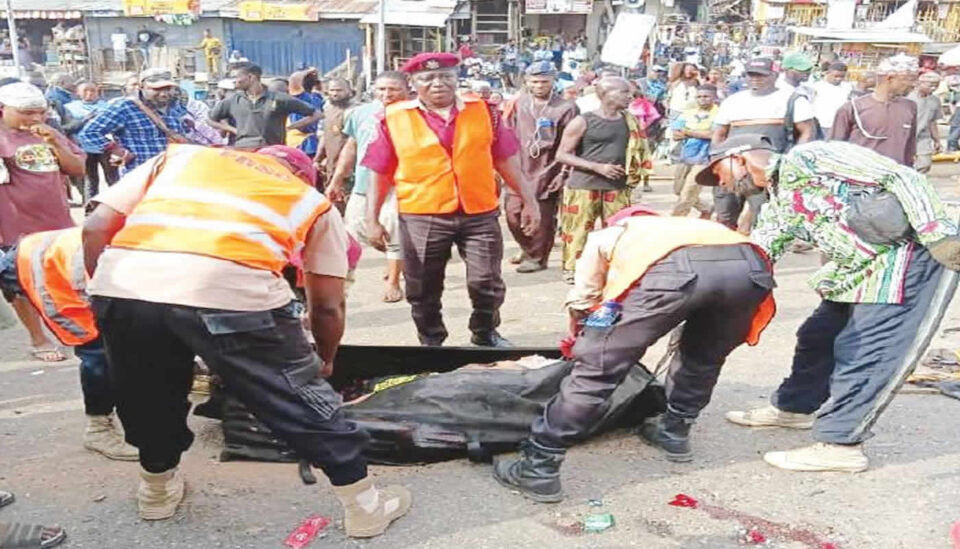
A pedestrian has lost his life after being knocked down by a Toyota Coaster bus at Imowo, along the Imowo-Ibadan Road inward Ijebu Ode in Ogun State.

PUNCH Metro gathered on Monday from the spokesperson for the Ogun State Traffic Compliance and Enforcement Agency, Babatunde Akinbiyi, that the fatal accident occurred at about 4:45 pm on Sunday and caused serious traffic congestion along the route due to the obstruction caused by the bus.

He noted that TRACE operatives and police officers from the Obalende Division were immediately deployed to the scene to manage traffic and rescue operations.

According to him, the accident happened when the pedestrian allegedly failed to check the other side of the road before attempting to cross.

The agency noted that there was a diversion to a single lane outward Ijebu Ode due to ongoing road rehabilitation works along the axis.

The statement read, “According to eyewitness account, the pedestrian forgot to check the other side of the road before crossing the road. There is diversion to one lane due to ongoing road rehabilitation on the axis.”

Akinbiyi added that no other injuries were recorded in the incident aside from the death of the male pedestrian.

He further disclosed that its operatives controlled vehicular movement around the scene to ease traffic congestion and prevent secondary accidents.

“TRACE operatives assisted in carrying the presumed dead into the OGSAS ambulance, while the body was subsequently conveyed to the General Hospital mortuary, Ijebu Ode,” the statement added.

The TRACE Head of Media stressed further that the accidented Toyota Coaster bus was later evacuated from the road and moved to the Police Area Command, Igbeba, for further investigation.

See also  Iran Warns UK That Allowing US To Use British Bases Is Participation In Aggression

The agency confirmed that normal vehicular movement had been restored after the evacuation exercise.

PUNCH Metro reported earlier that an auto crash along the Third Mainland Bridge left a policeman riding on a motorcycle, dead after being hit by a Lexus car.

The driver of the car was said to have surrendered himself to the police following the incident.

Continue Reading

News

FG cracks down on unapproved contract variations in MDAs

Published

on

The Federal Government, through its Bureau of Public Procurement, on Sunday barred government Ministries, Departments, and Agencies from processing upward revisions of contract sums without first obtaining a Bureau certificate.

This was as it issued other sweeping guidelines that centralised the review of all contract variations and scope modifications under its authority. According to a statement signed by its Head of Press and Public Relations, Zira Nagga, the Bureau said the reform is designed to close one of the most persistent channels for cost inflation and corruption in Nigeria’s public procurement system.

The guidelines, issued pursuant to Sections 5(a) and (o) of the Public Procurement Act 2007, give effect to a Federal Executive Council-approved policy conveyed by the Secretary to the Government of the Federation in December 2025.

The statement is titled ‘Contract Variations: BPP Releases Guidelines.’

The new guidelines replace an earlier 2013 framework that required Presidential approval only for variations above 15 per cent of the initial contract sum or N1bn.

Under the new framework, every request for a variation order, fluctuation claim, or scope modification, regardless of size, must first be submitted to the BPP for review and certification before proceeding to the relevant approving authority.

Nagga noted that a BPP Certificate of No Objection, valid for six months, is now a mandatory precondition for any further action. Variations processed without it will attract sanctions under the Public Procurement Act 2007, including suspension of responsible officers and debarment of contractors, the statement said.

It also quoted the Bureau’s Director-General, Adebowale Adedokun, as saying, “Variations must not become a backdoor for cost inflation and scope creep.

See also  FG pushes states to establish power firms as blackouts persist

“These guidelines ensure that every adjustment to a public contract is necessary, justified, and delivers value to Nigerians. The BPP will apply these rules rigorously and fairly across all MDAs.”

Accordingly, the guidelines draw a firm line between permissible and impermissible grounds for variation. Acceptable grounds include unforeseen site conditions, material errors in design or bills of quantities, statutory changes after contract execution, significant price escalation due to macroeconomic shocks or force majeure, and value engineering improvements that reduce cost without altering scope.

Variations arising from inadequate planning, avoidable design flaws, or the addition of new components not contemplated in the original contract scope will be rejected outright, Nagga noted.

Such additions, the guidelines stated, must be procured as entirely separate contracts, a provision aimed at blocking the practice of using variations to effectively award new projects under the cover of an existing contract.

On fluctuation claims, adjustments for changes in the cost of labour, materials, and exchange rates, the guidelines introduced new deterrents against deliberate project delays.

It stated that, going forward, contractors found to have intentionally slowed down execution in order to generate larger fluctuation claims will be denied those claims and may be debarred if the claims are found to be bogus or overstated.

The revised approving authority thresholds are now tied to the augmentation sum, the amount of the increase, rather than the total revised contract cost. Works variations of N10bn and above will require Federal Executive Council approval.

It stated, “Those between N5bn and N10bn go to the Ministerial Tenders Board; those between N75m and N5bn to the Parastatal Tenders Board; and anything below N75m for works, or N50m for goods and services, can be approved at the Accounting Officer level.”

See also  Protests spread in Tanzania over controversial poll

Similar thresholds apply to goods and services procurement. To address the upstream cause of many avoidable variations, the guidelines mandated the use of approved final designs for all procurements from the outset.

It also stated that the use of preliminary or flawed designs that subsequently generate unnecessary variations will attract regulatory sanctions, a provision targeting the entrenched practice of commencing projects with incomplete engineering designs.

On transparency, the BPP said all MDAs are required to publish details of every approved variation, including the contractor’s name, original contract sum, augmentation amount, revised contract sum, and grounds for the increase, on their websites and the BPP portal within 30 days of Tenders Board approval.

The BPP said it will also periodically submit council notes to the Federal Executive Council on reviewed and approved variations across government. The guidelines take immediate effect and apply to all ongoing projects regardless of when the original contract was awarded.

punch.ng

FOLLOW US ON:

FACEBOOK

TWITTER

PINTEREST

TIKTOK

YOUTUBE

LINKEDIN

INSTAGRAM

Continue Reading

Trending