Connect with us

Politics

PDP, ADC blocs reject joint presidential ticket; read details

Published

on

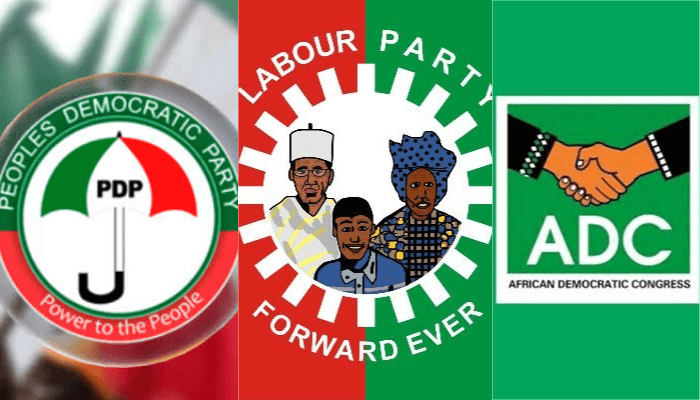
Factions of the Peoples Democratic Party, African Democratic Congress, Accord Party, and Labour Party have rejected the Ibadan opposition summit, stating it does not represent their official stance. They reaffirmed plans to field separate candidates against President Bola Tinubu in the 2027 elections.

The PDP National Working Committee, backed by the Minister of the Federal Capital Territory, Nyesom Wike, claimed that former Vice President Atiku Abubakar, former Senate President David Mark, former Governors Rabiu Kwankwaso (Kano), Peter Obi (Anambra) and other opposition figures were misled by ‘’impostors’’ who organised the summit.

Also reacting, the two ADC camps of the 2023 ADC presidential candidate, Dumebi Kachikwu, led by Kingsley Ogga and Nafiu Gombe, in separate interviews with our correspondents, denied any involvement in the meeting, while the Accord Party warned that it could institute legal action against individuals or groups parading themselves as representatives of the party.

This comes as the Labour Party’s Interim National Chairman, Nenadi Usman, also disassociated the party from the high-profile summit in Ibadan where political leaders agreed to present a single presidential candidate in 2027.

In response, the All Progressives Congress rejected what it called attempts by opposition leaders to exert pressure through blackmail, stating that Oyo State Governor, Seyi Makinde, is unfit to hold office over his alleged inciting remarks about “Operation Wetie” during the summit.

After months of internal wrangling and with several court cases still pending, the ADC, led by David Mark, joined forces with the PDP faction aligned with Governor Makinde and other opposition parties in Ibadan, Oyo State, for an opposition summit on Saturday.

Addressing participants as the chief host, Makinde cautioned the Federal Government against suppressing the political will of Nigerians, recalling that the historic ‘Operation We tie’ crisis began in Ibadan.

‘Operation We tie’ was a violent political uprising that took place in Western Nigeria in 1965. It stemmed from a 1962 power struggle within the ruling Action Group party between Chief Obafemi Awolowo and Chief Samuel Ladoke Akintola, which later escalated following the disputed 1965 elections

In a communique issued after the meeting, the opposition leaders warned the APC-led Federal Government against turning Nigeria into a one-party state, vowing to resist such moves. They announced plans to present a joint presidential candidate against the ruling party in the 2027 election.

Party chairmen who allegedly signed the communique were Mark of the ADC; Tanimu Turaki (SAN) of the PDP, Hakeem Baba-Ahmed of the Peoples Redemption Party; Ajuji Ahmed of the New Nigeria Peoples Party; Cleopas Moses of the National Democratic Coalition; Uche Nnadi of the Action Peoples Party and Mgbudem Maxwell of Accord.

Others included Yusuf Dantalle of the Allied Peoples Movement, Adekunle Omoaje of the Action Alliance, Samuel Memeh, Abdulrahman Abubakar of the Young Progressives Party, Yabagi Sani of the Action Democratic Party, and Dan Nwanyanwu of the Zenith Labour Party.

Notable figures at the summit included former Vice President Atiku Abubakar, Governor Makinde, Obi, Kwankwaso, former Osun State Governor Rauf Aregbesola, former Cross River State Governor Liyel Imoke, and former Sokoto State Governor Aminu Tambuwal.

Also present were former Rivers State Governor Rotimi Amaechi, former Information Minister Jerry Gana, political economist Pat Utomi and Kashim Ibrahim, among others.

Reacting to the development, the Wike-backed PDP described those who convened the Ibadan opposition summit as impostors, adding that it would field a separate candidate against President Tinubu.

Its National Publicity Secretary, Jungudo Mohammed, in an interview with The PUNCH on Sunday, criticised the Turaki-led PDP leaders who attended the summit.

“Certainly, our party cannot be part of that arrangement, not because we are not open to having alliances and understandings with opposition parties. We all belong to the opposition, and we all aim toward achieving one thing, which is taking over power from the APC. But the people who went there were not representing the PDP.’’

Mohammed explained, “Opposition political parties must ensure they interact with legitimate representatives. The individuals who attended in the PDP’s name are impostors, restricted by court order from acting as party leaders.

‘’For us, as the genuine leaders and leadership of the PDP, we distance ourselves completely from yesterday’s gathering, not because we are not open to having alliances, but because of the way and manner other opposition political parties aligned themselves with the wrong leadership.

See also  Bayelsa’s next Deputy Gov: Behind-the-scenes moves, political calculations, intrigues

“Those who attended were misled. Those people you mentioned cannot and will not represent the PDP in anything. The PDP said it a few weeks ago, even during the inaugural speech of the national chairman, that the PDP has not entered into any negotiation or alliance with any political party, be it the ruling APC or any opposition party.

“We are the leading opposition party today, and if there is any need to convene a summit in the name of opposition political parties, the PDP is meant to take the centre stage. Makinde, not being a member of the PDP, could not have had the legitimacy, authority, or mandate to convoke, convene, and hold such a meeting.”

The publicity secretary maintained that their camp offers the only credible platform through which such an arrangement can be achieved.

“You could see from our timetable that we intend to field a presidential candidate. I do not know what they are really talking about. People who do not have a stable political party are talking about fielding a presidential candidate. Which political party do they intend to adopt in fielding that presidential candidate? Not PDP, and we are not part of it.”

“The PDP provides the only credible platform through which such an arrangement could be done, and the PDP that could do that is the one under the leadership of Abdurahman Muhammad and Senator Samuel Anyanwu.”

On its part, the ADC faction led by Interim National Chairman Ogga, also clarified that it was not involved in the summit, adding that opposition parties should instead focus on resolving their internal challenges.

“I want to make it clear that our group was not part of that opposition summit, and we are not in support of the decisions, either. My group does not support that arrangement. Everybody should be free to find and present their own candidate.

“The alliance aspect may sound good, but that is not what we are supposed to focus on now. Our priority should be to put the party in order because there is a crisis within the party, and that is what we should address first,” he admonished.

Also, the Nafiu Gombe-led faction of the ADC rejected both the summit and its resolutions, insisting the party was neither represented nor bound by its outcome.

The Chief of Staff to the bloc’s national chairman, Bala Kumo, made the position clear in an interview with The PUNCH, stressing that the ADC would pursue its independent electoral path.

He said, “We are not in support of it (a single presidential candidate for the opposition) as the authentic members of the African Democratic Congress. So, whatever resolution was taken in that place, we are not in support of it.

“The ADC is an existing party. It wasn’t registered yesterday, the day before yesterday, last week or last month. ADC has been in existence for almost 20 years. We are fielding a candidate, and Inshallah, all the elective offices at all levels will support it.’’

Continuing, he said, “In my view, the Ibadan Summit can best be described as the reunion of former members of the Peoples Democratic Party, aligning with aggrieved or disgruntled individuals who have been ignored by the party.

“So, for the record, I want to assure you that the African Democratic Congress was not involved in the summit, and should not be linked to any outcome or resolution coming from that summit.”

The Labour Party also denied participating in the Ibadan meeting, signalling a cautious approach to any coalition talks at this stage.

The Interim National Chairman of the party, Nenadi Usman, who spoke through her Senior Special Adviser on Media and Publicity, Ken Asogwa, stated that the party’s immediate priority remains its internal consolidation rather than external alliances.

“If you observe, you will discover that we are not part of those who went to the Ibadan Summit yesterday. As it stands today, we are focused on getting substantive leadership for the Labour Party in our next convention coming up next Tuesday, April 28.

“That is the position of the party for now. If there is a need for us in future to be in coalition with other political parties, we will inform Nigerians.”

In a related development, the Prof Chris Imumolen-led Accord Party denied any involvement in the decision reached at the summit, insisting that its name and symbol were used without authorisation and warning that it may pursue legal action against those responsible.

Imumolen, in a statement issued by the party’s National Secretary, Muktar Abdallah, described the use of the party’s flag at the summit as ‘’political impersonation rather than a misunderstanding.’’

See also  Wike - If you want to destroy PDP, bring Obi

Reacting, Imumolen clarified that the Accord Party is not part of any coalition with the ADC, PDP, or any allied group, and did not authorise the use of its name, symbol, or platform in any such arrangement.

The statement read, “This is not an oversight; it is a misrepresentation. The Accord Party will not be dragged into alliances it neither negotiated nor approved. What played out in Ibadan raises serious questions about the credibility and transparency of the coalition itself, if it must lean on the identity of parties that are not even at the table.

“The Accord Party remains focused on the 2027 general elections, with a clear ambition to present a presidential candidate under its own banner, not as a footnote in a hastily assembled coalition.

“Prof. Imumolen has therefore issued a 48-hour ultimatum to the conveners and participants of the Ibadan meeting to publicly explain how and why the Accord Party’s identity was used without consent. Failure to do so will trigger immediate legal action against all individuals and groups involved.

“You cannot borrow legitimacy by force. Those responsible must either explain themselves or prepare to defend their actions in court.”

The Accord Party further said it will strongly defend its identity, structure, and independence, and would not accept any attempt to use its platform for political convenience, whether openly or secretly.

Reacting to the utterances at the Ibadan meeting, the APC strongly condemned Governor Makinde over his  reference to ‘Operation Wetie,’ accusing him of inciting violence and describing his conduct as unbefitting of the office he occupies.

APC, in a statement by its National Publicity Secretary, Felix Morka, on Sunday, noted that Makinde’s violent rhetoric cannot be dismissed as mere opposition posturing, adding that it risks fueling anarchy, murderous rage and widespread lawlessness capable of undermining national stability.

The ruling party described Makinde’s remarks as baseless and senseless, warning that no individual, regardless of status, should be allowed to threaten or endanger the lives and safety of Nigerians or undermine the country’s hard-won democratic governance under the guise of political commentary.

“The All Progressives Congress categorically condemns Governor Makinde’s incitement as reckless and a clear and present threat to peace and national security. It is particularly disturbing for a sitting Governor, who bears constitutional responsibility as the Chief Security Officer of his state, to conjure up one of the darkest episodes of political violence in Nigeria’s history to threaten violence against the people and government of Nigeria.

‘’By his incitement to violence, Makinde has shown himself to be unworthy of the high office of Governor that he occupies. Makinde’s violent rhetoric cannot be dismissed as mere opposition posturing. His statement risks fueling anarchy, murderous rage, and widespread lawlessness capable of undermining national stability. We therefore call on all relevant security and intelligence agencies to take this unfortunate development seriously and act to safeguard lives, property, and defend Nigeria’s democratic order.’’

The APC alleged that the PDP was weakened by former Vice President Atiku’s takeover of its 2023 presidential ticket, which it said violated the party’s rotational zoning arrangement, adding that the Labour Party was allegedly destabilised by former Governor Peter Obi’s frequent party movements in pursuit of a presidential ticket.

It further claimed the ADC collapsed early due to leadership struggles involving the same set of opposition figures, whom it accused of abandoning parties instead of building them, leaving behind disunity within the opposition.

The statement read in part, “At the APC, we are confident that Nigerians are discerning and recognise that a party so grossly unable to manage its own internal affairs cannot be entrusted with the governance of Africa’s most populous and important country.

These opposition leaders and their coalition of confusion have not put forward any alternative vision for Nigeria’s development. All they have in their arsenal is fear-mongering built on false narratives about the APC.’’

Similarly, the Wike-backed PDP, in a statement issued on Sunday by Mohammed, strongly criticised Makinde’s ‘Operation We tie’ remarks.

The statement read, “This disgraceful statement emphatically reiterates that violence has absolutely no place in our political space today. Nigeria must come first, before politics and before personal ambitions. Without a peaceful and stable nation, no political system or democratic process can thrive.

See also  Tinubu picks Disu for pre-2027 security boost, DIGs to retire

“The PDP therefore calls on all Nigerians, irrespective of political affiliation, to unite in rejecting any rhetoric or action that could incite unrest or threaten national cohesion.

“Our shared history reminds us of the cost of division, and we must remain vigilant in safeguarding the peace we have worked hard to build.

“We further urge security and law enforcement agencies to carry out their duties with diligence and professionalism by reviewing the circumstances surrounding these reports and also ensure that all relevant individuals are available to respond to lawful inquiries, no matter how highly placed.”

The Oyo State APC chapter on Sunday described those who attended the summit as clownish characters who lack the capacity to promote democracy and good governance in the country.

In a statement issued by its Publicity Secretary, Olawale Sadare, the party said neither President Tinubu nor anyone in the ruling party would be troubled by the gathering or the actions of opposition figures, who it claimed do not have the seriousness needed to defeat the incumbent president at the polls.

“They are just wasting their time as it is just impossible for them to catch up with a man who is several kilometres ahead of them in a marathon,” the statement added.

Sadare continued, “It is even shameful that Governor Makinde, who has established himself as a naive and deceitful political player, is now the moral compass for some politicians who have recorded irredeemable failures in politics and governance in the past.

“As it stands now, they have gathered only palm fronds to fix a damaged vehicle, even as they look in the direction of fishermen for technical support.

“The ‘Operation We tie’ threat, which came from Gov. Makinde, would not be taken with a pinch of salt as it was a revelation, but he should realise that no unrest or violence will mar the 2027 general elections.’’

In defence of Makinde and the summit, the Turaki-led PDP, in a statement by its publicity scribe, Ememobong, explained that Makinde’s remarks were meant as a caution and advisory to the Federal Government, the APC, and other national institutions about the severe crisis that their actions and inactions could lead to.

“Only a guilty aggressor can interpret it to mean a threat or call to violence. It is common knowledge that those who do not learn from history are doomed by it.

“Governor Makinde offered a sobering reminder that when insatiable political greed and avarice replace patriotism and good governance, and are compounded by the accumulated anger and frustrations of the citizenry, the resultant conflagration will be of immeasurable proportion. This again is a fact that history bears witness to.

“The events that led to the sad incident of ‘we tie’ and the current happenings within the political space, as orchestrated by the APC, are not just similar but identical in both intent and execution. To continue doing the same thing while expecting a different result is the very definition of political recklessness.

“When pushed to the wall, people have no other direction to go but forward, against the wall itself. The current slide into elected totalitarianism has been entirely engineered by the APC and the Federal Government. They cannot decry the effect while remaining wilfully blind to the cause and to their own culpability in it.”

The Turaki-led PDP noted that when the APC was in opposition, it not only issued threats of violence but also openly vowed to make the country ungovernable, using the infamous “baboon and blood” narrative.

It continued, “They therefore lack any moral capacity to complain about a mere historical recollection by a sitting governor.

“As long as the targeted state-sponsored decimation of the opposition continues, the opposition parties will explore increasingly potent strategies, entirely within the ambit of the law, to prevent the enthronement of a one-party state under an elected dictator.

“The APC should be ashamed of its comprehensive failure in both governance and politics, and its resort to the crude tactics of inducement, intimidation, and persecution of opposition leaders.’’


Continue Reading
Click to comment

Leave a Reply

Your email address will not be published. Required fields are marked *

Politics

Read how power struggles threaten Ondo APC’s unity ahead of primaries

Published

on

The race to 2027 has begun, but within the Ondo APC, it is already turning into a battle of survival. Behind official assurances of unity lies a widening struggle for control, influence, and party tickets that could shape the state’s political direction long before the general election, writes PETER DADA

The Independent National Electoral Commission has scheduled political parties’ primaries for the 2027 general elections to hold between April 23 and May 30, 2026. The commission also directed parties to submit their digital membership registers at least 21 days before their respective primary dates—a process already underway.

In line with Section 84(2) of the Electoral Act 2026, political parties are required to adopt either direct primaries or the consensus method in selecting candidates for elective positions. This means all parties participating in the 2027 general elections must choose their flagbearers through one of the two approved modes.

Preparations have since gathered momentum, with aspirants declaring interest in presidential, governorship, National Assembly and state assembly contests. However, in Ondo State and seven other states with off-cycle governorship elections, only presidential, National Assembly and state assembly polls will be conducted.

In the Sunshine State, the All Progressives Congress remains the dominant political force, bolstered by a wave of defections from other parties. This dominance has fueled intense competition among aspirants, driven by the widespread belief that securing the party’s ticket significantly boosts chances of victory in the general election.

Despite this advantage, internal divisions persist within the party. Factions loyal to Governor Lucky Aiyedatiwa, Minister of Interior Olubunmi Tunji-Ojo, and supporters of the late former governor Rotimi Akeredolu continue to jostle for influence. However, none of the groups has openly opposed the re-election bid of President Bola Tinubu, indicating a shared front at the national level despite underlying state-level tensions.

With political parties required to adopt either the consensus or direct primary mode, there are growing concerns among some aspirants that neither option may favour those outside the governor’s camp. As a result, several contenders—particularly serving members of the National and State Assemblies—have reportedly taken their battle to Abuja, seeking automatic tickets from the All Progressives Congress leadership, amid fears that the state-controlled process may work against them.

Apart from Jimoh Ibrahim, who has since secured a diplomatic appointment, other incumbent federal lawmakers from Ondo State are said to be intensifying lobbying efforts at the Presidential Villa and the party’s National Secretariat in a bid to secure endorsement over the state leadership.

Sources within the party also revealed that some aspirants, who are not current legislators, are being pushed forward by influential power brokers in Abuja, in some cases against the preference of Governor Lucky Aiyedatiwa. The governor, it was gathered, is under increasing pressure to accommodate these interests despite having his own preferred candidates, particularly in the Ondo South Senatorial District.

The situation has reportedly heightened tensions within the party. At a recent APC stakeholders’ meeting held in Ore, Odigbo Local Government Area, supporters of various aspirants stormed the venue, apparently poised to resist any attempt by the governor to publicly endorse a preferred candidate. The meeting, which was presided over by Aiyedatiwa, could have degenerated into violence, but the governor refrained from naming any candidate.

Meanwhile, the Ondo South senatorial seat remains vacant following Ibrahim’s diplomatic appointment, with political actors awaiting the Independent National Electoral Commission to announce a date for a by-election.

A party source said the struggle over candidacy has become a major burden on the governor, noting that competing interests from Abuja have complicated his efforts to manage expectations.

See also  Convention: Four PDP governors storm Ibadan as INEC signals boycott

The source said, “The issue of candidacy in the forthcoming primary has become a burden on the governor, although he has his own preferred candidates but some aspirants are being given to him by order from Abuja, he has no option than to accept them. This certainly nullifies whoever he had promised automatic ticket. One thing that is sure is that many of those national and state assembly members may not get the party ticket, as many were cede to him (governor), being the party leader in the state , that’s why all of them are rushing to Abuja if they can get the ticket.

“Second thing is that some of the aggrieved members and aspirants are ready planning to leave the party or involve in anti-party activities if the choosing of the candidate is based on personal vendetta rather than popularity of the aspirants at their respective senatorial districts or federal constituencies.”

However, concerns persist that some of the governor’s preferred aspirants lack widespread support among party members and constituents in their respective senatorial districts and federal constituencies. Analysts warn that imposing unpopular candidates could prove costly for the All Progressives Congress in the general election, especially as some well-known aspirants have reportedly vowed to contest and win, with or without the party’s ticket.

Findings further indicate that the lingering disunity within the party has led Governor Lucky Aiyedatiwa to sideline certain members perceived as political adversaries. Those most affected are loyalists of the Minister of Interior, Olubunmi Tunji-Ojo, as well as supporters of the late former governor, Rotimi Akeredolu. Aspirants within these camps are said to be mobilising for a showdown, holding frequent strategy meetings across Ondo State.

There are also growing fears of a turbulent post-primary period, with observers warning that unresolved grievances could undermine the party’s chances in the general election. Historically, internal crises within the APC have created openings for opposition parties in the state.

Last week’s meetings between Bola Tinubu, the leadership of the National Assembly, and APC governors on the forthcoming primaries—where governors were empowered to oversee the process in their respective states—appear to have dealt a major blow to the ambitions of many anti-Aiyedatiwa APC members in Ondo State. National Assembly members who had relied on securing automatic tickets from Abuja have also been visibly disappointed. This development has disrupted several political calculations and permutations ahead of the primaries.

A reliable party source indicated that the situation has become less complex for Governor Aiyedatiwa. Although some aspirants were allegedly imposed on him by powerful interests in Abuja, he may still find ways to support his preferred candidates during the primaries, regardless of the mode of the exercise. However, this development carries the risk of deepening divisions within the party, as aggrieved aspirants and members of the anti-Aiyedatiwa faction may resort to anti-party activities during the general election unless decisive reconciliation efforts are undertaken by the governor and party leadership. To avert this, Governor Aiyedatiwa and the new party chairman, Mr. Kolawole Babatunde, need to initiate genuine reconciliation moves.

The source further revealed that the governor has preferred candidates, particularly in the Ondo South Senatorial District—his home district—whom he intends to support for party tickets. However, upon learning of this, some aspirants from the district, along with hundreds of their supporters, reportedly stormed the APC stakeholders’ meeting held on Sunday, April 19, in Ore, Odigbo Local Government Area. The meeting, presided over by the governor, nearly turned violent as protesters warned against the endorsement of any aspirant as the governor’s preferred candidate ahead of the primaries. Tensions were only defused when the governor refrained from naming any candidate.

See also  Tinubu Seeks Senate Confirmation of Amupitan as New INEC Chairman

Meanwhile, the Ondo South senatorial seat remains vacant following the diplomatic appointment of its former occupant, Jimoh Ibrahim. Political contenders are now awaiting the Independent National Electoral Commission (INEC) to announce a date for the bye-election.

According to the source:

“The issue of candidacy in the forthcoming primaries has become a burden for the governor. While he has his preferred candidates, others are being imposed on him from Abuja, leaving him with little choice but to accommodate them. The meeting convened by President Tinubu with governors and National Assembly members has further strengthened the governors’ influence over the primaries. This effectively nullifies any prior promises of automatic tickets to federal lawmakers, meaning many current legislators may not secure party nominations.

“Another implication is that aggrieved aspirants and party members are already considering defecting or engaging in anti-party activities if candidate selection is perceived to be driven by personal interests rather than popularity within their constituencies.”

There are also concerns that some of the governor’s preferred aspirants lack widespread support among party members and constituents. Imposing such candidates could undermine the party’s chances in the general election, especially as some popular but sidelined aspirants have reportedly vowed to contest—and potentially win—even without the APC ticket.

Further findings suggest that internal divisions within the party have intensified, with the governor allegedly sidelining members perceived as political opponents. Those most affected are individuals loyal to certain ministers and to the late Rotimi Akeredolu. Aspirants within this group are reportedly preparing for a political showdown, holding frequent strategy meetings across the state.

Many observers fear that the Ondo APC may face a turbulent post-primary crisis. Without effective conflict resolution, the party risks entering the general election deeply divided, which could significantly weaken its chances at the polls.

A similar scenario played out ahead of the 2019 general elections, when aggrieved party members defected or engaged in anti-party activities, leading to electoral losses in some senatorial districts and federal constituencies. Many believe a repeat is possible, as some disaffected aspirants are already exploring alternative political options.

Despite these concerns, Governor Aiyedatiwa sought to calm tensions at a recent stakeholders’ meeting by avoiding any public endorsement of candidates. Instead, he appealed for unity and party loyalty, urging aspirants to prioritise collective interest over personal ambition.

He further encouraged members to remain committed regardless of the outcome of the primaries, stressing that political success often requires patience and perseverance.

He said, “I am aware that many of you have individual ambitions — whether for the State House of Assembly or the National Assembly—but there is a paramount collective goal, and that is the re-election of President Bola Ahmed Tinubu in 2027. I therefore urge you to remain loyal and committed to the party, whether you win or not. There is always a time for everyone. Only one person can emerge at a time.

“There was a time I contested for the House of Representatives and did not get it. I also contested for the Senate; although I won the primary election conducted in the state, the party’s national leadership later granted an automatic ticket to the incumbent. Yet, I did not leave the party. In 2016, I was shortlisted for the deputy governorship ticket but was not eventually selected. Still, I remained a committed member. Today, I am the governor. So, there is time for everyone.”

In the same vein, the Director of Media and Publicity of the APC in Ondo State, Steve Otaloro, downplayed fears of a post-primary crisis, assuring that whichever mode is adopted for the forthcoming primaries will be credible and widely accepted.

See also  Starmer pushes strategic UK-Nigeria alliance with N1.4tn fresh deal

According to him, the party has established internal mechanisms to ensure a smooth and transparent process.

“The mode of primary for the APC in Ondo State will ultimately be decided through the party’s internal processes, in line with constitutional provisions and guidelines. What is critical is not necessarily the method adopted—whether direct primary or consensus—but the credibility of the process,” he said.

Otaloro stressed that both options are constitutionally recognised and must be implemented in a transparent, inclusive, and fair manner to all aspirants.

“Once the process is open and credible, it will naturally command acceptance among stakeholders and party faithful, thereby reducing the likelihood of rancour. The APC in Ondo State has the institutional capacity and leadership maturity to manage this effectively,” he added.

“Our collective priority is to ensure unity, uphold democratic principles, and strengthen the party ahead of the forthcoming electoral engagements.”

However, a group within the party, the Progressive Network for Tinubu, has warned against the imposition of unpopular candidates, insisting that the consensus option must reflect the will of the people.

The group’s Director-General, Olumide Obadele, said internal selection processes must prioritise popularity and grassroots support to avoid electoral setbacks.

“I believe strongly that the consensus approach, if properly applied, should produce the most popular candidate. Imposing an unpopular candidate could weaken the party’s chances at the polls,” he said, warning that voters are increasingly driven by popularity rather than financial influence.

He expressed confidence, however, that party leaders would not undermine the process by imposing candidates lacking public support.

“I can tell you, for free, that the consensus approach is the best approach we can use in politics. The indirect approach, for me, is too expensive. If you don’t have the funds or deep pockets, you cannot pursue it.

“But with the consensus idea, the most popular candidate emerges. Nobody will put forward an unpopular candidate because that would lead to failure in the election. It is a game of popularity. In the past, someone who was not popular but had deep pockets could succeed. But now, it is a game of popularity.”

Also weighing in, political scientist Muyiwa Aloba urged Governor Aiyedatiwa to tread carefully in managing the party’s internal tensions.

Aloba noted that while internal disputes were common in political parties, effective conflict management remained critical to electoral success.

“The only problem human beings have is that people don’t learn from history. What is happening now in Ondo APC is not new. Similar issues occurred during the administration of Rotimi Akeredolu, and poor crisis management contributed to the party’s losses in the 2019 elections,” he said.

He advised the governor to adopt an inclusive approach, accommodate diverse interests within the party, and prioritise unity ahead of the 2027 general elections.

“Conflicts are part of politics, but how they are managed will determine the party’s success,” he added.

“I will only advise the governor to learn from history, I will advise him, as a leader of the party in the state, to forget the past, accommodate and manage every interest and groups in the party if he wants the party to win well in the next year general election.”

punch.ng

FOLLOW US ON:

FACEBOOK

TWITTER

PINTEREST

TIKTOK

YOUTUBE

LINKEDIN

INSTAGRAM

Continue Reading

Politics

Atiku warns against campaign suspension in Borno, Benue, others

Published

on

Former Vice President Atiku Abubakar has cautioned against moves to suspend political campaigns in parts of Northern Nigeria, warning that such a step could undermine constitutional rights and deepen fears of disenfranchisement amid worsening insecurity.

Atiku’s reaction follows reports that the Senate may be weighing the suspension of political activities in eight states grappling with escalating violence, including Borno, Benue and Plateau.

In a statement issued on Sunday by his Senior Special Assistant on Public Communication, Phrank Shaibu, the presidential aspirant on the platform of the African Democratic Congress described the development as deeply troubling, noting that while insecurity remained a grave national challenge, it must not be used to justify restrictions on democratic participation.

He said, “Let it be clearly stated that the right to vote and participate in the electoral process is fundamental and cannot be abridged under any guise.

“Any attempt—whether deliberate or disguised—to suppress political activities in parts of Northern Nigeria raises legitimate concerns about disenfranchisement.”

Atiku recalled earlier intelligence suggesting possible efforts to weaken electoral participation in key northern states, warning that recent developments appeared to reinforce such concerns.

“This is not merely about campaigns; it is about representation, inclusion, and the integrity of our democratic process.

“You cannot cure insecurity by silencing the voices of the people. Democracy must not become a casualty of government failure,” he added.

The former vice president stressed that citizens in the North, like their counterparts across the country, deserved both security and full democratic participation, insisting that neither should come at the expense of the other.

See also  PDP Reps reduced to 72 as Enugu lawmakers join APC

He added that it remained the responsibility of the government to guarantee security, just as citizens must be allowed to freely exercise their civic rights without fear or intimidation.

“At a time when citizens are already battling hardship and insecurity, the least the government can do is to guarantee their right to be heard, not to restrict it.

“Any policy that creates the impression of targeted exclusion will only deepen distrust and national division,” he warned.

Atiku further called on the Independent National Electoral Commission, security agencies and the administration of President Bola Tinubu to clarify their positions and reassure Nigerians that no part of the country would be denied its constitutional rights.

The debate over suspending political activities comes amid renewed anxiety within the National Assembly over the deteriorating security situation, particularly in the North-East and parts of the North-West and North-Central.

Last week, the senator representing Bauchi Central, Abdul Ningi, urged the Senate to consider far-reaching emergency measures, including halting political activities in frontline states most affected by insurgency and banditry.

Raising a point of order during plenary, Ningi warned that the worsening violence demands urgent and decisive action beyond routine deliberations.

He said, “Mr President, we cannot continue to think that because we are in Abuja, therefore this thing (insecurity) does not affect us.

“One of the things that we must do, and I want us to take this issue very seriously, is either to suspend all political activities across this country or look at the frontline states of Borno, Plateau, Bauchi, Benue, Niger, Sokoto, Kebbi and some parts of Kano.

See also  Tinubu Seeks Senate Confirmation of Amupitan as New INEC Chairman

“We need to suspend activities in these states until we are sufficiently certain that the insecurity challenges are over.

“This is because we are not dealing with this insecurity issue at all. And I am not blaming anybody. We cannot come here every time to lament.”

Ningi’s proposal reflects mounting concern over a resurgence of attacks by Boko Haram insurgents, including coordinated assaults on military formations and renewed threats against rescue operations for abducted civilians.

Continue Reading

Politics

APC Elders Endorse Tinubu, Namadi, Purchase ₦150 Million Nomination Forms

Published

on

The All Progressives Congress (APC) Elders Committee in Jigawa State has purchased nomination forms worth ₦150 million for President Bola Ahmed Tinubu and Governor Umar Namadi, endorsing both leaders as sole candidates for the 2027 elections.

The endorsement was announced by the Jigawa APC Chairman, Ahmed Garba, during a strategic meeting with Governor Namadi in Dutse.

According to him, the decision followed extensive consultations among party elders, stakeholders, and political leaders across the state.

He noted that the move was aimed at strengthening unity within the party and ensuring continuity in governance at both the national and state levels.

The development comes as the APC released its timetable for the 2027 elections, fixing its presidential primary for May 15 and 16, 2026.

Under the party’s guidelines, presidential aspirants are required to pay ₦100 million for expression of interest and nomination forms, while governorship aspirants are to pay ₦50 million.

The Jigawa APC Elders Committee also adopted the consensus model for the party’s primaries, describing it as a strategy to minimise internal disputes and present a united front.

The committee said the approach would promote stability within the party and enhance its chances in the 2027 general elections.

Party leaders expressed confidence in the leadership of Tinubu and Namadi, citing achievements in infrastructure, agriculture, education, and economic reforms.

They added that the early endorsement would consolidate support for the APC and strengthen preparations ahead of the elections.

The committee maintained that the decision reflects the collective will of stakeholders in the state to sustain ongoing development efforts and secure victory for the party at all levels.

See also  Starmer pushes strategic UK-Nigeria alliance with N1.4tn fresh deal

FOLLOW US ON:

FACEBOOK

TWITTER

PINTEREST

TIKTOK

YOUTUBE

LINKEDIN

INSTAGRAM

Continue Reading

Trending