Connect with us

Business

NNPC / Heirs Energies ends gas flaring at OML 17, seals deals with offtakers

Published

on

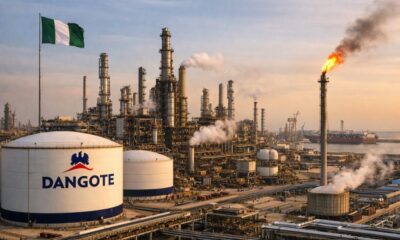
The NNPC / Heirs Energies OML 17 Joint Venture on Tuesday signed Gas Flare Commercialisation Agreements under the Nigerian Gas Flare Commercialisation Programme and approved Non-NGFCP frameworks.

At the ceremony held in Lagos, the JV said the event marked a significant transition from regulatory approvals to structured commercial execution, enabling flare gas volumes across OML 17 to be captured and deployed for productive use, including power generation, industrial applications, cooking gas and compressed natural gas, in alignment with Nigeria’s gas development priorities and energy-transition objectives.

The agreements brought together Heirs Energies, as operator of the OML 17 Joint Venture, and approved flare gas offtakers under frameworks designed to eliminate routine flaring while converting previously wasted resources into economic value.

The offtakers are AUT Gas, Twems Energies, Gas & Power Infrastructure Development Limited (PCCD) and Africa Gas & Transport Company Limited.

Speaking at the ceremony, the Chief Upstream Investment Officer of NNPC Upstream Investment Management Services, Seyi Omotowa, representing NNPC Limited, described the milestone as a practical demonstration of Nigeria’s commitment to gas-based development.

“For us at NNPC Limited and NUIMS, flare gas commercialisation is not a compliance exercise; it is a strategic pathway to improving energy availability, deepening gas-based industrialisation and strengthening Nigeria’s position as a responsible energy producer. OML 17 has become a practical model of this vision, moving decisively from approval to delivery.”

He commended Heirs Energies for disciplined execution and investment, noting that the JV continues to set benchmarks for operational delivery and gas development within Nigeria’s upstream sector.

See also  Net reserves jump 772% to $34.8bn in two years

The Nigerian Upstream Petroleum Regulatory Commission Chief Executive, Gbenga Komolafe, who was represented at the ceremony by the Senior Manager, NUPRC, Mr Ojo Olalekan, reaffirmed the commission’s commitment to supporting the implementation of flare gas commercialisation projects and ensuring that operators and offtakers are enabled to deliver bankable, environmentally responsible gas-to-market solutions in line with the Petroleum Industry Act 2021.

“This ceremony demonstrates Heirs Energies’ commitment to eliminating routine gas flaring across OML 17 and aligns fully with the commission’s Gas Flare Commercialisation Programme and national energy and emission-reduction objectives,” he said.

Heirs Energies’ Chief Executive Officer, Osa Igiehon, noted that the agreements reflect the company’s broader gas-led strategy and brownfield excellence approach, focused on creating long-term value for Nigeria.

“Gas sits at the heart of Nigeria’s development journey. Through disciplined investment, partnership with regulators and credible offtakers, and a clear execution focus, we are converting waste into value, strengthening domestic energy supply and supporting responsible operations across OML 17,” he noted.

Igiehon added that the NGFCP and Non-NGFCP flare gas projects build on recent operational progress by the OML 17 Joint Venture, including a significant increase in gas delivery to the domestic market through brownfield interventions and infrastructure optimisation.

“The JV has also continued to deepen its host-community partnerships through targeted healthcare interventions, education support and skills-development programmes across its areas of operation.

“With the symbolic signing completed, the flare gas offtakers are expected to progress into full project implementation, working closely with the JV, regulators and communities to deliver commercial, environmental and social outcomes.

See also  FAAC deductions gulp 41% of N84tn revenue in three years

“The OML 17 NGFCP initiative reinforces Nigeria’s position as a gas-led economy, supporting domestic power generation, industrial growth and responsible resource development while advancing the country’s energy-transition objectives,” he stated.

punch.ng

FOLLOW US ON:

FACEBOOK

TWITTER

PINTEREST

TIKTOK

YOUTUBE

LINKEDIN

TUMBLR

INSTAGRAM

Continue Reading
Click to comment

Leave a Reply

Your email address will not be published. Required fields are marked *

Business

Lagos bans petroleum tankers from transporting edible oil

Published

on

The Lagos State Government has banned the use of petroleum tankers in the transportation and distribution of edible oil as part of efforts to strengthen food safety, hygiene, and compliance standards across the sector.

The restriction forms part of a broader regulatory framework introduced through a Memorandum of Understanding (MoU) signed between the Lagos State Consumer Protection Agency (LASCOPA) and major stakeholders in the edible oil transportation chain.

The agreement involves the Marketers and Sellers of Edible Oil Association of Nigeria (MASEON), the Nigerian Association of Road Transport Owners (NARTO), and the Association of Edible Oil Tanker Drivers of Nigeria under the National Union of Edible Oil Tanker Drivers of Nigeria (ETD/NUEOTDN).

In a statement issued on Friday, LASCOPA said the move was aimed at stopping the use of tankers previously deployed for petroleum and hazardous substances in the transportation of edible oil.

The agency warned that the practice exposes consumers to serious health risks caused by possible contamination from chemical residues left in fuel tankers.

“The key objectives of the agreement include ensuring that tankers designated for edible oil transportation are used exclusively for that purpose; preventing the use of edible oil tankers for petroleum products and hazardous substances,” the statement read.

According to the agency, the MoU introduces a strict compliance framework mandating the exclusive use of food-grade certified tankers for edible oil transportation.

LASCOPA said the framework would also strengthen hygiene standards, improve traceability, and enhance operational monitoring within the edible oil distribution chain.

The agency added that stakeholders have committed to implementing tanker registration and identification systems, periodic inspections, random spot checks, laboratory testing of edible oil samples, and joint enforcement operations to ensure full compliance.

See also  FAAC deductions gulp 41% of N84tn revenue in three years

It further stated that enforcement activities would be intensified under the Lagos State Consumer Protection Agency Law, 2025.

“Stakeholders are committed to tanker registration, identification systems, periodic inspections, random spot checks, laboratory testing of edible oil samples, and joint enforcement operations to ensure compliance,” the statement added.

LASCOPA also said it would step up monitoring activities and investigate consumer complaints as part of efforts to protect public health and improve consumer confidence in food transportation standards across Lagos State.

punch.ng

FOLLOW US ON:
FACEBOOK

TWITTER

PINTEREST

TIKTOK

YOUTUBE

LINKEDIN

INSTAGRAM

Continue Reading

Business

NNPC urged to revive refineries after Dangote snub

Published

on

The National Publicity Secretary of the Independent Petroleum Marketers Association of Nigeria, Chinedu Ukadike, has tackled the Nigerian National Petroleum Company Limited (NNPC) over its attempt to increase its stake in the Dangote Petroleum Refinery despite the poor state of government-owned refineries.

Ukadike stated this while reacting to comments by the President of the Dangote Group, Aliko Dangote, that the refinery rejected requests by the NNPC to increase its 7.25 per cent stake in the $20bn facility.

Dangote had disclosed this during an interview with the Chief Executive Officer of the Norwegian Sovereign Wealth Fund, Nicolai Tangen, monitored by our correspondents on Wednesday.

Reacting to the development, Ukadike questioned why the national oil company was seeking to invest more funds in the privately-owned refinery when the Port Harcourt, Warri, and Kaduna refineries under its control had remained largely inactive despite billions of dollars spent on rehabilitation.

“Why is NNPC trying to invest money in the Dangote refinery when it has three refineries that are not working? Why is NNPC not investing that money in those ones?” Ukadike asked.

He added, “The NNPC did not revive our refineries, but they want to look for where the refinery is already working to put money into it. Does that make sense?”

The IPMAN spokesman said Dangote had the right to reject the offer from the NNPC if he considered it unsuitable for his business interests.

“If Dangote refused to sell more stakes to NNPC, he must have his reasons. Dangote is a businessman. He doesn’t want issues, unnecessary crises, and nepotism. He knows what he wants, and I also think he has enough cash to fund his business,” he stated.

See also  CBN announces new withdrawal limit, removes deposit cap

Ukadike further urged the national oil company to focus on reviving critical oil infrastructure across the country instead of pursuing additional ownership of the refinery. “The NNPC should repair the pipelines and revive the refineries instead of eyeing the Dangote refinery,” he said.

Dangote had stated during the interview that the NNPC was interested in acquiring more shares in the refinery after previously purchasing a 7.25 per cent stake for $1bn in 2021. According to him, the request was rejected because the company planned to list the refinery publicly and allow more Nigerians to own shares in the project.

“The other biggest risk is government inconsistencies in policies, and we are addressing that one because if you look at our refinery, the national oil company already owns 7.25 per cent, and they are trying to buy more. We are the ones that said no; we want to now spread it and have everybody be part of it,” Dangote said.

The NNPC had initially planned to acquire a 20 per cent stake in the refinery, but later reduced its ownership to 7.25 per cent after failing to pay the balance before the June 2024 deadline.

Dangote had explained this in 2024, saying, “The agreement was actually 20 per cent, which we had with NNPC, and they did not pay the balance of the money up until last year; then we gave them another extension up until June (2024), and they said that they would remain where they had already paid, which is 7.2 per cent. So NNPC owns only 7.2 per cent, not 20 per cent.”

See also  Global markets surge on US rate hopes

However, a stakeholder in the petroleum sector who pleaded for anonymity because of the sensitivity of the matter held that the interest of the nation is well served by NNPC having a 20 per cent stake in the Dangote refinery.

“I think Nigeria is better served by NNPC being a shareholder. If NNPC could have taken 20 per cent of that refinery, Nigeria as a country would be better served,” the stakeholder said.

According to him, the fact that the NNPC failed to get the 20 per cent take before does not mean it could not get it again. He said Dangote refused NNPC’s offer because he wants to remain in control.

“You know Dangote is planning to value his company at $50bn. I think he’s going to sell 10 per cent only, so he remains in control, making a lot of money for himself. Selling only 10 per cent means he has 90 per cent. If NNPC were there with 20 per cent, then NNPC would have two directors. These two directors would have some say,” he said.

The stakeholder added that such an important asset cannot exist in a country without the government’s involvement.

“You can’t have such a big asset in the country, and then the government or the government’s agent has no say in the decisions of that company. It can’t happen. It’s wrong. I’m not saying the government must have a say in all the big companies, but in a company that is so big that it can influence whether the sun rises or falls in that country, the government must have a say.

See also  Net reserves jump 772% to $34.8bn in two years

“The refinery is big. In any case, NNPC is also the supplier of last resort. It’s the national oil company. That has some meaning. I think that in the best interest of the country, if we all agree that Dangote is too big to fail, then it means that Nigerians as a people need to be inside the Dangote refinery to make sure it does not fail,” the operator said.

Meanwhile, a senior official of the NNPC said the NNPC is proud of its current stake in the Dangote refinery.

“The NNPC is proud and happy that we own a 7.2 per cent stake in Dangote. And whatever we own as a stake in Dangote as a national oil company is on behalf of the entire Nigeria. So, when the opportunity presents itself in the long term, yes.

“But right now, we are proud of the 7.2 per cent stake we own in the Dangote refinery. Apart from that, the quality and level of collaboration that is currently going on between NNPC and Dangote is in the interest of the entire Nigeria,” the official said, begging not to be mentioned because he was not authorised to speak on the matter.

punch.ng

FOLLOW US ON:

FACEBOOK

TWITTER

PINTEREST

TIKTOK

YOUTUBE

LINKEDIN

INSTAGRAM

Continue Reading

Business

2027 poll spending may trigger inflation, MPC warns

Published

on

The Governor of the Central Bank of Nigeria and Members of the Monetary Policy Committee have warned that rising political and election-related spending ahead of the 2027 general elections could undermine the country’s disinflation gains and trigger fresh inflationary pressures.

The warnings were contained in the personal statements of MPC members released by the apex bank and obtained by The PUNCH on Thursday. The MPC, at its 304th meeting held on February 23 and 24, 2026, reduced the Monetary Policy Rate by 50 basis points from 27 per cent to 26.5 per cent, while retaining other key monetary parameters.

CBN Governor, Olayemi Cardoso, had earlier warned in the MPC communiqué that election-related fiscal spending could threaten the inflation outlook despite the current moderation in prices.

According to the communiqué signed by Cardoso, “The outlook indicates that the current momentum of domestic disinflation will continue in the near term. This is premised on the lagged impact of previous monetary policy tightening, sustained stability in the foreign exchange market and improved food supply. However, increased fiscal releases including election-related spending could pose upside risk to the outlook.”

Also, in his personal statement, he noted “Growing fiscal pressures, from reduced government fiscal headroom and the approaching 2027 election cycle, warrant particular attention given the well-established link between pre-election fiscal expansion and inflation.”

CBN Deputy Governor for Economic Policy, Dr Muhammad Abdullahi, also highlighted election-related spending as a major risk to the inflation outlook. He said, “As political activities intensify ahead of the 2027 elections, increased fiscal injections and consumption spending could elevate demand-side inflation.”

See also  EFCC Begins Probe Of Ex-NMDPRA Boss After Dangote’s Petition

Abdullahi added that “the fiscal deficit has already increased significantly, and election-related spending is likely to exacerbate this trend in 2026 and early 2027.” According to him, stronger fiscal-monetary coordination would be needed to manage the liquidity impact of rising government spending.

Similarly, the CBN Deputy Governor for Operations, Emem Usoro, warned that the pre-election environment could worsen liquidity conditions and inflation expectations. Usoro stated, “Crucially, the pre-election environment increases the risk of liquidity surges, higher FX demand and a drift in inflation expectations.”

She added that the risks justified maintaining tight liquidity conditions despite the moderate rate cut. According to her, “These considerations support small, cautious adjustments and the retention of strong liquidity and prudential buffers.”

Also raising concerns was the newly appointed Deputy Governor, Lamido Yuguda, who said increased fiscal releases and election spending could disrupt the disinflation trend.

Yuguda, who was a former Director General of the Securities and Exchange Commission, noted, “The 75 per cent CRR on non-TSA public deposits remains critical, particularly given the potential for increased fiscal releases as implementation of Executive Order 9 advances.”

He further warned that, “Potential increases in fiscal spending associated with the electoral cycle could generate demand pressures and disrupt the disinflation trajectory.”

A member of the MPC, Dr Aloysius Ordu, warned that political spending tied to the elections could put pressure on foreign exchange demand and test the resilience of the economy. He said, “Domestically, rising political spending and FX demand pressures associated with the 2027 elections will test the resilience of the economy.”

See also  FAAC deductions gulp 41% of N84tn revenue in three years

Ordu added that although reforms such as Executive Order 9 were expected to improve fiscal transparency and strengthen reserves, high debt servicing costs and political-cycle spending remained major concerns for macroeconomic management.

Another MPC member, Bandele Amoo, also expressed concern over excess liquidity from fiscal injections and early political activities ahead of the elections. He said, “My primary concern is the persistence of excess liquidity from fiscal injections, which could undermine disinflation gains and exchange rate stability.”

Amoo further noted that “fiscal spending pressures linked to the 2026 budget cycle, and early political activities ahead of the 2027 elections may heighten risks.”

Another committee member, Professor Murtala Sagagi, said the main domestic risks to inflation included fiscal slippages and election-related spending. He said, “Upside risks to the inflation outlook warrant monitoring, particularly increased fiscal releases including election-related spending and any pass-through from global oil price volatility to domestic fuel prices.”

Sagagi added that “the primary domestic risks are fiscal slippage and the possibility of election-related spending which are medium-term in nature.” He urged stronger fiscal discipline and closer coordination between monetary and fiscal authorities.

The next meeting of the Monetary Policy Committee is scheduled to hold on Tuesday, May 19 and Wednesday, May 20, 2026. This would be about four days after the National Bureau of Statistics is expected to release the country’s Consumer Price Index report for April 2026 on May 15.

Nigeria’s inflation rate rose to 15.38 per cent in March 2026, marking a reversal in the recent easing trend, as increases in food, transport, and accommodation costs pushed prices higher. The PUNCH observed that this was the first time the headline inflation rate had increased since March 2025.

See also  Global markets surge on US rate hopes

In its Inflation Forecast report for April 2026, the Financial Market Dealers Association projected that Nigeria’s headline inflation would rise to 16.42 per cent year-on-year in April 2026, as sustained pressure from food prices, higher energy costs and elevated global commodity prices continue to shape the domestic price environment.

punch.ng

FOLLOW US ON:

FACEBOOK

TWITTER

PINTEREST

TIKTOK

YOUTUBE

LINKEDIN

INSTAGRAM

Continue Reading

Trending