Connect with us

Business

Afreximbank drives $4bn funding for Dangote refinery

Published

on

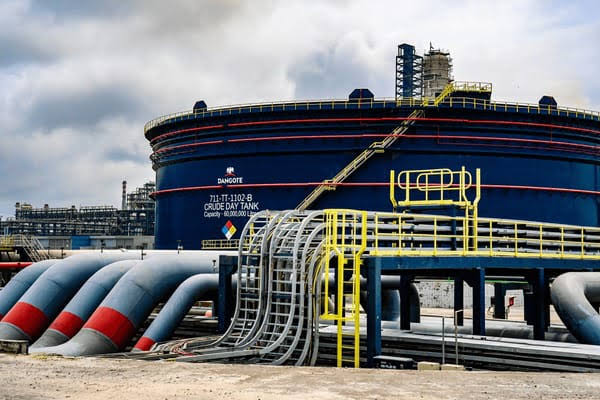
The African Export-Import Bank has underwritten $2.5bn out of a $4bn senior syndicated term loan for Dangote Petroleum Refinery and Petrochemicals, in a move aimed at strengthening the refinery’s financial position and supporting its long-term growth.

In a statement issued on Tuesday and posted on its website, the bank said it acted as a co-Mandated Lead Arranger alongside Access Bank for the five-year facility. It explained that the loan would be used to consolidate existing debt, optimise the refinery’s capital structure, and align its financing with current operational realities.

The bank described the deal as a major milestone for the Dangote refinery, which has a refining capacity of 650,000 barrels per day and is regarded as Africa’s largest refinery and petrochemical complex. Afreximbank noted that its $2.5bn contribution represents the largest share in the syndicate, underscoring its leadership role in mobilising capital for Africa’s industrialisation.

The statement read, “African Export-Import Bank (Afreximbank) is pleased to announce that it has underwritten $2.5bn in the $4bn senior syndicated term loan in favour of Dangote Petroleum Refinery and Petrochemicals FZE.

“Afreximbank and Access Bank were appointed co-Mandated Lead Arrangers for the five-year facility to consolidate existing financing, optimise its capital structure, and align with the refinery’s operational status and long-term growth plan.

“The transaction marks a major milestone for DPRP, Africa’s largest refinery and petrochemical complex with a capacity of 650,000 barrels per day. The facility will enhance balance sheet flexibility, strengthen the company’s financial position, and support the refinery as a strategic supplier of refined petroleum products to Africa and the global market.”

See also  Vehicle imports slide 10% on weak consumer spending

The bank said the financing aligns with its broader mandate to promote import substitution, boost intra-African trade, and enhance energy security across the continent.

“Afreximbank’s participation of $2.5bn is the largest share in the syndicate and underscores the Bank’s leadership in mobilising capital to support Africa’s industrialisation, advancing import substitution, promoting intra-African trade in refined petroleum products, and strengthening energy security.

“Since the commencement of refining operations in February 2024, Afreximbank has supported the refinery with a $1bn working capital facility, as well as acting as Financial Adviser on the Naira-for-Crude initiative, which is facilitating the purchase of crude oil and sale of refined products in local currency, eliminating the dependence on foreign currency,” the statement added.

Providing further insight, the President and Chairman of the Board of Directors of Afreximbank, George Elombi, said the bank’s continued investment in the Dangote Group reflects its confidence in African-led industrial projects.

“We take immense pride in being the single largest provider of financing to the Dangote Group. We do so primarily because Dangote is African. When we invest in ourselves, we do more than create jobs and wealth or expand government revenues; we build a secure and resilient future for our continent. This is why we are pleased to have invested about $15bn in the Dangote Group since 2015.

Elombi stressed that there was nothing more rewarding than investing in African enterprises, emphasising that empowering them was imperative for the continent’s self-sustainability.

He noted, “Afreximbank and its Board of Directors stand ready to support the realisation of Dangote Group’s aspirations because, when we build our institutions and provide the requisite support to grow, we will no longer have to look elsewhere for benevolence or salvation in difficult times.”

See also  CCB quizzes OSOPADEC leadership over alleged N463m misappropriation

This transaction makes a powerful statement about Afreximbank’s commitment to backing transformative and indigenous industrial projects that are reshaping Africa’s economic future.

The Dangote refinery stands as a bold symbol of what African ambition, African capital, and African execution can achieve at scale. Beyond expanding refining capacity, it is strengthening the foundations of Africa’s energy security, reducing dependence on imports, and opening new frontiers for intra-African trade and industrial development.

Afreximbank is proud to stand alongside this historic achievement and to continue supporting the continent’s journey towards greater self-sufficiency, resilience, and prosperity.”

Reacting, the President and Chief Executive Officer of Dangote Industries Limited, Aliko Dangote, said the facility would position the refinery for its next growth phase.

“This financing marks an important step in strengthening the financial foundation of Dangote Petroleum Refinery & Petrochemicals and positions the business for the next phase of its growth,” he said. “We appreciate Afreximbank’s continued support and confidence in our vision to build world-class industrial capacity that serves Nigeria, Africa, and global markets.”

The bank also disclosed that the loan attracted strong interest from a consortium of African and international financial institutions, reflecting sustained investor confidence in the refinery project.

The $20bn Dangote refinery commenced operations in February 2024 and has been positioned as a game-changer in Nigeria’s downstream oil sector, with expectations to significantly reduce the country’s reliance on imported petroleum products.

Afreximbank has been a key financial partner in the project, having previously provided a $1bn working capital facility and served as financial adviser on the Federal Government-backed naira-for-crude initiative.

See also  States demand forensic audit of $8.8bn crude-for-loan deals

The initiative allows the refinery to purchase crude oil and sell refined products in naira, easing pressure on foreign exchange demand and supporting local currency stability. The latest $4bn syndicated loan signals growing confidence in the refinery’s operational viability and its potential to reshape energy supply dynamics across Africa.

The syndicated term loan attracted strong interest from a consortium of African and international financial institutions, reflecting continued confidence in the Dangote Petroleum Refinery as a transformative industrial asset and in Africa’s broader industrialisation agenda.

punch.ng

FOLLOW US ON:

FACEBOOK

TWITTER

PINTEREST

TIKTOK

YOUTUBE

LINKEDIN

Continue Reading
Click to comment

Leave a Reply

Your email address will not be published. Required fields are marked *

Business

Oil nears $110 as Trump threatens strike in Iran

Published

on

Oil prices rose to $109.3 on Sunday amid the unending tension in the Middle East, data by Oilprice.com has shown.

This was as the United States President, Donald Trump, warned Iran that the “clock is ticking” after talks to bring the war to an end continued to stall.

From about $107 a barrel last week, oil prices continue to go higher, impacting the cost of refined petroleum products at the pump.

Recall that Trump had last week rejected the proposal by Iran to end the crisis and reopen the all-important Strait of Hormuz. Iran has remained in control of the strait since the war started in February, making oil transportation impossible.

On Sunday, Trump warned Iran to act fast or lose everything. “They better get moving FAST, or there won’t be anything left of them. TIME IS OF THE ESSENCE!” he wrote on his Truth Social platform.

The BBC reports that the message came as the president was due to speak with Israeli Prime Minister Benjamin Netanyahu on Sunday.

Trump warned earlier that the ceasefire agreed with Iran was on “massive life support” after rejecting Tehran’s demands to end the war.

Trump had labelled the Iranian response to US proposals “totally unacceptable”.

An Iranian foreign ministry spokesperson, Esmail Baghaei, insisted the response was “responsible” and “generous”.

According to Iran’s semi-official Tasnim news agency, it includes an immediate end to the war on all fronts, a reference to the continued Israeli attacks against Iran-supported Hezbollah in Lebanon, a halt to the US naval blockade of Iranian ports, and guarantees of no further attacks on Iran.

See also  NISO cuts transmission losses to 7% from 10% in one year

It also reportedly includes a demand for compensation for war damage and an emphasis on Iranian sovereignty over the Strait of Hormuz.

Trump said Chinese President Xi Jinping had agreed Tehran must reopen the Strait of Hormuz, though China gave no indication it would weigh in.

Iranian Foreign Minister Seyyed Abbas Araghchi stated that the Strait of Hormuz remains open to commercial traffic, but ships must cooperate with the Iranian Navy and the authorities while navigating the region.

About 30 Chinese vessels transited the strait on Wednesday.

Continue Reading

Business

Lagos bans petroleum tankers from transporting edible oil

Published

on

The Lagos State Government has banned the use of petroleum tankers in the transportation and distribution of edible oil as part of efforts to strengthen food safety, hygiene, and compliance standards across the sector.

The restriction forms part of a broader regulatory framework introduced through a Memorandum of Understanding (MoU) signed between the Lagos State Consumer Protection Agency (LASCOPA) and major stakeholders in the edible oil transportation chain.

The agreement involves the Marketers and Sellers of Edible Oil Association of Nigeria (MASEON), the Nigerian Association of Road Transport Owners (NARTO), and the Association of Edible Oil Tanker Drivers of Nigeria under the National Union of Edible Oil Tanker Drivers of Nigeria (ETD/NUEOTDN).

In a statement issued on Friday, LASCOPA said the move was aimed at stopping the use of tankers previously deployed for petroleum and hazardous substances in the transportation of edible oil.

The agency warned that the practice exposes consumers to serious health risks caused by possible contamination from chemical residues left in fuel tankers.

“The key objectives of the agreement include ensuring that tankers designated for edible oil transportation are used exclusively for that purpose; preventing the use of edible oil tankers for petroleum products and hazardous substances,” the statement read.

According to the agency, the MoU introduces a strict compliance framework mandating the exclusive use of food-grade certified tankers for edible oil transportation.

LASCOPA said the framework would also strengthen hygiene standards, improve traceability, and enhance operational monitoring within the edible oil distribution chain.

The agency added that stakeholders have committed to implementing tanker registration and identification systems, periodic inspections, random spot checks, laboratory testing of edible oil samples, and joint enforcement operations to ensure full compliance.

See also  N804bn arms imports spark calls for local production

It further stated that enforcement activities would be intensified under the Lagos State Consumer Protection Agency Law, 2025.

“Stakeholders are committed to tanker registration, identification systems, periodic inspections, random spot checks, laboratory testing of edible oil samples, and joint enforcement operations to ensure compliance,” the statement added.

LASCOPA also said it would step up monitoring activities and investigate consumer complaints as part of efforts to protect public health and improve consumer confidence in food transportation standards across Lagos State.

punch.ng

FOLLOW US ON:

FACEBOOK

TWITTER

PINTEREST

TIKTOK

YOUTUBE

LINKEDIN

INSTAGRAM

Continue Reading

Business

NNPC urged to revive refineries after Dangote snub

Published

on

The National Publicity Secretary of the Independent Petroleum Marketers Association of Nigeria, Chinedu Ukadike, has tackled the Nigerian National Petroleum Company Limited (NNPC) over its attempt to increase its stake in the Dangote Petroleum Refinery despite the poor state of government-owned refineries.

Ukadike stated this while reacting to comments by the President of the Dangote Group, Aliko Dangote, that the refinery rejected requests by the NNPC to increase its 7.25 per cent stake in the $20bn facility.

Dangote had disclosed this during an interview with the Chief Executive Officer of the Norwegian Sovereign Wealth Fund, Nicolai Tangen, monitored by our correspondents on Wednesday.

Reacting to the development, Ukadike questioned why the national oil company was seeking to invest more funds in the privately-owned refinery when the Port Harcourt, Warri, and Kaduna refineries under its control had remained largely inactive despite billions of dollars spent on rehabilitation.

“Why is NNPC trying to invest money in the Dangote refinery when it has three refineries that are not working? Why is NNPC not investing that money in those ones?” Ukadike asked.

He added, “The NNPC did not revive our refineries, but they want to look for where the refinery is already working to put money into it. Does that make sense?”

The IPMAN spokesman said Dangote had the right to reject the offer from the NNPC if he considered it unsuitable for his business interests.

“If Dangote refused to sell more stakes to NNPC, he must have his reasons. Dangote is a businessman. He doesn’t want issues, unnecessary crises, and nepotism. He knows what he wants, and I also think he has enough cash to fund his business,” he stated.

See also  PHOTOS: Unilever Nigeria Upgrades Facilities at Local Government Primary School, Elero-Igbesa, Ogun State

Ukadike further urged the national oil company to focus on reviving critical oil infrastructure across the country instead of pursuing additional ownership of the refinery. “The NNPC should repair the pipelines and revive the refineries instead of eyeing the Dangote refinery,” he said.

Dangote had stated during the interview that the NNPC was interested in acquiring more shares in the refinery after previously purchasing a 7.25 per cent stake for $1bn in 2021. According to him, the request was rejected because the company planned to list the refinery publicly and allow more Nigerians to own shares in the project.

“The other biggest risk is government inconsistencies in policies, and we are addressing that one because if you look at our refinery, the national oil company already owns 7.25 per cent, and they are trying to buy more. We are the ones that said no; we want to now spread it and have everybody be part of it,” Dangote said.

The NNPC had initially planned to acquire a 20 per cent stake in the refinery, but later reduced its ownership to 7.25 per cent after failing to pay the balance before the June 2024 deadline.

Dangote had explained this in 2024, saying, “The agreement was actually 20 per cent, which we had with NNPC, and they did not pay the balance of the money up until last year; then we gave them another extension up until June (2024), and they said that they would remain where they had already paid, which is 7.2 per cent. So NNPC owns only 7.2 per cent, not 20 per cent.”

See also  States demand forensic audit of $8.8bn crude-for-loan deals

However, a stakeholder in the petroleum sector who pleaded for anonymity because of the sensitivity of the matter held that the interest of the nation is well served by NNPC having a 20 per cent stake in the Dangote refinery.

“I think Nigeria is better served by NNPC being a shareholder. If NNPC could have taken 20 per cent of that refinery, Nigeria as a country would be better served,” the stakeholder said.

According to him, the fact that the NNPC failed to get the 20 per cent take before does not mean it could not get it again. He said Dangote refused NNPC’s offer because he wants to remain in control.

“You know Dangote is planning to value his company at $50bn. I think he’s going to sell 10 per cent only, so he remains in control, making a lot of money for himself. Selling only 10 per cent means he has 90 per cent. If NNPC were there with 20 per cent, then NNPC would have two directors. These two directors would have some say,” he said.

The stakeholder added that such an important asset cannot exist in a country without the government’s involvement.

“You can’t have such a big asset in the country, and then the government or the government’s agent has no say in the decisions of that company. It can’t happen. It’s wrong. I’m not saying the government must have a say in all the big companies, but in a company that is so big that it can influence whether the sun rises or falls in that country, the government must have a say.

See also  Vehicle imports slide 10% on weak consumer spending

“The refinery is big. In any case, NNPC is also the supplier of last resort. It’s the national oil company. That has some meaning. I think that in the best interest of the country, if we all agree that Dangote is too big to fail, then it means that Nigerians as a people need to be inside the Dangote refinery to make sure it does not fail,” the operator said.

Meanwhile, a senior official of the NNPC said the NNPC is proud of its current stake in the Dangote refinery.

“The NNPC is proud and happy that we own a 7.2 per cent stake in Dangote. And whatever we own as a stake in Dangote as a national oil company is on behalf of the entire Nigeria. So, when the opportunity presents itself in the long term, yes.

“But right now, we are proud of the 7.2 per cent stake we own in the Dangote refinery. Apart from that, the quality and level of collaboration that is currently going on between NNPC and Dangote is in the interest of the entire Nigeria,” the official said, begging not to be mentioned because he was not authorised to speak on the matter.

punch.ng

FOLLOW US ON:

FACEBOOK

TWITTER

PINTEREST

TIKTOK

YOUTUBE

LINKEDIN

INSTAGRAM

Continue Reading

Trending